Is Lufthansa Cargo Preparing to Exit Its Airbus A321 Freighter Program?
Key Takeaways
- •Lufthansa Cargo's four A321 converted freighters have remained grounded at Frankfurt International Airport since mid-April, when Lufthansa Group abruptly halted CityLine operations citing rising fuel costs and labor disputes.
- •Lufthansa Cargo has removed its corporate branding from the aircraft and is in discussions with several potential operators, though BBAM reportedly refuses to take the aircraft back and Lufthansa prefers not to sublease them.
- •According to Aerodynamic Advisory, 38% of the 82 A321 converted freighters globally are inactive, compared with a 14.8% inactivity rate for the 283 available Boeing 737-800 freighters.
- •Multiple operators including Global Crossing Airlines, SmartLynx Airlines, and Air Transport Services Group have reduced or shuttered A321 freighter operations due to weak demand and unfavorable economics.
- •Customer disruption from the grounding has been minimal, as Lufthansa Cargo continues serving regional freight through its Boeing 777 fleet, passenger aircraft belly capacity, and ground transportation alternatives.
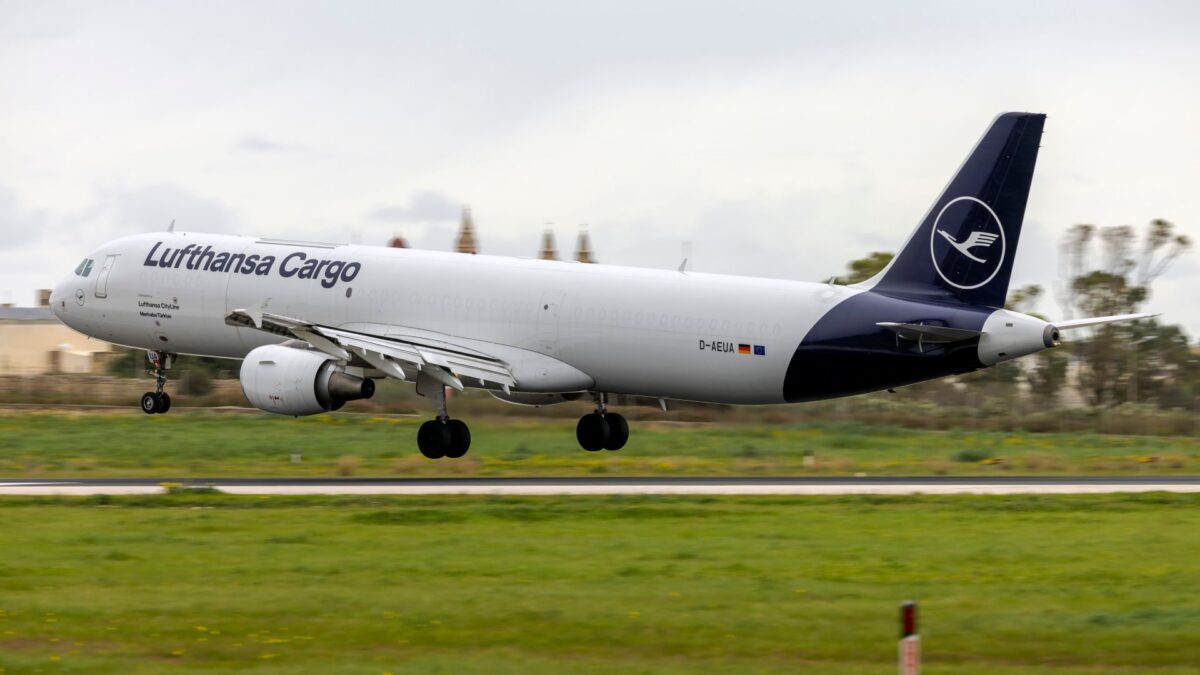
Lufthansa Cargo maintains that it will soon resume commercial service with its four Airbus A321 converted freighters, grounded for nearly four months, but mounting evidence suggests the carrier has effectively abandoned the narrowbody jets and is seeking to offload them.
The cargo subsidiary of Lufthansa Group (XETRA: LHA) is prepared to walk away from the A321 freighters after less than four years of service. Industry sources in aviation and logistics say the aircraft have underperformed relative to expectations and that Lufthansa Cargo no longer requires the capacity — most regional freight customers can be adequately served through the company's passenger airline and trucking networks without any meaningful disruption. The retreat underscores how quickly the economics of narrowbody freighters have deteriorated since the pandemic-era cargo boom that originally justified their adoption.
CityLine Shutdown Grounds the Fleet
The A321s had been operated on behalf of Lufthansa Cargo by CityLine, which supplied crews and operational support until Lufthansa Group accelerated the closure of the unprofitable regional carrier. The group abruptly halted CityLine operations in mid-April, citing rising fuel costs tied to the Iran war and mounting pressure from labor disputes. The four A321 freighters have since remained parked at Frankfurt International Airport, Lufthansa's primary hub.
At the time of the grounding, the cargo division issued a statement: "Our strategic European network is a key component in maintaining global supply chains. Lufthansa Cargo and the Lufthansa Group are aware of this responsibility. We will now be working with the Lufthansa Group to find a way to offer this cargo capacity to our customers again as soon as possible."
Lufthansa Cargo, ranked as the world's 14th-largest cargo airline by scheduled traffic, operates a fleet of 12 Boeing 777 intercontinental freighters and also manages cargo shipments across Lufthansa Group's passenger airlines, utilizing the belly hold space on those aircraft.
A Brief but Productive History
Lufthansa took delivery of the A321 freighters during 2022 and 2023 from San Francisco-based BBAM Aircraft Leasing & Management, following their conversion by a specialty repair facility to accommodate shipping containers on the main deck. The cargo airline marketed the aircraft's capacity on short- and medium-haul routes targeting e-commerce customers across Europe, as well as parts of the Middle East and North Africa. The A321 freighters entered service during a period when e-commerce volumes were still elevated from pandemic-driven shifts in consumer behavior, making dedicated narrowbody cargo aircraft appear strategically attractive.
As recently as March, Lufthansa Cargo executives remained publicly optimistic about the A321 program, highlighting its role in supporting automotive sector clients — a strategic focus for the company. In one instance, a chartered A321 was dispatched on less than 24 hours' notice from Frankfurt, Germany, to Vienna, Austria, to collect a shipment of components and deliver them to Belgrade, Serbia, preventing a production line shutdown. Two additional charter flights followed in the ensuing days.
In February, Lufthansa Cargo operated 11 A321 freighter flights from Casablanca, Morocco, on behalf of Mercedes-Benz over an 11-day period.
Search for a New Operator
Responding to inquiries about the delayed return of the A321 fleet, spokeswoman Katharina Stegmann indicated that Lufthansa Cargo was seeking a third-party contract carrier to replace CityLine as the operator.
"We are currently working intensely to evaluate the available options for operating our A321-fleet. Currently, it appears that this will be handled by an operator outside Lufthansa Group. It has not yet been definitively determined whether the suspension will remain in effect for the entire summer flight schedule," Stegmann said in a June 29 email.
"Our goal is not only to provide a short-term solution, but also to establish a structurally improved solution that will ensure even greater stability and flexibility in the future. Until we can implement a new operating structure, the aircraft will remain grounded. There is no exact timeline foreseeable at the moment, but we are working on restarting the operations as soon as possible."
Ghost Freighters
Any prospect of resuming A321 operations now appears remote. A Lufthansa Cargo spokesman confirmed to FreightWaves that the company has stripped its brand name and livery from the four freighters.
"As part of the ongoing evaluation of different operating scenarios, the aircraft have been transitioned to a neutral exterior appearance. Since the aircraft are currently grounded, the branding was removed during this period," Jan Paulin said in a July 16 statement. "For operational reasons, the aircraft are moved on a regular basis, for example to undergo scheduled inspections and maintenance checks."
The removal of corporate branding raises significant questions about whether Lufthansa Cargo intends to operate the aircraft at all. The company's latest statement speaks broadly of finding "a sustainable solution for the future operation of the aircraft" but pointedly omits any mention of resuming flights under the Lufthansa Cargo banner.
"We are currently working intensively to evaluate the available options for operating our A321 freighter fleet. As part of this process, we are in discussions with several potential operators to identify a sustainable solution for the future operation of the aircraft. The duration of the current suspension of flight operations has not yet been finally determined," Paulin said.
Lease Standoff with BBAM
The shift to a neutral livery signals that Lufthansa Cargo is attempting either to return the A321s and terminate the multi-year lease with BBAM or to sublease them to another all-cargo operator, according to an industry executive familiar with the matter.
BBAM reportedly has no interest in taking the aircraft back, while Lufthansa would prefer not to sublease them. "It's a bit of a standoff at the moment," the source said. "I don't think they'll operate back for Lufthansa."
The lessor's reluctance is shaped by a broader oversupply of narrowbody freighters, the result of a surge in passenger-to-freighter conversions during the pandemic-era boom in air cargo demand. With global air freight volumes normalizing from their 2020–2022 peaks, many of those converted aircraft are now competing for a shrinking pool of dedicated cargo business. Remarketing the A321s at equivalent lease rates to a carrier of comparable creditworthiness would prove challenging, particularly given that most operators continue to prefer the Boeing 737-800 in the same category.
Some aircraft owners have found it more profitable to remove engines from idle A321 freighters and lease them to passenger airlines scrambling to avoid capacity cuts amid a global engine repair and production slowdown. However, the Lufthansa aircraft belong to BBAM's freighter fund, and BBAM is intent on keeping them in cargo service, the source noted.
BBAM representatives did not respond to repeated requests for comment.
From Lufthansa's perspective, subleasing is far from ideal because the company would remain an intermediary, with its credit still obligations to BBAM. "If they do cut a deal with BBAM to return the airplanes it would mean millions of dollars of termination fees," the source told FreightWaves.
A Broader Industry Pattern
Lufthansa Cargo's experience reflects a wider industry reckoning with the A321 freighter. A prominent air logistics expert with background in both airline operations and as an airline customer noted that the A321 "is an expensive aircraft to operate in cargo configuration and every operator is having a hard time making money."
Miami-based Global Crossing Airlines idled two of its four A321 freighters this year, citing soft demand and an inability to exit its lease. Latvia-based SmartLynx Airlines, which operated a fleet of A321 converted freighters, shut down its cargo operations entirely in March 2025 after losing a major contract.
In January, Air Transport Services Group — the world's largest freighter lessor and a contract cargo airline serving clients such as Amazon and DHL Express — dissolved its joint venture for converting Airbus A321 passenger aircraft into all-cargo configuration, citing collapsed demand for A321 freighters.
Turkish Airlines' cargo division has wet-leased A321 freighters from another airline to cover temporary capacity requirements but is dissatisfied with their financial performance, according to a logistics industry source.
Structural Disadvantages Versus the Boeing 737-800
FreightWaves consulted multiple air cargo analysts and operators who contend that the A321 is economically unviable without consistently high capacity utilization, the right type of commodity, and an optimal route system. All requested anonymity to speak candidly without jeopardizing business relationships.
The fundamental problem, according to an expert formerly employed by one of the aircraft manufacturers, is that the Boeing 737-800 outperforms the A321 in efficiency. The A321 is heavier, consuming more fuel, and has required more maintenance than originally projected, resulting in higher per-trip costs compared with the 737-800. The Boeing 737-800 also benefits from a more mature conversion ecosystem, with multiple certified modification facilities and a larger pool of qualified maintenance technicians.
A321 lease rates also tend to be higher because the aircraft are generally newer than converted 737-800 freighters, and conversion costs are typically embedded in the lease.
According to data from Aerodynamic Advisory, 38% of the 82 A321 converted freighters on the market are currently inactive, compared with an inactivity rate of 14.8% for the 283 available Boeing 737-800 freighters.
Over time, operators have found that the A321's volumetric capacity is well suited to high-frequency, small-package shuttle routes but is less competitive for general freight.
"The A321 passenger-to-freighter experiment is a failure. The only way to make money is if you pack them full of e-commerce day-in and day-out and then they might only break even. But with high fuel costs, and so on, these are doomed in my opinion," said the logistics professional.
One notable exception is Qantas, which operates six A321 converted freighters on behalf of Australia Post and is slated to receive three additional A321s in the coming months.
Minimal Customer Impact
Lufthansa Cargo could achieve greater operational flexibility by contracting with narrowbody freighter operators on an as-needed basis for short-term capacity surges, rather than maintaining dedicated aircraft that cannot be efficiently utilized, the aviation executive noted.
The airline has acknowledged that it has supported customers without interruption since the grounding. "Thanks to our extensive global network, supported by our own Boeing 777 freighters and the belly cargo capacity provided by Lufthansa Group passenger airlines, we are able to continue offering our customers flexible and reliable transportation solutions," Paulin said.
Jonathan Mellink, head of sales and marketing at cargo consultancy Rotate, said the A321s' withdrawal from Lufthansa Cargo's fleet has had a relatively limited effect on customers within the intra-European network. The freighters provided approximately 210 metric tons of daily regional capacity and likely delivered higher service levels than passenger aircraft or trucking alternatives, he noted.
Germany-based logistics provider Dachser has also reported minimal disruption. Spokesman Hedrik Durst said the company leveraged its extensive European road network to absorb traffic previously carried by the freighters.
The head of an air freight shipping cooperative said he has observed no shipper delays, citing ample regional air cargo and ground transportation alternatives.

