London Stock Exchange Plans 24/7 Trading Venue for 2027, Bridging Traditional Finance and Crypto-Era Expectations
Key Takeaways
- •The London Stock Exchange intends to launch a dedicated 24/7 trading venue in the first half of 2027, subject to regulatory approval from the Financial Conduct Authority.
- •The standalone platform will operate separately from LSE's main market and will initially support only exchange-traded products, including ETFs linked to UK and US equities.
- •Cryptocurrency exchanges such as Coinbase and Kraken have established the standard for continuous trading, influencing retail investor expectations for traditional markets.
- •The new venue will integrate agentic AI capabilities to support portfolio analysis, market surveillance, and automated trading decisions.
- •Institutional investors remain more cautious than retail investors about extended-hours trading, citing concerns over liquidity, staffing, and counterparty risk during overnight sessions.
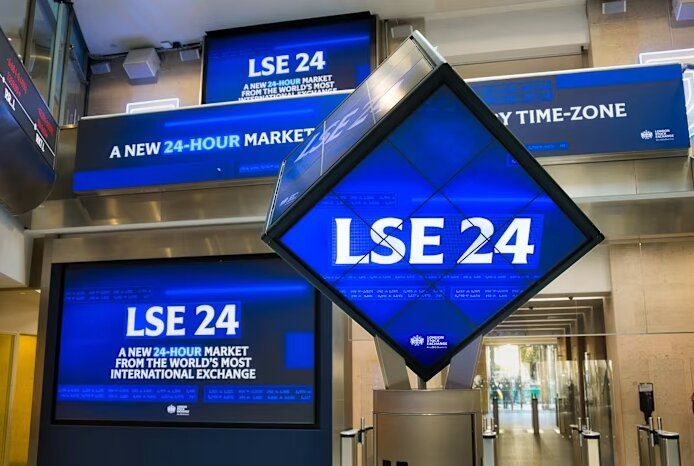
Traditional financial markets are accelerating toward an always-on trading model inspired by the cryptocurrency ecosystem. The London Stock Exchange (LSE) has announced upgraded plans to launch a dedicated 24/7 trading venue in the first half of 2027, responding to growing demand from retail investors for round-the-clock market access. The proposal will require approval from the Financial Conduct Authority before it can go live.
A Standalone Platform Alongside the Main Exchange
The new venue will operate independently of LSE's primary market, which will maintain its existing hours from 8:00 a.m. to 4:30 p.m. The overnight session will run from 5:00 p.m. to 7:50 a.m., with a scheduled break for end-of-day processing.
At launch, the service will be limited to exchange-traded products (ETPs), including ETFs tracking UK and US share markets. ETPs are a logical starting point because their basket-based structure typically carries lower volatility and simpler pricing mechanics than single stocks — qualities that help manage risk during overnight sessions when trading volumes are historically thinner and spreads can widen. In a press release, the exchange cited the relative simplicity of investing in ETPs compared with individual stocks as a key reason for starting with this asset class.
The Financial Times first reported on the exchange's evolving strategy.
Crypto Platforms Set the Benchmark
Cryptocurrency exchanges such as Coinbase and Kraken have established the benchmark for 24/7 trading, giving retail investors continuous access to digital asset markets. That experience has fueled growing expectations for similar access to traditional financial products, particularly during major news events or market-moving developments that occur outside standard trading hours. Retail trading platforms such as Robinhood have already begun narrowing this gap by offering 24/5 access to selected US-listed stocks, signaling a shift in investor expectations that predates the LSE announcement.
LSE CEO Julia Hoggett stated that global retail investors — especially those in Asia — are increasingly seeking trading opportunities at times that suit them, regardless of conventional exchange hours.
Broader Industry Movement Toward Extended Hours
The LSE's initiative follows similar efforts by other major exchanges. Nasdaq, the New York Stock Exchange (NYSE), and Cboe Global Markets have all moved toward longer trading hours or expanded trading platforms. Meanwhile, crypto platforms have gone a step further by offering tokenized stocks with 24/7 trading, increasingly blurring the line between traditional finance and digital asset markets.
In a parallel development, major financial institutions have been exploring tokenization of real-world assets. BlackRock, JPMorgan, and Coinbase recently joined a UK tokenization taskforce targeting the $88 trillion RWA market.
AI-Enhanced Infrastructure
Beyond extended hours, the new LSE venue will incorporate agentic AI capabilities designed to assist with portfolio analysis, market surveillance, and automated trading decisions. Industry participants believe AI-driven investing will play an increasingly significant role as markets evolve.
Demand for longer trading sessions is currently stronger among retail investors than institutional investors, who remain more conservative. Institutions have cited concerns about liquidity, operational staffing, and counterparty risk management during overnight hours as factors that may slow their participation. Industry groups have noted that the full benefits of near-24-hour trading have yet to be fully realized.
Competitive Pressure from Digital Asset Exchanges
The LSE's move underscores the broader influence of cryptocurrency markets on global financial infrastructure. Analysts suggest that continuous trading — long a differentiating feature of digital asset exchanges — is becoming a competitive necessity for traditional exchanges seeking to remain relevant in an increasingly digital investment landscape.
Separately, Binance has teased an "AI Pro" tool, hinting at next-generation trading capabilities for its millions of users, further illustrating the convergence of AI, crypto, and traditional finance.
