BBC Should Not Normalize Antisocial Phone Behaviour on London Transport, Critics Argue
Key Takeaways
- •A BBC London opinion piece introduced the term "loudcasting" and argued that playing audio out loud on public transport represents a form of social connection rather than antisocial behavior.
- •Matt Kenyon counters that the vast majority of commuters dislike loudcasting and that comparisons to youth protest movements or boombox culture are unconvincing.
- •Transport for London's conditions of carriage explicitly prohibit unreasonably loud device usage, but enforcement has been negligible, with no fines issued in five years.
- •The article notes that cities such as Tokyo and Stockholm, which maintain higher civic standards, do not tolerate similar behavior on public transport.
- •Kenyon argues that the BBC's institutional authority lends undue legitimacy to a viewpoint that most passengers find unreasonable and that the behavior should not be accepted as inevitable.
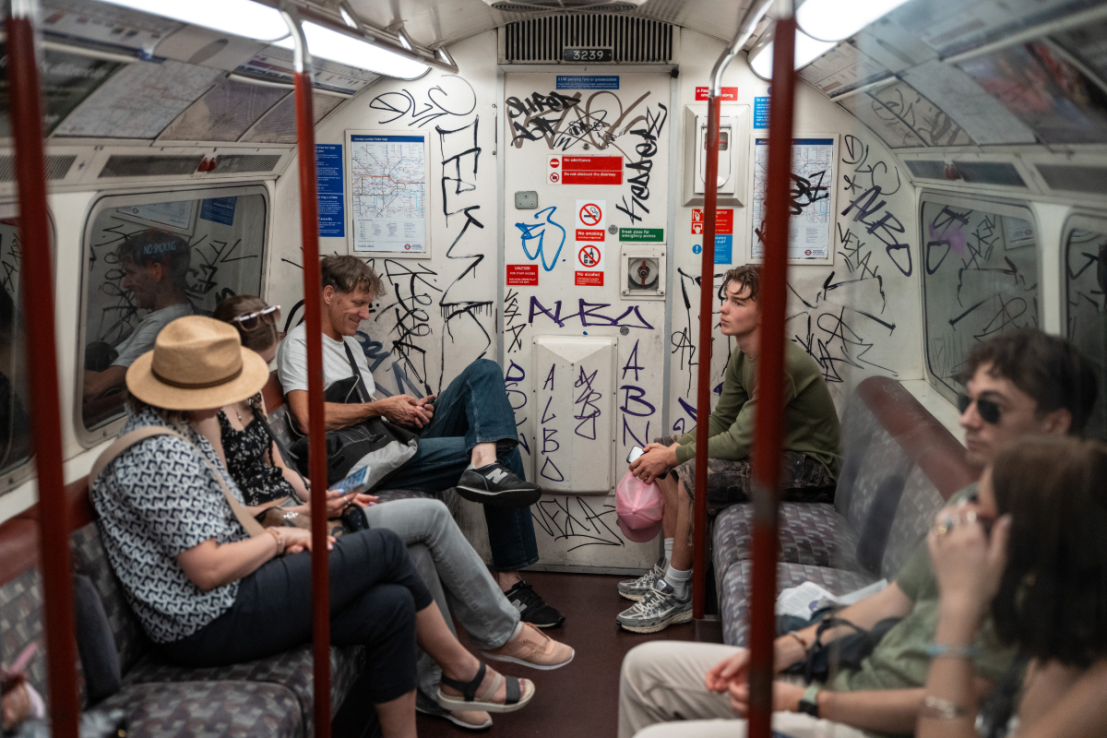
Life is already challenging enough for commuters without commentators suggesting that playing music out loud on public transport constitutes a form of performance art, writes Matt Kenyon.
A few years ago, while travelling on a Chiltern Railways train, the author sat opposite a woman who had not realized her headphones were improperly plugged in. Her phone was blasting 'Pompeii' by Bastille at considerable volume. A few knowing smiles were exchanged among passengers before she realized everyone could hear the 2013 indie hit in immaculate detail, prompting shared laughter.
Such incidents are niche. The far more typical experience for London commuters involves glaring, bleary-eyed, at fellow passengers who play TikTok videos out loud on the Tube. According to a BBC London opinion piece published this week, the various loudspeaker intrusions on buses and the Underground are, in fact, an important part of the capital's social fabric. The article even introduces a term for this: "loudcasting."
The BBC article raises the prospect that "loudcasting can be a tool for connection." Its author notes that boomboxes back in the day also "caused a stir," in an effort to frame antisocial blaring on public transport as a kind of digital subculture. Woven throughout is the argument that subjecting carriage-loads of commuters to tinny device speakers represents a contemporary youth protest movement. But the effect is less Arab Spring and more Ali G.
Thin comparisons are drawn to early objections about phone calls made on 1990s mobile phones, though this mainly serves to highlight how far standards have declined — from public phone calls, to loud speaker conversations, and finally to playing music out loud. The shift has been accelerated by improvements in smartphone speaker quality, which have made it technically trivial to broadcast audio at volumes audible across an entire carriage.
Social Soundscapes or Antisocial Behaviour?
The BBC article quotes a University of Sussex professor with a "long-running interest in soundscapes." Another academic described the phenomenon as a "fascinating human phenomenon of marking social territory" — imagery that strays uncomfortably close to open urination as a means of announcing one's presence.
Another academic, from Belfast, insisted that it is "quintessentially social to play music and hope your peers appreciate that music." As the author notes, it would take a braver person than most to play loud music out loud on a bus in Belfast.
A Liberal Democrat spokesperson told BBC London that the phenomenon is the fault of technology companies, who should be distributing free earphones instead. No suggestion was made that users might simply choose not to watch videos or listen to music in the absence of headphones. The BBC journalist noted that after contacting several major consumer tech companies, none responded. It is worth observing that there is a fairly inverse correlation between areas of high Liberal Democrat voting density and the concentration of public transport usage.
The article does acknowledge international cultural differences, noting that this behaviour would be far more clearly frowned upon in a Japanese or Swedish city. In such places, one is also far less likely to witness someone barging through metro barriers or shouting at strangers in the street, because those cities do not tolerate the broader pattern of "broken windows" — the criminological concept, introduced by James Q. Wilson and George Kelling in 1982, that visible signs of minor disorder encourage further escalation — that gradually undermines civic trust.
Enforcement Gap
While the article concedes that "the vast majority of people dislike" the practice of "loudcasting," it notes that the public rarely reports such incidents to authorities. Furthermore, Transport for London has stated that of those who are prosecuted, no one has been fined in five years. TfL's own conditions of carriage explicitly state that passengers must not use any device in a way that may be unreasonably loud, though enforcement has historically relied on byelaw prosecutions that are both rare and resource-intensive.
The BBC article's author asks: "Am I out of touch?" — though whether he is out of touch is, in some respects, beside the point. It is perfectly reasonable for a columnist to hold an unpopular opinion.
The broader issue, the author argues, is that the BBC News website carries an institutional authority that lends a sanctifying effect to the views it publishes. The difference between a BBC journalist expressing such views and an independent columnist doing the same is that the former implicitly writes on behalf of the British public. The author disclosed having written an article for the BBC four years ago about "the oldest joke ever told," while noting that he had injected very little of his own personality into it.
The BBC write-up, the author contends, indulges the view that this behaviour — which by the article's own admission enjoys levels of popularity comparable to late-stage Keir Starmer — is ingrained, inevitable, and almost involuntary. The author's advice to readers: ignore that framing, because it need not be the case.
