Lotus Emira 420 Sport: New £105,900 Flagship Adds Power and Cuts Weight
Key Takeaways
- •The Lotus Emira 420 Sport is now the flagship of the Emira range and uses a 420hp Mercedes-AMG 2.0-litre four-cylinder engine with an eight-speed dual-clutch gearbox.
- •Lotus lists the car at £105,900, and the £12,900 Lightweight Handling Pack is presented as close to essential by the reviewer.
- •The 420 Sport is claimed to reach 62mph in 3.7 seconds, has a top speed of 186mph, and can lap Lotus's test track in 1 minute 27 seconds.
- •The car is lowered by 5mm, gets revised aerodynamics and optional Multimatic spool-valve dampers, a titanium exhaust, a lithium-ion battery and a carbon-fibre tailgate with the handling pack.
- •The reviewer says the Emira 420 Sport is the most convincing and best-polished Emira yet, though the Porsche 911 Carrera remains the stronger all-rounder.
The wealth gap separating the world's richest one percent from the remaining 8.2 billion people is increasingly visible in the enthusiast car market. At Monterey Car Week in California this month, newly revealed hypercars have included the Aston Martin Valen, McLaren McL 6GT, Gordon Murray Automotive S1, Lamborghini Revuelto SV, Bugatti Destrier and Hennessey Blackbird, among many others. Yet while high-net-worth buyers feast on such automotive unobtanium, the aspirational, mid-market sports car appears to be off the menu.
Two of the segment's main players, the Porsche 718 Cayman and Toyota GR Supra, have recently ceased production without direct replacements. The Alpine A110 is likewise on hiatus until its electric successor arrives later this year. The BMW M2 continues, but it is a different sort of dish: meatier and, in the reviewer's view, ultimately less flavoursome than a dedicated sports car. For buyers who still want a compact, driver-focused coupe rather than a heavyweight performance car, the field is getting thinner.
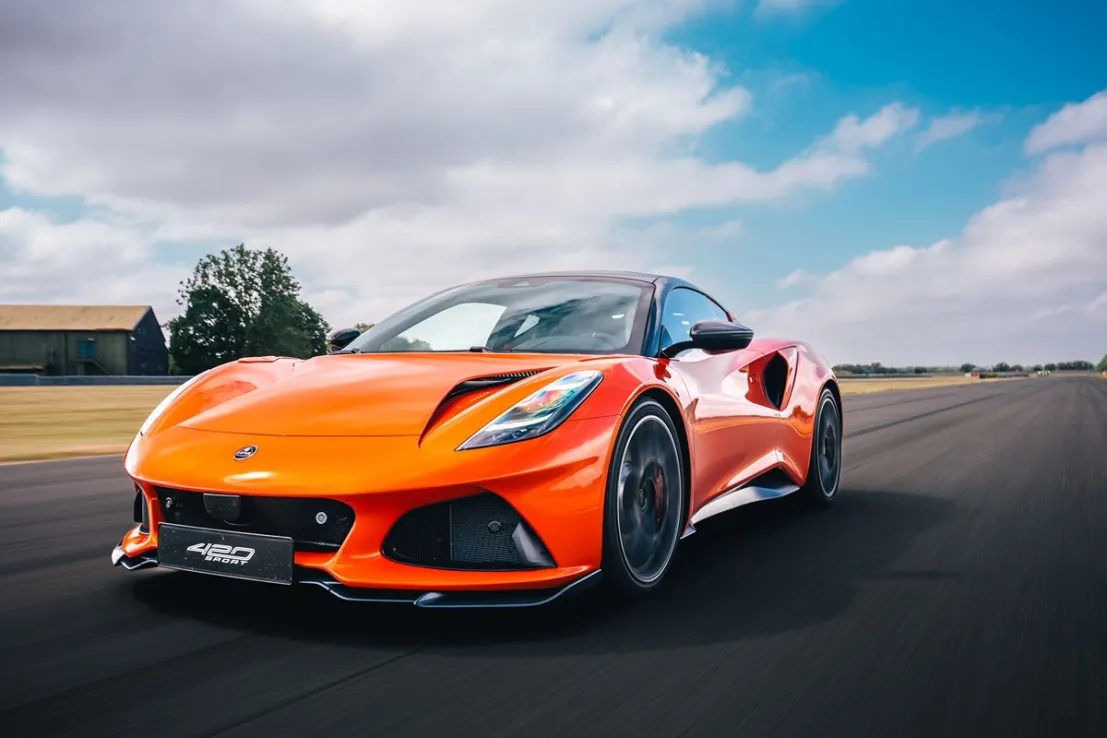
This shrinking field is the context for the Lotus Emira 420 Sport, which combines more power from a feisty Mercedes-AMG engine with less weight and a sharper chassis. It is Norfolk's answer to the Porsche Cayman GT4 — if that car still existed.
Lotus Emira: Taking on the 911 Carrera
The price is the immediate sticking point. The existing Emira Turbo and Turbo SE were broadly equivalent to the Cayman S and GTS, but the £105,900 asked for the 420 Sport leapfrogs Lotus into Porsche 911 Carrera territory — particularly once the £12,900 Lightweight Handling Pack is added, which the reviewer considers more or less essential. Lotus's £2 million Evija hypercar may cater to the one percent, or perhaps the 0.1 percent, but a 420 Sport remains beyond the reach of most.
To recap, the Emira is offered with a choice of two engine configurations. The 2.0-litre four-cylinder Mercedes-AMG motor is available only with an eight-speed dual-clutch gearbox and comes in three outputs: 360hp (Turbo), 400hp (Turbo SE) and 420hp (420 Sport). Alternatively, the Emira V6 SE uses a 400hp 3.5-litre Toyota V6 with either a six-speed manual or six-speed automatic transmission.
There is no Sport derivative of the V6, which makes the new 420 Sport the official flagship of the Emira range. Besides the extra horses, it musters 369lb ft of torque, generates up to 25kg more downforce and carries up to 25kg less weight. Zero to 62mph takes 3.7 seconds and top speed is 186mph. Lotus handling guru Gavan Kershaw says it can lap the factory test track in 1 min 27 sec — two seconds quicker than an Emira Turbo SE.
Styling inspired by the Turbo Esprit
The Emira is assembled at Hethel inside the Chapman Production Centre (the electric Eletre SUV and Emeya saloon are built in Wuhan, China), where design boss and Lotus lifer Russell Carr walked the reviewer around the 420 Sport. “The changes were about form and function working together,” he explains. “That is the Lotus way.”
The whole car is lowered by 5mm, with larger apertures in the front bumper and a new splitter to direct cooling air towards the brakes. Slash-cut vents in the front wings also help evacuate air from the wheelarches. “You can see them while driving,” notes Carr. “Lotus calls these the Becker points – named them after Roger Becker, our chief test driver for many years, who insisted on having these visible peaks to gauge a car's width, and place it accurately in corners.”
Seen from the side, the 420 Sport has more sculpted sills and deeper air intakes, plus a louvred tailgate inspired by the classic Turbo Esprit. Further back sit a lip spoiler at the trailing edge of the rear deck, smoked tail lights and a deeper diffuser. The result looks more aggressive than its Turbo and SE siblings, yet also fussier and less elegant — particularly if the Sport add-ons are specified in unpainted carbon fibre.
What's in the Lotus Emira Lightweight Handling Pack?
The standard 420 Sport gets revised Bilstein dampers tuned for quicker turn-in and tighter body control. The Lightweight Handling Pack, however, brings race-bred spool valve dampers from Multimatic — the Canadian company that built the latest Ford GT. With 11 clicks of manual adjustment for both bump and rebound, Gavan Kershaw says they provide “a far more settled and responsive feel”.
Other items in the bundle include a titanium exhaust system (saving 10kg alone), a compact lithium-ion battery, a carbon fibre tailgate and bespoke, Lotus-stamped Michelin Pilot Sport Cup 2 tyres.
A further option across the Emira range is a targa roof. Yours for £5,000, its tinted glass panel can be unclipped and lifted out — an easy, one-person job — then stowed in a dedicated bag behind the seats. Unlike in a Porsche 911, there is space for only two people, the boot holds a meagre 151 litres, and there is no 'frunk' beneath the bonnet.
Inside the Lotus Emira 420 Sport
Some of the 420 Sport's styling tweaks look a bit 'aftermarket', but there is no doubt it swivels heads — particularly in the new, Sport-exclusive Tangelo Orange colour. While few people look twice at a 911 Carrera, the Lotus could easily be mistaken for a McLaren or Ferrari.
Inside, it feels far more luxurious than an Elise or Evora, with wall-to-wall leather and Alcantara trim. The crisp, 10.25-inch touchscreen is straightforward to operate and provides wireless Apple CarPlay and Android Auto connectivity. Optional niceties include heated seats and a premium, British-made KEF audio system.
Behind the squared-off steering wheel, the driver's fingertips find new carbon fibre shift paddles: longer, with a more mechanical action. The view ahead is panoramic, but rearward visibility is reduced to 1970s supercar levels by the slatted engine cover — at least there is a reversing camera. The naff 'bomb switch' cover for the start button is an affectation the reviewer would rather Lotus left to Lamborghini; beneath it, the mid-mounted four fires with an abrupt bark.
Emira 420 Sport on the road
The roads of Norfolk may not be worse than anywhere else in Britain, but some of them are undeniably bad. No wonder the cars honed there by Lotus Engineering for other manufacturers — from the Aston Martin DB9 to the Proton Satria GTI — have tended to ride and handle so fluently.
The test car was fitted with the trick Multimatic dampers, so the standard 420 Sport setup could not be assessed. With this configuration, at a middling 'click five' level of adjustment, the ride is firm without being brittle: it transmits every imperfection in the road surface yet rounds off the worst impacts, maintaining the car's composure even when Norfolk bitumen does its worst. “We talk about turbulence – the harsh, thudding sensation you sometimes feel aboard an aircraft,” says Kershaw. “It's the opposite of what we work to achieve. You should never feel like you are fighting with the car.”
As you'd hope, the same carefully enunciated communication flows through the steering — this being one of a handful of new cars to still use hydraulic power assistance rather than a CO2-saving electric setup. It feels wonderfully linear and full of feedback, helping the driver make the most of the Emira's enhanced cornering ability. The 'mini McLaren' analogy works well here, too.
The four-cylinder AMG engine isn't as tuneful as the flat-six in a you-know-what, even with the titanium tailpipes fitted, but it is mightily effective. Indeed, while previous four-pot Emiras were outgunned by the Mercedes-AMG A45 S hot hatchback, this one unleashes the M139 motor's full potential. Its manic, always-on intensity might seem at odds with the car's settled, balanced chassis, yet the whole package comes together to create the most polished and most convincing Emira yet.
Driving on-track at Hethel
Lest we forget, the 420 Sport is also the most circuit-focused Emira. So it seemed only right, after a cross-country blast back to Hethel, to squeeze in a few laps of the on-site test track: fast, technical and with worryingly little run-off when exiting the Rindt Hairpin — a chance to drive the car to its limits, and perhaps test the driver's own.
This is where the Multimatic dampers come into their own, riding the kerbs with conviction and giving the Emira an unburstable sense of composure lap after lap. In the best Lotus tradition, this is a car you coax and finesse rather than grab by the scruff, and it feels faithfully on your side — even at three-figure speeds through the long Windsock corner that opens onto the Mansell Straight. The standard-fit AP Racing brakes are powerful and tirelessly consistent, too.
Dislikes? The seats could do with more support for track driving (Lotus has surely missed a trick by not offering a hard-shell bucket option), and the gearbox isn't the quickest or most intuitive dual-clutcher out there, despite some recalibration work. Still, there are no unexpected blots in the 420 Sport's dynamic copybook. It feels limber and malleable, preferring to be driven with precision, but is also game for throwing a few sideways shapes when the mood takes you — Track with ESC Off is the mode for that.
Verdict: Lotus Emira 420 Sport
For many car companies, the word 'Sport' simply denotes a trim level: a set of alloy wheels and some go-faster stripes, perhaps. At Lotus, though, it means something special. The story started with the Esprit Sport 300 in the early 1990s — a homologation special built for Stateside SCCA racing — then progressed to lighter, faster and more focused versions of the Elise, Exige and Evora. There have also been lightweight Lotus Sport bicycles, such as the carbon fibre Type 108 that Chris Boardman rode to victory at the Olympics in 1992.
True to form, the new Sport 420 is more than just a cosmetic makeover and an extra 20hp. It dials up the Emira experience, making it more engaging and exciting, but without unduly limiting its ability to be driven every day — something only the most committed Elise or Exige owner would attempt.
Granted, a Porsche 911 Carrera is still a better all-rounder; no surprises there. But the Lotus looks so much more special, has rarity on its side and is ultimately more fun on the right road (or racetrack). And versus the now-defunct Cayman GT4? That's a close call, and the Porsche might edge it for the reviewer, largely thanks to its more emotive engine. Still, in a market with increasingly few options, there are no wrong choices here — and the Lotus Emira finally feels absolutely right.
Source: City AM Markets — https://www.cityam.com/lotus-emira-420-sport-the-best-emira-yet-is-a-downsized-supercar/
Tim Pitt writes for Motoring Research.

