Lombard Review 2026: LBTC, BTC.b, Bitcoin Earn and Bitcoin-Backed Borrowing
Key Takeaways
- •LBTC displayed a 0.90% APY on November 17, 2026, well below its variable 2.5% net target, with yield generated through a covered-call Bitcoin options strategy operated by Bitwise Investment Manager.
- •The review found conflicting figures across Lombard's pages for total value locked, consortium membership and Bitcoin Earn yields, while LBTC's locked value had fallen roughly 80% from its May 2025 peak.
- •Lombard's BARD token traded about 94% below its March 2026 high, with roughly 60.3% of supply not yet circulating and no verified current right for holders to receive fees.
- •Lombard excludes US and UK persons and restricted jurisdictions, LBTC redemptions can take up to 10 days, and holders on five deprecated chains must bridge to Ethereum by December 10, 2026.
- •The protocol earned a 3.5 out of 5 editorial score for naming its custodians, signers and auditors, publishing 10 audit reports, and maintaining a $500,000 bug bounty with no recorded hacks.
Last updated: November 17, 2026. Independent editorial review. We have no commercial relationship with Lombard.
Overview
Lombard is a Bitcoin-focused protocol that issues Bitcoin-backed tokens and offers ways to earn yield, borrow against Bitcoin, move it between networks and use it in decentralized finance. Its principal tokens are LBTC, a yield-bearing non-rebasing token, and BTC.b, a non-yield-bearing token intended to track Bitcoin at a 1:1 ratio.
This review is for Bitcoin holders who may be unfamiliar with wrapped tokens, bridges, covered calls and vaults, as well as readers who want to understand Lombard in late 2026. Lombard’s documentation says LBTC yield comes from selling Bitcoin options through Bitwise Investment Manager, LLC. The protocol also offers Bitcoin Earn, a credit strategy and Bitcoin Smart Accounts for institutions using regulated custodians.
We reviewed Lombard’s public website, documentation and live application on desktop, tablet and phone and compared displayed figures with independent sources. We created an unfunded MetaMask profile but did not connect it because the application required legal attestations. We therefore did not deposit, mint, redeem, borrow, bridge, swap, sign transactions, test the SDK or Smart Accounts, read audit reports or review credit agreements. Information about those activities comes from Lombard’s public pages and documentation.
Quick verdict
Lombard is one of the better-documented Bitcoin products we reviewed. It identifies custodians, its strategy manager, signing institutions and auditors, and provides a risk page with ratings for many risks.
The main weaknesses are commercial, operational and presentational. LBTC’s live yield was well below its target; pages showed conflicting figures for yield, consortium size and value locked; LBTC value was about 80% below its peak; and BARD was about 94% below its high. US and UK persons and people in restricted jurisdictions are excluded.
Lombard is best viewed as a serious but unfinished institutional-style product for eligible non-US and non-UK users who accept dependence on custodians, institutions and code. Before considering any product, readers should compare the current rate with the target, confirm eligibility and understand the time and conditions required to exit.
What Lombard does
Bitcoin operates on its own network and cannot be used directly in most lending, borrowing and trading applications on networks such as Ethereum or Solana. A common solution is a wrapped token: a user deposits Bitcoin with a custodian and receives a token on another network intended to represent the same value.
- BTC.b: A non-yield-bearing token intended to maintain a 1:1 relationship with Bitcoin.
- LBTC: A non-rebasing token whose value in Bitcoin terms can increase when part of its backing generates income.
In general, a user sends native Bitcoin to a Lombard-generated address and receives LBTC or BTC.b on another supported network. Lombard says named institutions hold the Bitcoin and that 10 of 14 independent institutions must approve every critical action. LBTC can be used as collateral. To withdraw native Bitcoin, the user burns the token and Lombard sends Bitcoin to the specified address; LBTC redemption can take up to 10 days.
Testing, access and geographic restrictions
Before wallet selection, Lombard requires acceptance of its Terms of Service and LBTC Product Terms and an attestation that the user is not domiciled in a restricted jurisdiction and is not a US or UK person. We left those boxes unticked and did not see a connected dashboard, balances, deposit forms or transaction approval screens.
The wallet interface included EVM, Sui, Solana and Starknet tabs and listed MetaMask, Binance Wallet, WalletConnect, Trust Wallet, OKX Wallet, Coinbase Wallet, Phantom, Bitget, Uniswap, Backpack, Rainbow, Core and Rabby among others. Several pages displayed: “Product unavailable. This product is unavailable to you based on the Lombard Terms of Service.” Lombard’s documentation says the LBTC yield strategy and direct minting and redemption are unavailable to US or UK persons and people in restricted jurisdictions. The complete list is in the Terms of Service, which we did not review.
Connecting a wallet generally shares an address, while an “Approve” transaction can authorize a contract to move a token. BTC.b documentation warns that a mint cannot be canceled after Bitcoin has been sent to the deposit address.
Conflicting value-locked figures
Lombard displayed several different figures:
- The application showed total TVL of $548.0 million, consisting of LBTC at $409.5 million, Bitcoin Earn at $59.5 million and the credit strategy at $38.0 million. Those three figures total $507.0 million, leaving approximately $41 million unexplained on that page.
- DefiLlama listed LBTC at $429.1 million, BTC.b at $140.5 million and Lombard Vaults at $59.2 million, totaling $628.8 million, although some overlap may exist.
- CoinGecko valued circulating LBTC at $389.6 million, based on 6,033 LBTC at $64,576 each.
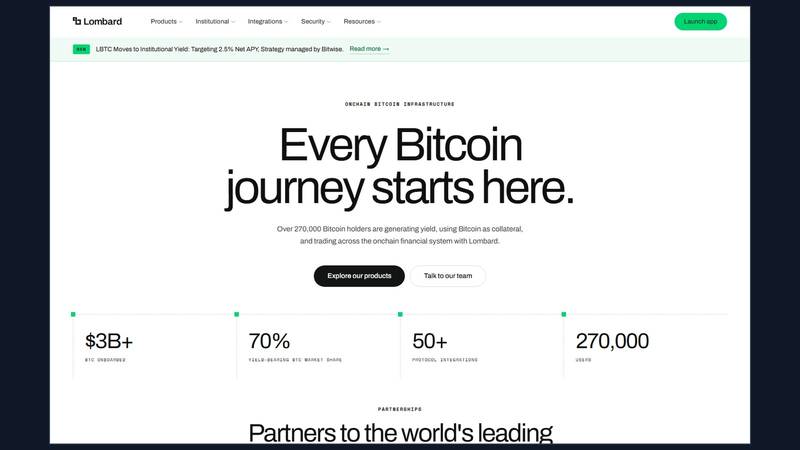
- Lombard’s homepage and documentation claimed “$3B+ BTC onboarded.” The site did not say whether this was cumulative, so we treat it as a marketing figure rather than a current balance.
DefiLlama showed LBTC locked value of $2.107 billion on May 12, 2025, compared with $429.1 million at review, a decline of about 80%. CoinGecko showed LBTC falling from $125,812 on October 6, 2025, to $64,576. The available data cannot separate price effects from withdrawals. DefiLlama categorizes LBTC as “Restaked BTC,” BTC.b as “Bridge” and tracks Vaults separately.
Website and application
The desktop homepage displayed $3B+ BTC onboarded, 70% yield-bearing BTC market share, 50+ protocol integrations and 270,000 users. A banner stated that LBTC was moving to institutional yield, targeting 2.5% net APY, with Bitwise managing the strategy. The application at includes Portfolio, LBTC, Earn, Borrow, Bridge and Swap. The pages opened adapted to smaller screens without clipped text.
The BTC.b product page still listed Katana even though documentation said native minting and redemption on Katana were deprecated from September 16, 2026, suggesting that page may be outdated.
LBTC: yield-bearing Bitcoin
Lombard describes LBTC as non-rebasing: the token count remains constant while each token can become worth more Bitcoin. Documentation says yield comes from a covered-call strategy operated by Bitwise Investment Manager, LLC, a subsidiary of Bitwise Asset Management.
In a covered call, a Bitcoin owner sells another party the right to buy Bitcoin at a specified price by a specified date in exchange for a premium. If the price does not reach the strike, the seller keeps the Bitcoin and premium; if it rises above the strike, the seller gives up some upside.
According to Lombard’s documentation, calls are set roughly 1.5 to 2 standard deviations above the market price; positions are generally rolled every six to eight weeks and never last longer than six months; the strategy uses no leverage or put options, has no physical delivery and is cash-settled; and the underlying Bitcoin is not lent.
Only 50% to 60% of backing is active. The remaining 40% to 50% is passive, stays in Security Consortium custody, earns no yield and is used first to fund redemptions. The active portion is held in segregated accounts at Anchorage Digital Bank and Kraken Institutional. Bitwise can open and close option positions but, according to the documentation, cannot withdraw or move the Bitcoin.
On November 17, 2026, the LBTC page showed 0.90% current APY, “from 0.90% and building” and “Targeting 2.5%.” The documentation says 2.5% is variable, non-guaranteed and subject to losses. The current figure was about 36% of the target. At a Bitcoin price of $64,576, the target represented approximately 0.025 BTC per year and the current rate approximately 0.009 BTC per year.
To mint LBTC, a user sends native Bitcoin to a generated address. The Security Consortium and Bascule verify the deposit, after which LBTC is sent to the selected address. The minimum deposit is 0.0002 BTC. To redeem, the user requests withdrawal and LBTC is burned; native Bitcoin is sent within a window of up to 10 days. Lombard calls the possibility of LBTC trading below fair value during that wait “depeg risk.”
BTC.b
BTC.b is intended to maintain a 1:1 relationship with Bitcoin and pays no yield. Lombard says it was originally launched by Ava Labs and acquired in October 2025.
The product page states “Bitcoin for DeFi. Zero fees.” and lists Ethereum, Avalanche, MegaETH, Katana, Stable and Monad. Documentation says a 0.0001 BTC fee applies in one context, the minimum is 0.0002 BTC, Bitcoin network fees during minting are roughly $2 to $20, and destination-chain gas varies. At $64,576 per Bitcoin, the two stated BTC amounts equal approximately $6.46 and $12.92.
The product card says “0 fees, instant,” while documentation says minting requires three to six Bitcoin confirmations and redemption takes about two hours. “Instant” therefore cannot describe the complete Bitcoin leg; the page does not explain the distinction.
Bitcoin Earn and credit strategy
Bitcoin Earn is a “meta-vault” accepting LBTC, BTC.b or native Bitcoin. It allocates funds across strategies and issues BTCe, whose price increases as rewards compound. Withdrawals have a 14-day processing window. Available pages showed a current APY of 2.65%, a 4% figure and a 4.5% target, without clearly explaining the distinction. The displayed allocation was 60% to Sentora and 40% to the Bitcoin Onchain Credit Strategy, whose borrower is Flow Traders. Ethereum users may receive BARD incentives through Merkl while a campaign is active.
The Bitcoin Onchain Credit Strategy supports stablecoin borrowing by “regulated trading firms.” Flow Traders is the identified borrower and pays a fixed premium. Lending occurs through Cap, the rate is agreed directly rather than set by market demand and the premium is paid in Bitcoin terms. The page showed $38.0 million TVL, said the product had been live since July 2026, accepted BTC, LBTC or BTC.b and displayed a 4% target. A corporate borrower can default; a fixed premium does not remove credit risk.
Earn and Borrow dashboards
The Earn dashboard opened without a wallet and showed $548.0 million TVL, 50+ protocols including Aave, Morpho, Jupiter and Spark, and 10 chains. Automated Strategies displayed LBTC with a 2.5% target and $409.5 million, Bitcoin Earn with a 4.5% target and $59.5 million, and the credit strategy with a 4% target and $38.0 million.
The dashboard also showed looping LBTC with up to 94.5% loan-to-value across six markets, liquidity provision through five pools and “other incentivized activities.” Looping borrows against a deposit to acquire more of the same asset and increases both potential gains and losses. At 94.5% LTV, a relatively small price decline could eliminate the position; the page did not display a warning next to it.
The Borrow page showed 12 markets across four protocols—Aave, Spark, Morpho and Jupiter—with maximum LTV of 86%. LTV is the share of collateral value that can be borrowed. At 70% to 86% LTV, a decline of roughly 15% to 30% in LBTC’s value could trigger liquidation, depending on the protocol.
Utilization measures how much supplied liquidity has been borrowed. Above 90%, little liquidity remains and rates can rise. The Base market showed 17.39% APY with only $3,000 available. CoinGecko showed LBTC down about 21% over 30 days; a borrower at 86% LTV would be close to liquidation after a move of that size.
Bridge, Swap and chain changes
The Bridge page presented a route from Ethereum to Monad using BTC.b and said bridging was “fully traceable.” Documentation says bridging uses Chainlink CCIP with Security Consortium approval in a “dual-verification” design. Since September 2026, all routes go through Ethereum. The Swap page defaulted to ETH in and LBTC out and required a wallet.
On September 16, 2026, Lombard deprecated native minting and redemption of LBTC and BTC.b on TAC, Sonic, Katana, Berachain and Starknet. Holders on TAC, Sonic, Katana and Berachain must bridge to Ethereum by December 10, 2026, 23 days after the review date. The Starknet bridge to Ethereum remains available.
Smart Accounts, SDK and documentation
Bitcoin Smart Accounts target institutions holding Bitcoin with regulated custodians. The product page promises “no custody, control, or title transfer.” Documentation says a custodian designates an account, Lombard issues an onchain BTC.b receipt token and the token can be used as collateral on protocols such as Morpho while Bitcoin remains in custody. The design uses partially signed Bitcoin transactions and time locks to emulate covenants. The only call to action was “Talk to our team.”
Lombard describes its SDK as a TypeScript toolkit for wallets, exchanges and applications. The site says it is used by Ledger, Binance and Bybit. Documentation pages fetched for this review were marked “Last updated on November 9, 2026.”
BARD, governance and market data
LBTC daily volume was $326,000 against market capitalization of $389.6 million, approximately 0.08%. BARD daily volume was $6.37 million against market capitalization of $39.16 million, approximately 16%. BARD’s fully diluted value was $98.75 million, about two and a half times market capitalization, with 39.7% circulating. Approximately 60.3% was not circulating.
BARD was about 94% below its March 2026 high. Lombard says a community sale raised $6.75 million at a $450 million fully diluted valuation. The documentation says 22.5% circulated at launch, with remaining tokens scheduled to unlock over 48 months. The team and investors together hold 45%, locked for 48 months with linear release beginning at month 12. Because the reviewed documentation did not establish the launch date, the amount already unlocked cannot be determined.
Named investors include Polychain Capital, Franklin Templeton, YZi Labs, formerly Binance Labs, OKX Ventures and HTX Ventures. Strategic exchange partners listed include Binance, Bybit, OKX, HTX and Bitget. The documentation says BARD utility will evolve with the roadmap. We found no verified current right for holders to receive fees; Lombard collects vault operating fees and a 20% LBTC rewards fee but does not state that BARD holders receive them.
The Lombard Finance Foundation, incorporated in the Cayman Islands, is described as ecosystem steward and holds 20% of BARD. We found no live voting page. Based on the material reviewed, BARD holders do not currently appear to control the protocol. Custody control rests with the Security Consortium and the Lombard team controls upgrades subject to a 24-hour timelock.
Fees and security
Lombard’s fees page is Fees should be checked before any transaction. The 20% rewards fee uses a high-water mark and applies only to new gains above the previous peak. The documentation gives the example that on 1.00 BTC of gains, 0.20 BTC is charged and 0.80 BTC goes to holders. The 2.5% target is stated to be net of this fee, which applies only to the active 50% to 60% portion. The documentation describes no operating fee and a 0% minting fee in the relevant context.
Lombard names 14 consortium members and says 10 of 14 must sign. However, other pages refer to 15 independent institutions or a 12-member consortium. We believe 14 is correct because 14 names appeared on the members page, but the discrepancy is material. Bitwise Onchain Solutions is a consortium member while Bitwise Investment Manager operates the yield strategy. Kraken is a member and holds active Bitcoin through Kraken Institutional. OKX is a member, its venture arm is an investor and the documentation lists OKX, Binance and others as strategic partners.
The active 50% to 60% is held at Anchorage Digital Bank and Kraken Institutional in accounts described as segregated, Lombard-owned and bankruptcy-remote. The passive portion is held in Security Consortium custody. The arrangement relies on regulated custodians and a multiparty signing group rather than a single smart contract.
Documentation lists 10 reports from six firms. Cantina is named as a sixth partner but had no dated report in the list reviewed. The newest listed report was from October 2025. DefiLlama counted two LBTC audits. We did not read the reports or confirm whether they covered the newer covered-call strategy or chain changes. Lombard has operated a public Immunefi bug bounty since September 2024, with a maximum bounty of $500,000.
DefiLlama’s hacks database had no entry for Lombard. Lombard says there have been no incidents resulting in user-fund losses and that full backing has been maintained since launch; we could not independently confirm the second statement. Risks include Bitcoin price declines, a sharp rally affecting the covered-call strategy, smart-contract bugs, bridge or signer failure, borrower default or liquidation, regulatory restrictions, liquidity problems and temporary trading below fair value.
Comparison, suitability and verdict
Using November 17, 2026 figures, LBTC ranked seventh among large Bitcoin tokens tracked by DefiLlama. The first three were issued by or tied to very large exchanges and were substantially larger. Lombard’s claim of 70% yield-bearing BTC market share could reflect a narrow definition, but we could not reproduce it from DefiLlama and Lombard did not state its methodology.
Strengths include detailed documentation; named custodians, strategy manager, signers and auditors; 10 audit reports; a $500,000 bounty; no DefiLlama hacks entry; a high-water-mark rewards fee; a wallet-free Borrow table; disclosure of current and target APY; and responsive layouts.
Weaknesses include the gap between the 0.90% current APY and 2.5% target; conflicting consortium, TVL and Bitcoin Earn figures; exclusion of US and UK persons and restricted jurisdictions; the roughly 80% decline from peak locked value; BARD’s decline and developing utility; redemption and withdrawal delays; institutional dependence; an audit list more than a year old; and the BTC.b page’s continued listing of Katana after the chain change.
BTC.b may suit eligible users seeking a non-yield-bearing Bitcoin representation. LBTC is intended for users who accept variable yield and redemption that can take up to 10 days. The Borrow page may help readers compare markets, while Smart Accounts target institutions using regulated custodians. The products may be unsuitable for anyone needing Bitcoin within days, lacking wallet experience, living in an excluded jurisdiction or expecting the 2.5% target to be guaranteed.
Our editorial score is 3.5 out of 5. Lombard is unusually open about its structure, fee design and risks, but the live-yield gap, contradictory site figures, restrictions, decline in deposits and BARD’s performance limit the score. It is a serious institutional-style product that remains under development and requires careful review of the terms.
Frequently asked questions
Is Lombard safe?
It has 10 audit reports from six firms, a public bounty, named custodians and no DefiLlama hacks entry. It is not risk-free because users depend on institutions, custodians and an options strategy.
What is the difference between LBTC and BTC.b?
BTC.b is intended to remain worth one Bitcoin and pays no yield. LBTC can increase in Bitcoin value because part of its backing generates income. LBTC redemption can take up to 10 days; BTC.b redemption takes about two hours.
What yield does LBTC pay?
The page showed 0.90% current APY on November 17, 2026, against a variable, non-guaranteed 2.5% net target.
Can people in the US or UK use Lombard?
Lombard’s documentation says the LBTC yield strategy and direct minting and redemption are unavailable to US and UK persons and people in restricted jurisdictions.
Is BARD a good investment?
This review does not provide investment advice. BARD was about 94% below its March 2026 high, approximately 60.3% of supply was not circulating and its documented utility was still evolving.
How long does it take to receive Bitcoin?
Documentation says up to 10 days for LBTC, about two hours for BTC.b and a 14-day processing window for Bitcoin Earn. We did not test withdrawals.
Why do Lombard’s pages show different figures?
The reason is not always stated. Some differences may reflect current, target and “up to” figures; the 12-, 14- and 15-member counts appear to involve outdated or inconsistent text.
Can users lose money?
Yes. Risks include Bitcoin declines, losses from the options strategy during a sharp rally, smart-contract bugs, signer failure, borrower default or liquidation and LBTC trading below fair value.
What did this review not test?
We did not connect a wallet, mint, redeem, deposit, borrow, bridge, swap or sign transactions. We did not test Smart Accounts or the SDK, read audit reports or review credit agreements. Information about those activities comes from Lombard’s documentation.
Primary sources
- Lombard homepage:
- Lombard application:
- Lombard documentation:
- Lombard audits:
- Lombard risks:
- Lombard fees:
- LBTC on DefiLlama:
- LBTC on CoinGecko:
- BARD on CoinGecko:
Disclaimer
This article is an independent editorial review for information only. It is not financial, legal or tax advice. Crypto assets are volatile and users can lose some or all of their money. We tested Lombard without connecting a wallet and did not sign any transaction. Lombard’s products are not available to everyone; users should review local rules and the Terms of Service before acting. Figures came from the sources and dates identified in the article and may have changed.
Checked by AiCryptoCore QC Team before publication on November 18, 2026, for headline accuracy, original value, factual consistency, metadata, commercial disclosure, authorship claims, review evidence and risk disclosure. AiCryptoCore uses AI for research, drafting and review. Its editorial team is responsible for the articles it publishes and says it corrects or withdraws articles when necessary.

