Portfolio Balance vs. Loanable Funds: A Teaching Note
Key Takeaways
- •The article contrasts the loanable-funds model, which sets interest rates through saving and investment, with the liquidity-preference or portfolio-balance view, which focuses on money-bond portfolio allocation.
- •Both frameworks would predict upward pressure on interest rates when government deficits or other borrowing needs absorb available financing.
- •The author notes that corporate credit demand, especially from AI-related capital spending, has been influencing rates and fits naturally into the loanable-funds framework.
- •Stanford economist Hanno Lustig argues that US government debt has become riskier and more comparable to high-quality corporate bonds.
- •The Gilchrist–Zakrajšek spread is described as low, indicating that the credit-risk gap between US Treasurys and corporate bonds has narrowed.
Is the real interest rate determined by the demand and supply of all savings, private and public? Or is it set by the demand for money versus bonds, emanating from liquidity preference and (outside) wealth demand? These are the questions an Econbrowser author set out to answer in anticipation of teaching this Fall semester.
Two frameworks for the interest rate
The loanable funds model — the classical framework — treats the interest rate as the price that equilibrates total saving with investment demand. In that picture, government budget deficits absorb private saving, shift the supply of loanable funds, and push interest rates higher.
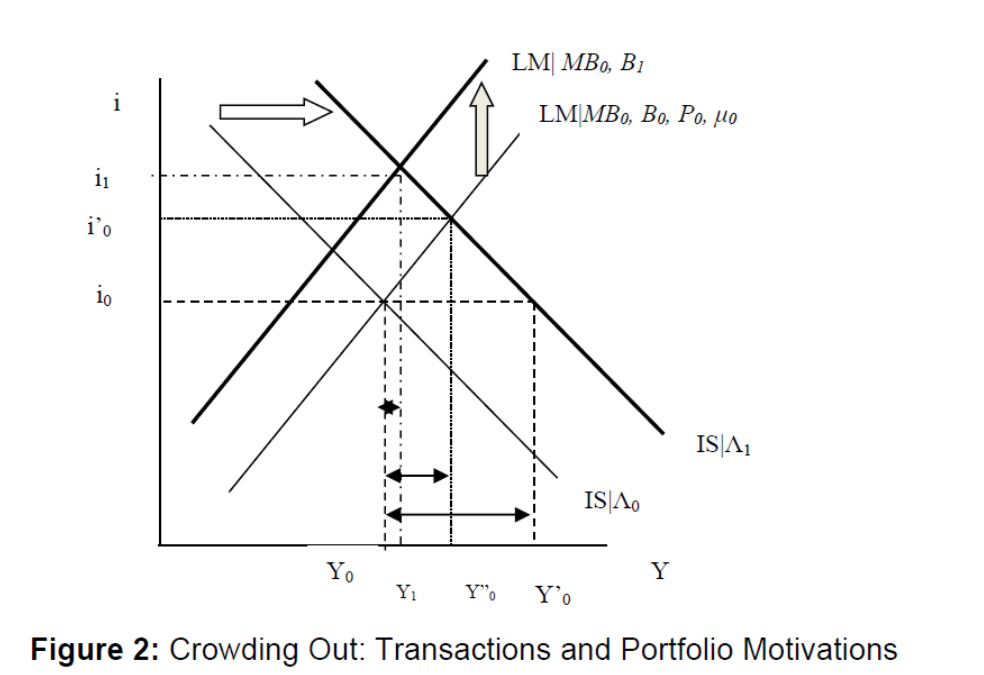
The liquidity-preference, or portfolio-balance, approach — rooted in Keynesian IS-LM analysis — instead views the rate on bonds as determined by portfolio allocation between money and bonds, given wealth and the money supply. The author notes that this is the framework usually used in class, to illustrate portfolio crowding out arising from government budget deficits, with the teaching example couched in IS-LM terms (teaching notes, PDF).
The loanable-funds depiction of rising demand for savings from budget deficits delivers the same qualitative outcome: both frameworks predict higher interest rates, and both, the author argues, contain insights. The open question is which one is more accurate — a long-standing dispute in macroeconomics, running back through the classical–Keynesian debates that produced IS-LM in the first place. The stakes are not merely pedagogical: the two frameworks attribute rate pressure to different forces — flows of saving and investment versus the allocation of a given stock of wealth — and so point toward different evidence when rates move.
Outside assets and Ricardian equivalence
If one could focus on outside assets only — a setting consistent with a world in which Ricardian equivalence does not hold — then the loanable-funds view determines the interest rate on government debt. (Ricardian equivalence, associated with economist Robert Barro, holds that government borrowing is offset by higher private saving because taxpayers anticipate future taxes; in a non-Ricardian world, government debt counts as net wealth.)
Corporate credit demand and AI capex
However, recent journalistic accounts — for example, a New York Times report — have noted that demand for credit emanating from corporates, particularly those involved in AI capital expenditure, has had an influence on rates. Borrowing of this kind sits naturally in the loanable-funds story, where it registers as investment demand; in portfolio-balance terms it matters chiefly as inside assets that compete with other claims for space in investors' portfolios.
Stanford finance economist Hanno Lustig argues that, in fact, US government debt has become more “risky,” so that government debt and other inside assets — such as high-quality corporate bonds — have become closer substitutes. Lustig deploys a picture of the AAA–Treasury gap in support of this argument (paper, PDF).
Gilchrist–Zakrajšek evidence
The author plots the Gilchrist–Zakrajšek spread, which controls for maturity. The measure is the excess bond premium developed by economists Simon Gilchrist and Egon Zakrajšek and described in the Federal Reserve's FEDS Notes (original April 2016 note; October 2016 update). The premium isolates the portion of corporate credit spreads that goes beyond expected default losses — a gauge of credit-market investor risk appetite that the FEDS Notes connected to recession risk.
Figure 1: Gilchrist–Zakrajšek spread, % (blue). Source: FRB.
The spread is quite low, suggesting that the credit-risk gap between US Treasurys and corporates has, indeed, shrunk.

