Fernando Llorente Predicts 2-1 Spain Win in World Cup Final: Zoomex X Space Recap
Key Takeaways
- •Fernando Llorente predicted a 2-1 Spain victory in the World Cup Final, a forecast tied to a Zoomex charity pledge of 1,000 USDT that would increase to 5,000 USDT if the prediction proves correct, with funds supporting people affected by hardship in Venezuela.
- •Llorente attributed England's semifinal loss to Argentina to overly defensive substitutions after taking a 1-0 lead, noting England held only twelve percent possession during the final fifteen minutes while Argentina controlled eighty-eight percent of the ball.
- •Spain neutralized France's attacking threat in their semifinal by dominating possession, with Llorente describing the team's composure as remarkably relaxed and praising Rodri's return to peak form as a key strength heading into the final.
- •Llorente identified Lionel Messi, Enzo Fernández, and Alexis Mac Allister as Argentina's most influential players, warning that Spain must avoid turnovers in areas where Argentina can quickly transition into dangerous counterattacks.
- •The panel discussed the Golden Boot race, noting that Mbappé, Messi, and Haaland each had eight goals, but with Haaland and Mbappé eliminated, only Messi remained in contention alongside Spain's Mikel Oyarzabal, who had five goals.
Fernando Llorente believes Spain's greatest advantage over Argentina in the World Cup Final is the same quality England abandoned in their semifinal defeat: keeping the ball.
The best defence, he argued, is to defend with possession. When you hold the ball, you dictate the tempo. England, after going 1-0 up against Argentina, retreated to the halfway line with five defenders and one exhausted striker. Argentina absorbed the pressure for thirty minutes, waited for openings, and proved clinical when they arrived. Llorente insisted England had the personnel to choose differently. Spain, he said, will not repeat that mistake.
That was the core message Llorente delivered on the eve of the World Cup Final, where he has officially predicted a 2-1 Spain victory.
Zoomex World Cup Edition X Space: Fifth and Final Episode
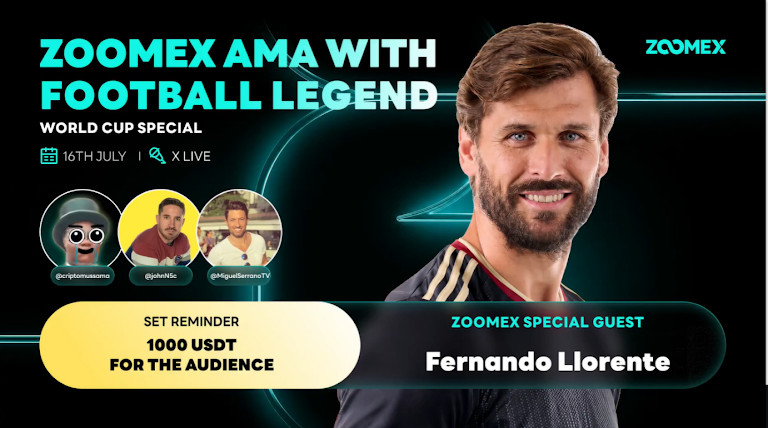
As part of the Zoomex World Cup Impact Pledge, Zoomex hosted the fifth and final episode of its World Cup Edition X Space, a live audio discussion format on X. World Cup winner Fernando Llorente joined football commentators Juan, Gran Mussama, and Miguel Serrano TV for the discussion. Fernando Lillo Aranda hosted the session from Boston as anticipation built in the final hours before the World Cup Final.
The session also marked the conclusion of the five-part charity initiative that accompanied every episode of the series. With Llorente predicting a 2-1 Spain win, the pledged 1,000 USDT allocation will support people affected by hardship in Venezuela — a cause that a friend recently brought to Llorente's attention. If the prediction proves correct, the allocation will increase to 5,000 USDT.
Spain's Composure: Playing as if Among Friends
Fernando Lillo Aranda repeatedly returned to a question on the minds of many Spain supporters: How can such a young team remain so composed against opponents like France and Argentina?
Llorente, while covering the tournament for Dazón and Spanish television, spoke with members of the Spain squad before the France match. Their description matched what he later witnessed on the pitch.
"Before the game they already told me that in the changing room they were calm, that they were talking about their things, jokes, stories and such. It surprises me, the attitude so relaxed they have before such an important game, and then how much they came out, because in that sense we were much more involved than the French in the game. They came out winning all the duels. It seemed to me that we were much more involved than them."
Before kickoff, Llorente had expected Spain to struggle against France's pace and attacking quality — Mbappé, Olise, Dembélé, and Barcola — as well as France's counter-attacking threat and the danger of midfield turnovers triggering rapid transitions. Instead, Spain neutralized those strengths by controlling possession and depriving France of the tempo they needed. In that reading, possession was not simply an aesthetic choice; it was Spain's defensive mechanism against opponents built to punish open spaces.
"These guys are surprising me. The ability they have to play these types of games in which there is so much pressure, they play as if they were playing with friends, with a naturalness, with a confidence that escapes me."
Llorente praised Rodri, who had been returning to peak form throughout the tournament, and described Spain's second goal against France as emblematic of the team's style:
"From the goal, defense, midfield, how they break the middle, Fabián, the pass, the wall of Porro. It was pure caviar."
He noted that Spain constantly rotated positions — defenders stepping into midfield, midfielders arriving in attacking zones, and players interchanging roles so fluidly that opponents could not identify consistent defensive assignments.
What England Did Wrong Against Argentina
The panel's most detailed tactical discussion centred on England's defeat to Argentina, which had taken place the previous evening.
"I think that England made a mistake. In the end, you score a goal and you think that with that it is already done. And in the end what you cannot allow yourself is to get behind and let Argentina dominate you. They had players on the bench, an incredible squad to have done something different. Players who were still tired, I would have brought players up quickly. Having had players up quickly could have put Argentina in serious trouble. Saka, Rashford left too late, Madueke. Players who could have killed them on the counter, and yet they took out five defenders, 5-4-1, which in the end, apart from Harry Kane up there, who was already very tired, without a counter-attack exit."
Miguel Serrano TV reinforced the analysis with match statistics. During the final fifteen minutes, England held just twelve percent possession while Argentina controlled eighty-eight percent of the ball. England completed only two effective passes in the final ten minutes — one of which came from goalkeeper Jordan Pickford.
Miguel argued that England's defensive substitutions conveyed a message to Argentina. It was not "we are protecting this lead" but rather "come and attack me, because I am staying here." Argentina responded accordingly.
Gran Mussama compared England's approach to Diego Simeone's Atlético Madrid:
"When he is winning, when he goes 1-0 with a very tight result, they fall back and the opposing team sees it. Either a guy with a good shot or someone scores a goal and they keep closing until he scores."
For Gran Mussama, dropping deeper simply invited additional pressure from the opposition.
Argentina's Key Players
Discussing Argentina's strengths, Llorente identified Lionel Messi, Enzo Fernández, and Alexis Mac Allister as the team's most influential players. Highlighting Mac Allister's less-heralded contributions:
"Enzo yesterday moved the team as he wanted, always seeing when Messi was alone, and at the last minute how he went to the right wing because there Messi was all the time alone, and from there they raised the whole play."
"The opportunities he had yesterday to score a goal was incredible. It is going to be a very complicated game because they have that ability to get out of trouble. If you give them the smallest minimum option to return to the game they are very dangerous."
Llorente outlined Spain's priorities for the final:
"We do not have to get into their game. They have to leave with the same mentality they had against France. Being ready in the duels, reading where the balls can fall to get there before them. Keep dominating the game and not give them too many options. Don't make mistakes, that's the main thing in a final like this."
The Striker's Craft: Space, Touch, and Defensive Disruption
The session featured a technically detailed discussion on the art of striker play inside the penalty area, prompted by Lionel Messi's headed equalizer for Argentina. Llorente explained how minimal physical contact from a defender at the right moment can completely disrupt a striker's ability to finish.
"When the strikers enter the area, what complicates your life the most is to have the defender already touching you and bothering you. If before the centre, to anything, you give a little touch to the striker, he is dead. When it happened to me playing, that is the worst thing they can do to you. You have to try to gain space so that the defender does not bother you, because if when you are jumping the minimum touch already makes it very difficult for you to finish."
Drawing on his own career, Llorente described how his physical presence helped him create space inside the box, but experienced defenders could still neutralize opportunities with a well-timed touch before a header or shot.
"I remember that when I was going to the shot, suddenly the side from the opposite side comes at you. I always tried to look for the back of the defenders. When the side comes on the other side that you do not see it and gives you a little touch before the shot, you were dead. There were sides that did it very well. Very smart people who bothered you at that moment and you have nothing to do."
From a defender's perspective, Llorente offered guidance on marking strikers:
"When you are defending and the striker enters the area, do not focus only on the centre. Do not neglect. The striker is going to try to take your back and take advantage of that. You have to be touching him, grabbing, looking at the centre and the player who is going to score. Because a lot of people accumulate, one thinks it belongs to one defender, the other thinks it belongs to the other, and in the end the striker finishes without a mark."
According to Llorente, that was precisely what happened during Argentina's equalizer. With multiple players in the box and no assigned marker, Alexis Mac Allister arrived late and found himself completely unmarked despite not being among the tallest players on the field.
The Toughest Defenders: Van Dijk and Chiellini
During a quick-fire segment, Llorente was asked which defender in this World Cup he would least have wanted to face. He immediately named Virgil van Dijk.
"When I went to the Premier League, I was very surprised by how strong all the defenders were, they were all big, even bigger than me, stronger. He seemed to me to be a barbarity. Not only how strong he was, how fast he was, because he's very fast in the long run. He's a very complete defender."
Llorente recalled his first encounter with Van Dijk while playing for Swansea against Southampton:
"In my first game, I was at Swansea against him, and he was at Southampton. In the first clash that happened, he put his elbow in my ribs and fractured one of my ribs. I found out later. At that moment, I held on as best I could. He fell to the ground, I did my best, but the pain I was in was terrible. And then I played the next game, I scored my first goal against City, and I had to stop for a month because I couldn't take the pain anymore."
He noted that the Premier League's physical intensity required an adjustment after Spanish football, where contact was generally easier to manage: "I told my teammates to shoot me from below, because from above it was complicated."
Giorgio Chiellini, Llorente said, posed a different challenge — relentless physical marking rather than sheer athleticism.
"The first time I faced him was in an Italy-Spain, in a friendly. It was terrible. How does that mark you? Surely, that's the most sticky one, the one that hits you the most. The other one is stronger, but he doesn't hit you as much. Chiellini is exaggerated. He doesn't let you breathe."
Two seasons as Chiellini's teammate at Juventus, alongside Leonardo Bonucci and Andrea Barzagli, gave Llorente firsthand insight into the elite standard of Italian defending.
Rodri or Busquets: An Unfair Comparison
Gran Mussama asked Llorente whether Rodri at his peak or Sergio Busquets at his peak represented the higher standard.
"We can be talking about the two best midfielders in the world. At that time, we also not only had Busi, but Xabi Alonso, we had many options there, not just Busi. But Rodri is impressive. Unlike Busi, perhaps he has more travel, he is physically stronger. It is incredible how he is able to be everywhere. He also has the reliability in passes. I think he has more than 90% success in passes, which is incredible. I think he is the one with the most in the world."
Llorente emphasized that Rodri's return to top form was one of Spain's greatest strengths: "Perhaps it is the great news of Spain. Seeing Rodri again at his best is one of the keys for me."
Llorente also praised Mikel Oyarzabal for his technical ability and collective mentality:
"I am in love with how he plays, and more of how he plays, with his attitude. He is a boy who does not think about himself, he thinks only about the collective, about the team, about working. I love how he moves, how many times he goes down between the lines, helping the team to get out from behind. In the end, he gathers a lot of people in the centre of the field. The positions are rotated and that makes it very difficult for the defenders. Many times they do not know who to mark."
He connected Spain's tactical flexibility to a broader observation about the modern game:
"Nowadays they work a lot on the tactical issue, they tell them more or less what to do in the field, more mechanical movements, and a little creativity is taken away from the player. In Spain, I see that they interpret the game very well. They let each one take out the best that he has, or his creativity inside the field."
How Football Has Evolved
Juan asked whether modern football has become more physical or whether overall quality has simply increased, leaving less room for individual technique.
Llorente attributed the sport's evolution to greater emphasis on preparation, conditioning, and attention to detail:
"The details are taken care of more and more. All the players already have nutritionists, their diets, their individualised work, which before was impossible. I remember when I started, we would go out to the field and we would start shooting without warming up, without doing anything. Today you already have a pre-activation in the gym, then you go out, you have another warm-up when you go out to the field. They take great care of the details."
"Football is evolving. The fact of taking care of the details also makes you train more and better. The players are better physically, they take better care of themselves, everything is much more professionalised. It is more physical, you run more and every time everyone goes further to the limit. That is clear. That is why there is also so much equality, despite the fact that there are better teams than others."
Reflecting on his own style as a traditional centre-forward, Llorente acknowledged that physically dominant strikers who hold up long balls and bring teammates into the attack have become increasingly rare.
"Every time I see a long ball and there is a duel, normally the defenders win it. The one who plays from the back is a striker. It is complicated today to see a striker who, every time there is a long ball, keeps it and is able to give the team a way out from above."
He noted that many top clubs now emulate Barcelona's possession-based build-up, and that many goals in modern football originate from turnovers during build-up phases rather than from traditional attacking moves. That makes the Spain-Argentina matchup especially tactical: the same build-up patterns that help teams control matches can also become high-risk moments if possession is lost in areas where Argentina can transition quickly.
Panel Predictions and the Golden Boot Race
The panel concluded with their World Cup Final predictions:
- Fernando Llorente: 2-1 Spain (submitted on the FIFA platform)
- Miguel Serrano TV: 1-0 Spain, referencing Johannesburg 2010
- Juan: 3-1 Spain
- Gran Mussama: Initially 4-0 Spain if they scored early, later revised to 4-1 Spain with Lionel Messi scoring
Fernando Lillo Aranda offered to buy Gran Mussama a steak anywhere he chose if the 4-0 prediction came true. Gran Mussama later revised to 4-1, with Messi scoring, noting: "Since he's retiring as the best in history and didn't play in the World Cup."
On the Golden Boot race, Miguel Serrano TV outlined the standings: Kylian Mbappé, Lionel Messi, and Erling Haaland each had eight goals. With Haaland and Mbappé eliminated, only Messi remained in contention. Mikel Oyarzabal had five goals and would need a hat-trick in the final to draw level. The panel agreed they would accept Messi winning the Golden Boot if Spain won the World Cup.
Miguel also addressed narratives surrounding Argentina and officiating, referencing Lionel Messi's comments after Argentina's 2019 Copa América semifinal exit, where Messi criticized corruption and refereeing decisions he believed favoured Brazil. Miguel observed that current arguments echo those same concerns, and that championship-winning teams inevitably attract competing narratives.
The conversation concluded with discussion of Messi's future. With Messi expected to be 41 or 42 in 2030, the panel viewed another World Cup as unlikely. Gran Mussama suggested Major League Soccer had not maintained the same competitive intensity, while Juan argued that if Argentina won this final, Messi's legacy would already be complete — with the 2028 Copa América as a more realistic international objective.
The Central Lesson
One theme connected the entire discussion: successful teams remain committed to their plan even under pressure. Llorente pointed to England's substitutions against Argentina as an example of strategy changing out of anxiety rather than confidence. England's tactical decisions invited sustained Argentine pressure and altered the message communicated to both teams on the field.
By contrast, Llorente described Spain's dressing room before the France match as filled with calm conversation, jokes, and confidence. The plan remained the plan regardless of the scoreline.
"You have to play a game like the one we played against France. We practically did not make mistakes. Because if you lose the ball in a field where they can catch you in some counterattack with spaces, they are still a dangerous team."
Disciplined execution, Llorente concluded, is simply the successful implementation of the original plan. Any departure from that plan under pressure creates opportunities that elite teams like Argentina are fully capable of exploiting.
About Zoomex
Founded in 2021, Zoomex is a global cryptocurrency trading platform specializing in derivatives trading. The platform serves more than 3 million users across over 35 countries and regions, providing access to more than 590 trading pairs. Zoomex operates a high-performance matching engine and provides transparent asset displays, order information, fee structures, and trading rules.
The platform maintains registrations, licenses, and regulatory statuses across multiple jurisdictions, including the U.S. MSB, Canada MSB, U.S. NFA, and Australia AUSTRAC. Zoomex has completed security audits conducted by blockchain security firm Hacken and continues to strengthen its trust framework through initiatives including Proof of Reserves, Security & Transparency, Compliance Information, and Fees / Rules Transparency.
Beyond cryptocurrency trading, Zoomex has expanded its global brand through partnerships in elite sports, including the TGR Haas F1 Team, FIFA World Cup-winning goalkeeper Emiliano Martínez, and world-class tennis events such as Wimbledon. The X Space series fits that wider sports-marketing strategy by pairing football discussion with a charity pledge tied to the tournament.
Source: Metaverse Post

