Wyoming’s FRNT Adds Chainlink Proof of Reserve as LiquidChain Presale Nears $1 Million
Key Takeaways
- •Wyoming’s Frontier Stable Token will use Chainlink Proof of Reserve to verify backing assets on-chain between daily reserve reports.
- •FRNT was moved entirely onto Chainlink’s CCIP two weeks before the new reserve-verification announcement.
- •FRNT now operates across eight public blockchains, including Ethereum and Solana.
- •LiquidChain is a Layer 3 project that uses the Solana Virtual Machine to support cross-chain activity across Bitcoin, Ethereum and Solana.
- •LiquidChain’s presale has raised $959,000 at a token price of $0.0149, leaving it just below the $1 million mark.
Wyoming is turning its state-issued stablecoin into a more developed piece of multichain financial infrastructure.
The Wyoming Stable Token Commission announced yesterday that its Frontier Stable Token (FRNT) will adopt Chainlink Proof of Reserve, bringing near-real-time verification of the assets backing the token on-chain. Wyoming already publishes daily reserve attestations, but the new system adds automated verification between those reports.
The announcement came two weeks after the state moved FRNT entirely onto Chainlink’s Cross-Chain Interoperability Protocol (CCIP). FRNT now operates across eight public blockchains, including Ethereum and Solana, with CCIP serving as the exclusive infrastructure connecting those deployments.
For a stablecoin issued by a U.S. public entity, the move underscores how interoperability and reserve verification are becoming part of the core plumbing for digital money rather than optional extras. It also highlights how public-sector stablecoin projects are being built to operate across multiple networks from the start, which is relevant as more applications and users interact with several chains at once.
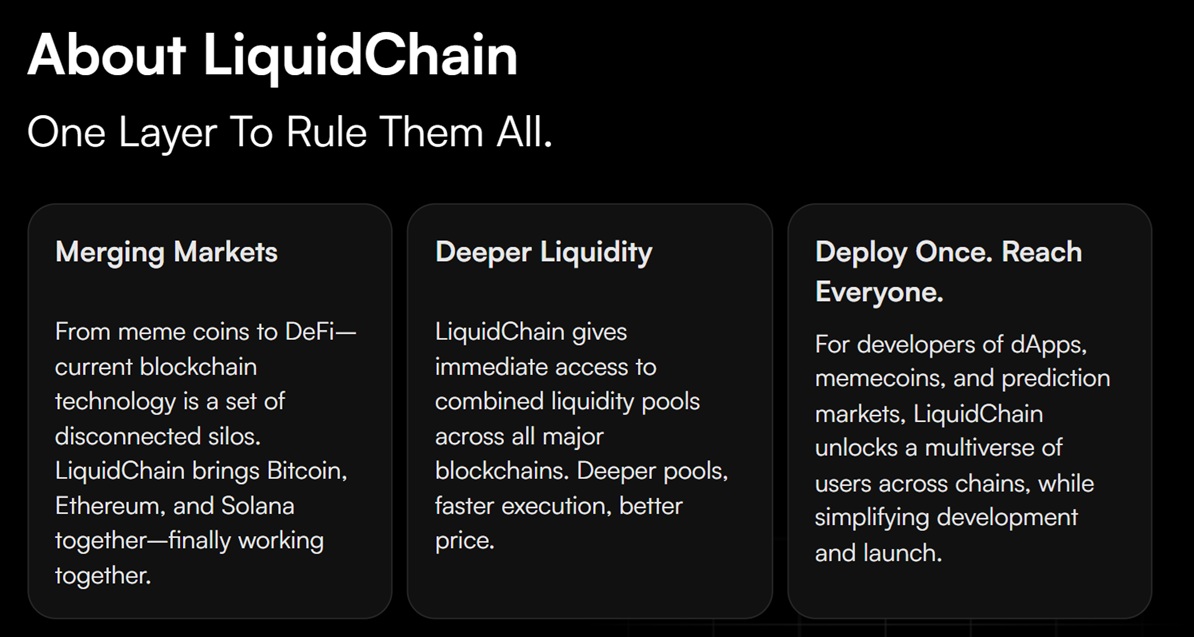
That approach is relevant to the team behind LiquidChain (LIQUID), a Layer 3 project that is taking the multichain idea further by building one execution environment that can verify and coordinate activity across Bitcoin, Ethereum and Solana.
The LIQUID presale has now raised $959,000, leaving it just short of its first $1 million milestone at a token price of $0.0149.
LiquidChain Builds Verification Into Cross-Chain Execution
Wyoming’s FRNT setup separates two functions: the stablecoin exists on individual blockchains, while dedicated infrastructure verifies reserves and coordinates movement between those networks.
LiquidChain addresses a different use case, but verification is also central to its architecture.
The protocol uses the Solana Virtual Machine (SVM) as its high-performance execution environment and uses it to create a single liquidity pool for Bitcoin, Ethereum, and Solana.
Its cross-domain proof system can reference all three chains within the same execution environment, enabling multichain operations without wrapping or bridging assets.
LiquidChain is designed so that multichain transactions can execute atomically. If a transaction requires several related steps across different domains, those steps either complete together or roll back, rather than leaving the user with only part of the intended operation finished on one network.
The result is an L3 built less around moving coins from one place to another and more around allowing applications to understand and act on several blockchain states at once.
What Happens When Apps Stop Caring Which Chain You Use?
That technical framework opens up several practical possibilities. A user can, for example, view and manage a portfolio of assets across Bitcoin, Ethereum, and Solana through a single interface rather than switching between separate wallets, bridges, and applications.
LiquidChain’s planned Unified Liquidity Application is being designed around that experience, with portfolio aggregation, cross-chain analytics, atomic swaps, and liquidity routing among its proposed features.
Atomic execution also makes longer actions less cumbersome. An application that needs to reference an asset on one network before taking an action can package those steps into one coordinated transaction instead of requiring the user to manually complete a sequence of transfers.
The ceremony starts with a single word. pic.twitter.com/vudkt5bEzI — LiquidChain (@getliquidchain) August 31, 2026
For builders, LIQUID also means fewer separate integrations to maintain as an application expands. A product designed around Ethereum users today may later want access to Solana activity or Bitcoin capital. LiquidChain’s pitch is that those additional markets can be addressed through the same underlying execution layer rather than bolted on individually afterward.
Wyoming is not focusing on one blockchain for FRNT, and neither is LiquidChain. The difference is that LIQUID aims to make the multichain model programmable, allowing developers to build products in which the boundaries between Bitcoin, Ethereum, and Solana become much less visible to the end user.
LIQUID Nears $1 Million as Exchange Listings Move Closer
LiquidChain is still early in that development path, but its presale is approaching an important milestone.
Investors have committed $959,000, with LIQUID available for $0.0149. Staking currently offers 1,190% APY, and SpyWolf and CertiK have reviewed the project.
According to the project’s current site, the tokenomics allocate 35% of LIQUID supply to development and another 7.5% to growth and exchange listings. Total supply is approximately 11.8 billion tokens.
The presale roadmap shows LiquidChain moving from its current first stage into Stage 2 and then to exchange listings, marking a transition from fundraising to public trading.
As more projects build for environments where verification and coordination across chains are standard requirements, infrastructure that can handle those interactions becomes increasingly central to the crypto stack.
With LIQUID now approaching $1 million in presale funding before its exchange phase begins, the project is presenting itself as a candidate to watch in the multichain infrastructure segment.
The post Next Crypto to Explode as First State Stablecoin Pushes Multichain Argument appeared first on icobench.com.
