Lima, Ohio Completes 2-MW Floating Solar Array on Twin Lake Reservoir
Key Takeaways
- •Lima, Ohio has completed a 2-MW floating solar array on Twin Lake Reservoir, becoming the third floating solar installation in the state.
- •The installation is expected to generate approximately $10 million in electricity savings over its lifetime by powering the city's water treatment plant, which processes 14 million gallons of drinking water per day.
- •The $5 million project secured $2.4 million in U.S. Department of Energy grants and nearly $1 million in direct pay tax credits created under the Inflation Reduction Act.
- •The floating array spans just four acres of reservoir surface, compared to a minimum of ten acres that an equivalent land-based system would typically require.
- •All three Ohio floating solar projects were developed by D3Energy and constructed by ARP Solar, with a 6-MW installation in Monroeville slated to come online before year's end.
Ohio has been battered by a week of severe weather, with intense thunderstorms sweeping across the state, powerful winds overturning a vehicle on the interstate north of Columbus, and heavy rainfall triggering flood watches across numerous counties. AEP Ohio, the central-Ohio utility, indicated it would need several more days to restore power to roughly 135,000 affected customers.
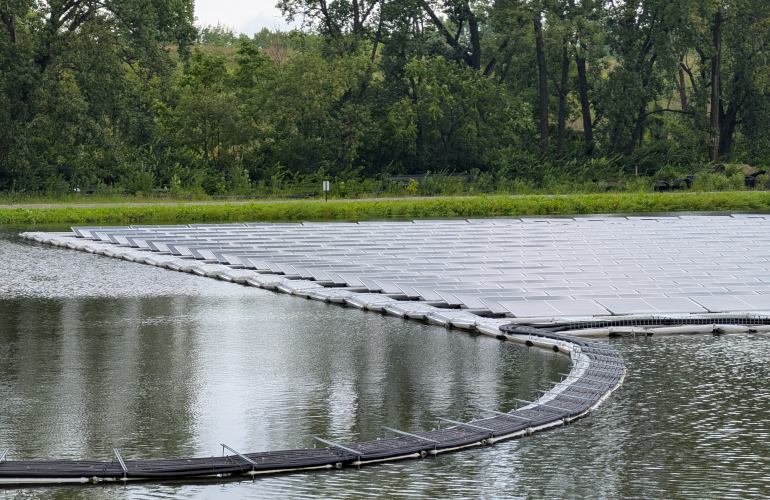
Amid the relentless rain, one northwest Ohio community gathered to mark a milestone in renewable energy infrastructure that is designed to withstand precisely such conditions. A 2-MW floating photovoltaic array has been completed atop the Twin Lake Reservoir in Lima — the third floating solar installation in the state. Although floating solar is a fast-growing renewable energy segment globally, adoption in the United States remains in its early stages compared to land-based systems. All three Ohio projects were developed by D3Energy and constructed by ARP Solar. The firms previously completed a 1.5-MW array for Del-Co Water in Delaware, Ohio, in 2024, and a 6-MW system in Monroeville is slated to come online before year's end.
Twin Lake Reservoir serves as the primary drinking water source for Lima's 35,000 residents. The adjacent water treatment plant processes approximately 14 million gallons per day and ranks as the city's single largest energy consumer — a common pattern across U.S. municipalities, where water and wastewater treatment routinely rank among the most energy-intensive publicly operated facilities. The new solar installation is projected to deliver $10 million in electricity savings over its operational lifetime.
"This project allows us to take an asset we already have — our reservoir — and use it in a new way to support the critical work happening at our water treatment plant every day," said Michael Caprella, Lima utilities director. "When you are treating approximately 14 million gallons of water each day, energy efficiency matters. This array gives us another tool to manage those costs while continuing to provide the safe reliable water our customers depend on."
Heavy statewide rainfall has no effect on the floating system, as its mooring lines and anchors are designed to adjust to fluctuating water levels. More than 3,100 bifacial solar panels — which capture sunlight on both their front and rear faces, making them well suited to the reflective surface of water — are mounted on Ciel & Terre Hydreilio floating systems, anchored to both the reservoir's banks and its floor. Generated power is fed to eight Yaskawa Solectria XGI inverters positioned onshore.
The 2-MW array occupies just four acres of the reservoir's surface. A comparable land-based system of the same capacity would require at least 10 acres to allow for proper spacing. Stetson Tchividjian, managing director of D3Energy, noted that in a state that has at times been resistant to land-based solar developments, this floating project encountered no apparent opposition.
"This project shows that clean energy doesn't have to come at the cost of land," Tchividjian said. "By building on water the city already owns, Lima is generating 2 MW of clean power while preserving nearly 10 acres. That's why D3Energy exists — to help communities grow their energy independence without giving up their land."
The Twin Lake project reflects years of collaboration spanning multiple mayoral administrations and partnerships across local, state, and federal levels. Planning originated five years ago, and the Lima City Council authorized the project in 2023. The $5 million installation secured $2.4 million in grants from the U.S. Department of Energy — assistance that former U.S. Sen. Sherrod Brown helped obtain — and will leverage nearly $1 million in direct pay tax credits, a mechanism created under the Inflation Reduction Act that allows tax-exempt entities such as municipal governments to receive clean energy tax credits as cash payments.
"This project is a great example of what can happen when leadership carries forward across administrations, and organizations come together around a shared goal," said Lima Mayor Sharetta Smith. "Today, we aren't celebrating one person or one moment. We're celebrating the many people who believed in this project, helped move it forward and ultimately brought it across the finish line."
