Looking at LGUs’ budget surplus and the ProGRESS consultation
Key Takeaways
- •LGUs have posted annual budget surpluses while the national government has averaged a P1.5 trillion deficit from 2020 to 2025.
- •The Mandanas ruling has increased LGUs’ share of national revenues, but many social and infrastructure functions remain with the national government.
- •LGUs had a beginning balance of P727 billion in 2025, ended the year at P776 billion, and are projected to close 2026 with P712 billion.
- •The Office of the President announced that the National Tax Allotment will rise to a record P1.4 trillion in 2027 to support faster devolution.
- •The Department of Finance’s ProGRESS consultations covered PIT, MCIT, excise taxes, and luxury vehicle taxation, including a new 75% tax bracket for vehicles worth over P8 million.
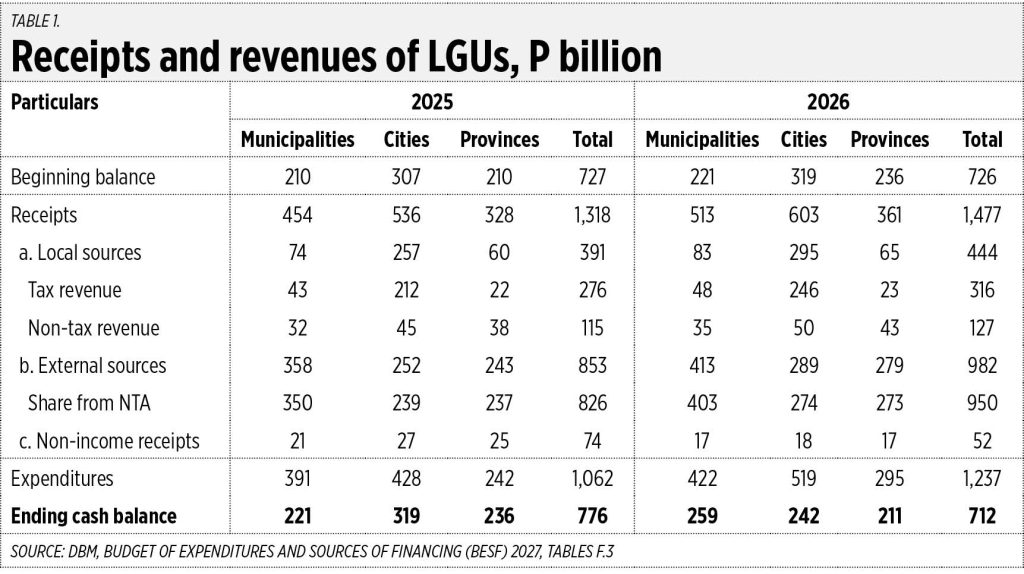
While the National Government suffers from a persistent and consistent budget deficit of P1.5 trillion a year, on average from 2020 to 2025, local government units (LGUs) have continued to post annual budget surpluses. This is because their revenues are rising with the implementation of the Mandanas ruling, which increases their share of national revenues, while their expenditures remain limited because many social and infrastructure functions are still handled by the National Government.
Using the 2025 actual and 2026 programmed data, LGUs had a beginning balance of P727 billion last year and an ending balance of P776 billion at year-end. This year, the projected ending balance is P712 billion.
Cities are generally more entrepreneurial in raising domestic or local revenues than municipalities and provinces. However, in receiving transfers from the National Government through the National Tax Allotment (NTA), municipalities receive more than cities and provinces. The growing gap between local revenue-raising capacity and reliance on transfers is one reason the pace of devolution remains an important policy issue.
Last week, the Office of the President, through Executive Secretary Ralph G. Recto, announced an increase in the NTA to a record P1.4 trillion for 2027. The aim was to speed up the devolution of functions from the national government to local governments. Mr. Recto also led the distribution of Special Allotment Release Orders (SAROs) under the Local Government Support Fund (LGSF) to municipalities in Luzon during the League of Municipalities of the Philippines (LMP) Luzon National Congress.
LGUs should assume more responsibility in delivering various socio-economic services to their constituents, given that they now have more resources than before. At the same time, many national agencies and departments should step back from higher spending to help reduce the annual budget deficit and lessen the need for more borrowing. More functions should be assigned to LGUs.
For example, the budgets and sizes of state universities and colleges (SUCs) should shrink as more LGU-owned universities and colleges (LUCs) are created and expanded. The budget of the Department of Health should also decrease as more LGU-owned hospitals and health centers are created and expanded.
The National Government should prioritize fiscal consolidation by controlling the sharp increase in the budget deficit and annual borrowing, as well as the rapid rise in interest rates and interest payments.
Yesterday, I attended the Department of Finance (DoF) Stakeholders Briefing on the Promoting Growth, Revenue and Equity towards Socio-Economic Sustainability (ProGRESS) bill at the LandBank main office in Manila.
The first item in the DoF’s whole-day consultation with hundreds of stakeholders was the reform of personal income tax (PIT) and minimum corporate income tax (MCIT). This was followed by proposed reforms in excise taxes on sugar, alcohol, tobacco, and plastics.
The DoF’s plan for PIT reform is a marginal adjustment of the income tax exemption from P250,000 to P350,000, as mentioned by the President in his State of the Nation Address on July 27. Since an annual income of P350,000 is not large today, I make my own three proposals: a) zero tax for annual income up to P500,000; b) reduce the tax brackets from six to five; and c) set a top marginal income tax rate of 25%.
The top marginal income tax rate in Malaysia is 30%, in Singapore it is 24%, and in Hong Kong it is 16%. Our other neighbors — Indonesia, Thailand, and Vietnam — have a top rate of 35%.
There would be revenue losses from a downward adjustment in PIT, but there would also be higher compliance and less tax dodging and underdeclaration of personal income. In addition, an income tax cut is equivalent to a large salary increase and bigger take-home pay, while household consumption is captured by other taxes such as VAT and excise tax.
Reforming the taxation of luxury vehicles was discussed during the afternoon session. The DoF has added another bracket: a 75% tax for vehicles worth over P8 million. I spoke during the open forum and argued that the DoF made a mistake in granting zero tax for full EVs and a 50% discount on hybrid EVs, so ProGRESS should consider withdrawing those privileges for EVs. They should pay the same tax rate as gasoline vehicles.
I will discuss the other components of ProGRESS in future columns.
Bienvenido S. Oplas, Jr. is the president of Bienvenido S. Oplas, Jr. Research Consultancy Services and Minimal Government Thinkers. He is an international fellow of the Tholos Foundation.
minimalgovernment @gmail.com

