LG and Nvidia Forge Strategic Partnership Targeting 2027 Humanoid Robot Debut
Key Takeaways
- •LG Group and Nvidia formalized a partnership covering humanoid robotics, AI factories, and autonomous driving.
- •The first flagship product is a bipedal humanoid robot scheduled for unveiling in the first quarter of 2027.
- •LG Electronics, LG Innotek, and LG Energy Solution will provide actuators, sensors, and batteries for the robot.
- •The companies will build a physical AI data factory using LG CNS' PhysicalWorks platform to support training and validation of robot models.
- •LG and Nvidia also plan to co-develop an AI-defined vehicle computing platform based on Nvidia's Drive Hyperion system.
LG Group is deepening its strategic alliance with Nvidia, signing a formal agreement that spans humanoid robotics, AI factories, and autonomous driving. The partnership's first flagship deliverable will be a bipedal humanoid robot slated for unveiling in the first quarter of 2027. The accord reflects Nvidia's strategy of supplying AI computing platforms, foundation models, and safety architectures to hardware partners rather than building robots under its own brand — a model that has drawn multiple robot developers to its Isaac robotics ecosystem amid a global race to commercialize humanoids for factories, warehouses, and homes.
LG Group Chairman Koo Kwang-mo traveled to Nvidia's headquarters in Santa Clara, California, where the agreement was signed on Thursday, approximately two months after Koo and Nvidia founder and CEO Jensen Huang held talks in Seoul in June focused on expanded cooperation in physical AI.
"As our collaboration accelerates, the areas where we can work together in AI factories, physical AI and mobility have become clear," Koo said. "We will accelerate the adoption of AI by building industry-leading reference models."
Huang emphasized that the companies' longstanding collaboration would speed the arrival of the next generation of robots, AI factories, and autonomous vehicles.
"The defining opportunity of physical AI is to give every machine the ability to understand the real world, reason and act safely alongside people — reshaping everyday life from the home and factory floor to the road," Huang said. "Building on years of collaboration, LG and Nvidia are combining LG's leadership in product engineering and manufacturing with Nvidia technology to accelerate the next era of robots, AI factories and autonomous vehicles."
Humanoid Robot Development
The planned bipedal humanoid will be built on Nvidia's Isaac GR00T foundation model and equipped with Nvidia's Jetson Thor computing platform alongside the Halos for Robotics safety architecture. GR00T is designed as a general-purpose foundation model for humanoid robots, intended to let manufacturers adopting Nvidia's platform leverage shared AI training infrastructure while differentiating through their own hardware, sensors, and operational data — placing LG's effort alongside other GR00T-based development programs emerging across the global robotics industry.
Multiple LG affiliates will supply core hardware components: LG Electronics will provide actuators — the joints and muscles that enable precise limb movement — LG Innotek will contribute sensors, and LG Energy Solution will deliver batteries. The affiliate-wide participation leverages LG's existing vertical integration across electronics manufacturing, component supply, and battery production.
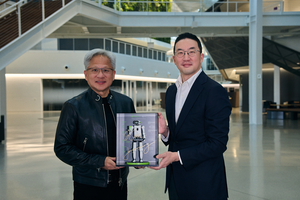
LG Electronics has already established a pilot production line at its facility in Changwon, South Gyeongsang Province, where initial manufacturing has begun. During the Santa Clara meeting, Koo presented Huang with a miniature version of the upcoming humanoid robot. The two executives posed with the signed model, offering a preview of the robot LG intends to reveal next year.
LG is also preparing to deploy robots in live manufacturing settings. By the end of this year, the company intends to station its wheeled CLOiD robot on a washing machine production line at LG Electronics' Tennessee plant.
Physical AI Data Factory
The two companies will collaborate on a physical AI data factory powered by LG CNS' PhysicalWorks platform. Data harvested from robots in the field will be channeled into training and validation pipelines, simultaneously advancing LG's proprietary robot foundation model. The data factory approach mirrors a broader industry shift toward generating real-world training data from deployed robots, a practice increasingly seen as critical for improving the reliability of AI-driven machines operating alongside humans.
AI Factory Initiative
Beyond robotics, LG plans to construct an AI factory integrating Nvidia's DSX architecture with technologies drawn from across the conglomerate. Contributing affiliates include LG Electronics, which will supply cooling systems; LG Energy Solution, providing batteries; and LG CNS and LG Uplus, contributing data center design and operational expertise.
A reference site built on Nvidia's next-generation Vera Rubin platform is scheduled for the first half of 2027. Vera Rubin succeeds Nvidia's current-generation Blackwell architecture in the company's named-release cadence, and the reference site is intended to demonstrate integrated AI factory operations at scale. That will be followed by an 80-megawatt AI factory in Cheonan, South Chungcheong Province, targeted for the first half of 2028. LG stated that the Cheonan facility will employ prefabricated modular construction to reduce build time by more than 20 percent and will serve as a training ground for physical AI systems, including robot foundation models.
Autonomous Driving Collaboration
In the mobility sector, the two companies will jointly develop a high-performance computing platform for AI-defined vehicles based on Nvidia's Drive Hyperion platform. The effort will fuse Nvidia's autonomous driving technology with LG's in-vehicle infotainment and automotive software capabilities. LG Electronics operates an established vehicle component solutions business supplying infotainment and telematics systems to global automakers, providing an existing manufacturing and customer base for the partnership's automotive ambitions.
LG's Robotics Momentum
LG has been intensifying its robotics initiatives leading up to the humanoid launch. The company introduced its CLOiD home robot at CES 2026 in January and established a CEO-led Robotics Business Center in June. Hundreds of CLOiD units are currently operating at a new robot data factory in Seoul, gathering training data to further refine LG's in-house robot foundation model. The acceleration aligns with South Korea's broader push to expand its robotics industry, where government policy has designated intelligent robots as a strategic growth sector supported by public investment and commercialization programs.

