LG to Unveil Nvidia-Powered Humanoid Robot in Q1 2027 Under Expanded Strategic Partnership
Key Takeaways
- •LG intends to unveil a bipedal humanoid robot in the first quarter of 2027 powered by Nvidia's Isaac GR00T platform, Jetson Thor onboard computing, and Halos integrated safety system.
- •LG's affiliates will supply critical robot components internally, with LG Electronics providing actuators, LG Innotek delivering sensors, and LG Energy Solution contributing batteries.
- •LG plans to establish a reference site using Nvidia's Vera Rubin platform in the first half of 2027 and build an 80-megawatt data center in Cheonan by the first half of 2028.
- •LG aims to commercialize a vehicle computing platform for autonomous driving using Nvidia's DRIVE Hyperion, expanding beyond its current infotainment and telematics business.
- •LG Electronics will test its CLOiD robot on the washing machine production line at its Tennessee factory to gather data for strengthening its proprietary robot foundation model.
LG to Unveil Nvidia-Powered Humanoid Robot in Q1 2027 Under Expanded Strategic Partnership
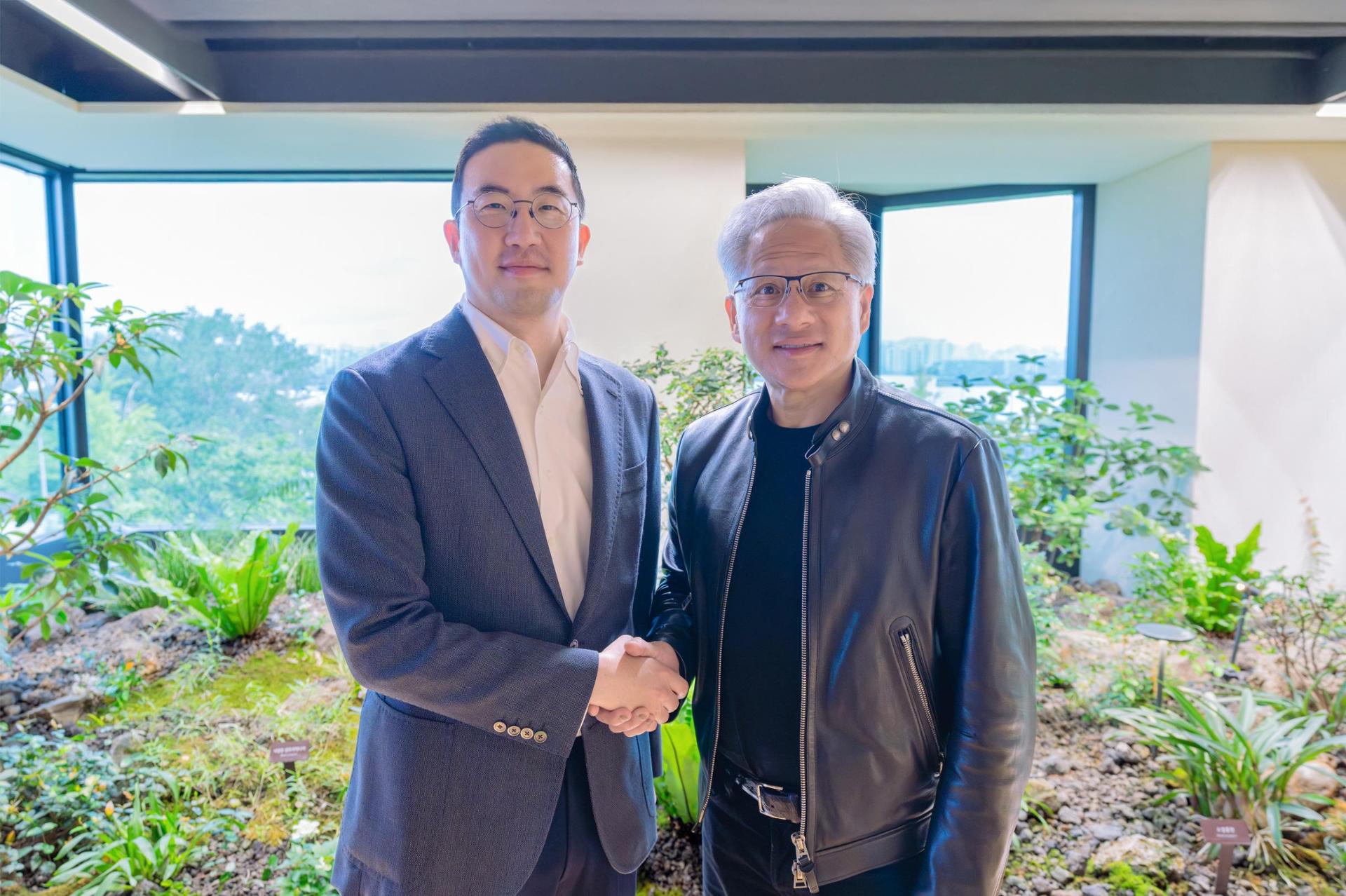
LG Group Chairman Koo Kwang-mo and Nvidia CEO Jensen Huang signed a strategic business collaboration memorandum of understanding (MOU) at Nvidia's headquarters in Santa Clara, California, on Thursday (local time), deepening a partnership that spans humanoid robotics, AI data centers, and autonomous mobility.
The agreement formalizes cooperation areas just two months after senior executives from both companies first pledged to work together in the AI industry. LG Group Vice Chairman Kwon Bong-seok, LG Electronics CEO Lyu Jae-cheol, LG Uplus CEO Hong Bum-shik, LG CNS CEO Hyun Shin-gyoon, and other LG Group executives attended the signing ceremony.
"As our collaboration gains momentum, the tasks where the two companies can work together have become clearer in the field of AI factory, physical AI and mobility," Koo said. "We will accelerate the adoption of AI by building industry-leading reference cases." Nvidia uses the term "AI factory" to refer to AI data centers.
"The defining opportunity of physical AI is to give every machine the ability to understand the real world, reason and act safely alongside people — reshaping everyday life from the home and factory floor to the road," Huang said. "Building on years of collaboration, LG and Nvidia are combining LG's leadership in product engineering and manufacturing with Nvidia technology to accelerate the next era of robots, AI factories and autonomous vehicles."
Humanoid Robot Development
A central focus of the partnership is the development of a bipedal humanoid robot, which LG plans to unveil in the first quarter of 2027. The robot will be built on Nvidia's Isaac GR00T platform — an open-source robotics development framework covering both simulation and robot learning, with GR00T serving as a reference platform for building, training, and testing humanoid robots. Nvidia has positioned GR00T as a foundational platform for the broader humanoid robotics industry, where companies including Tesla, Figure AI, and Agility Robotics are racing to commercialize bipedal machines for factory and warehouse deployment.
The robot will be equipped with Nvidia's Jetson Thor for onboard computing, enabling advanced reasoning and control. It will also incorporate Nvidia's Halos for Robotics, described by the company as the industry's first full-stack integrated safety system for robotics.
LG's key affiliates will contribute critical components: LG Electronics will supply actuators functioning as the robot's "muscles," LG Innotek will provide sensors acting as its "eyes," and LG Energy Solution will deliver batteries. This vertical integration across LG Group affiliates — a hallmark of the Korean chaebol structure — gives LG in-house sourcing capabilities that most standalone robotics startups lack.
LG Electronics' wheel-based CLOiD robot, which was showcased at CES 2026 in January, will be tested on the washing machine production line at the company's Tennessee factory. Data and manufacturing experience gathered from these trials will strengthen LG's own robot foundation model, currently under development. LG plans to leverage Nvidia's Isaac GR00T ecosystem while simultaneously building its proprietary AI model capabilities.
AI Data Center Initiatives
For AI data centers, LG will integrate Nvidia's DSX reference architecture — a system encompassing computing, networking, storage, power, and cooling infrastructure — with LG Electronics' cooling solutions, LG Energy Solution's batteries, LG Uplus' operational capabilities, and LS Group's power solutions. The partnership enters a market where global demand for AI computing infrastructure has triggered a wave of large-scale data center construction by cloud providers, telecom operators, and conglomerates worldwide.
In the first half of 2027, LG will establish a reference site using Nvidia's Vera Rubin AI computing platform to test the group's cooling, power, and IT technologies.
LG then plans to construct an 80-megawatt data center in Cheonan, South Chungcheong Province, during the first half of 2028. The facility will use a prefabricated design to reduce construction time and will serve to advance physical AI technologies and LG's robot foundation model.
Mobility and Autonomous Driving
In the mobility sector, LG intends to use Nvidia's DRIVE Hyperion autonomous driving platform to commercialize its vehicle computing platform for AI-defined vehicles. By building on Nvidia's technology, LG aims to expand its automotive electronics business beyond its current in-vehicle infotainment focus into full autonomous driving capabilities. LG Electronics already supplies infotainment and telematics systems to major global automakers, and the move into autonomous driving computing targets a higher-value segment of the automotive supply chain.

