LendProtocol Launches Fixed-Rate Lending Platform for XRP and RLUSD
Key Takeaways
- •LendProtocol says its platform offers XRP and RLUSD deposits with an advertised 12% APR and daily interest crediting.
- •Borrowers on the platform must provide collateral equal to 120% of the loan value, using one of six supported assets.
- •The company reports that the service has facilitated more than 743 million XRP in loans and has over 13,713 active lenders.
- •Native XRP staking does not exist at the protocol level because the XRP Ledger does not use Proof-of-Stake.
- •LendProtocol says it is a centralized lending service and is not an implementation of the proposed XLS-66 XRPL lending specification.
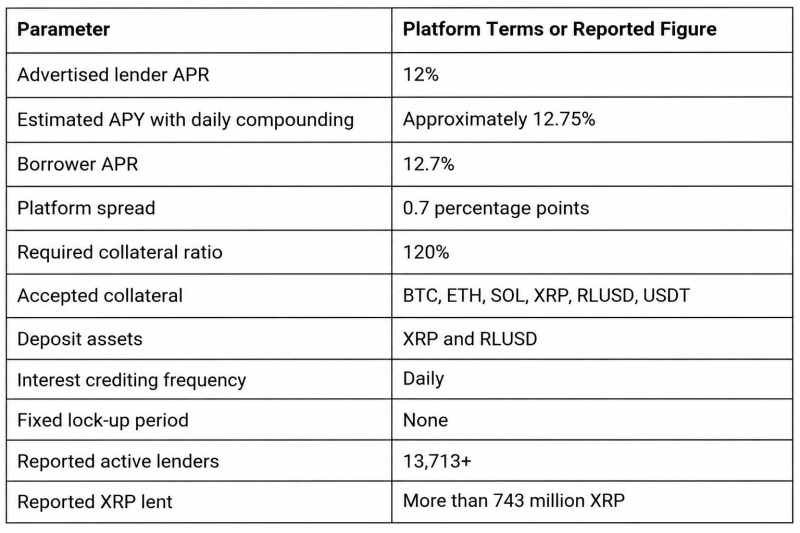
London, England, August 18, 2026 — LendProtocol has launched a fixed-rate lending platform built on the XRP Ledger, offering a new service for XRP and RLUSD holders. The platform advertises a 12% annual percentage rate (APR) with daily interest payouts and no fixed lock-up period, while requiring borrowers to post collateral equal to 120% of the loan value.
According to figures provided by LendProtocol, the service has already facilitated more than 743 million XRP in loans and serves over 13,713 active lenders. The company notes that these figures and the advertised interest rate are its own and should be independently verified where possible.
The offering presents an alternative for holders interested in earning potential interest on XRP, although it is a lending product rather than native blockchain staking. That distinction matters because XRP’s network design does not pay staking rewards at the protocol level, so products marketed around XRP yield typically rely on third-party structures rather than the ledger itself.
Why Native XRP Staking Does Not Exist
Unlike Ethereum and Solana, the XRP Ledger does not rely on a Proof-of-Stake consensus mechanism. Instead, it operates on a Federated Byzantine Agreement model, under which validators confirm transactions without distributing staking rewards to XRP holders. As a result, native XRP staking does not exist at the protocol level.
Services marketed as "XRP staking" therefore generally involve third-party lending, exchange programs, liquidity provision, or other yield-generating arrangements, each carrying its own custody, counterparty, liquidity, and market risks. XRP holders seeking a potential return on their assets have typically looked to centralized exchange products, lending services, or blockchain bridges. LendProtocol aims to add another option within the XRP Ledger ecosystem through a fixed-rate, centralized lending structure.
How the Lending Model Works
LendProtocol operates as a centralized finance (CeFi) intermediary. Users can deposit XRP or RLUSD, while borrowers must provide collateral equal to 120% of the loan value. Accepted collateral spans six assets: Bitcoin, Ethereum, Solana, XRP, RLUSD, and USDT.
The platform states that borrowers pay 12.7% APR and depositors receive 12% APR, with the remaining 0.7 percentage points serving as the platform's operating spread.
LendProtocol also says it assumes the direct lending exposure if an individual borrower defaults. This structure may reduce a depositor's exposure to individual borrower failures, but it does not eliminate all risk. Depositors remain exposed to risks associated with platform solvency, custody, collateral liquidation, cybersecurity, regulation, and operational performance.
Interest is calculated and credited daily, according to the platform. If the daily interest remains in the account and continues to earn interest, a 12% APR would produce an effective annual yield of approximately 12.75%. Actual results may depend on account terms, withdrawals, platform availability, and whether interest is continuously compounded.
RLUSD is also available as a deposit asset, which may appeal to users seeking exposure to a dollar-denominated asset rather than XRP price movements. RLUSD deposits nonetheless involve stablecoin, platform, custody, and counterparty risks.
Security Measures and Due Diligence
LendProtocol says its security measures include cold storage for most deposited assets, AES-256 GCM encryption for stored data, and mandatory two-factor authentication. Users are advised to independently review the platform's custody arrangements, legal terms, audits, withdrawal policies, and risk disclosures before depositing assets.
Distinct from the XLS-66 Proposal
LendProtocol is a consumer-facing CeFi lending service that uses the XRP Ledger for parts of its asset and transaction infrastructure. It is not an implementation of XLS-66, a proposed XRPL lending specification designed to support protocol-level lending structures with off-chain credit assessment.
Although the two models may run on the same underlying blockchain, they differ in structure, risk allocation, custody, and intended users. LendProtocol's offering is described as a fixed-rate, overcollateralized lending product managed by a centralized intermediary.
Users comparing XRP income products should therefore avoid treating LendProtocol deposits as native staking. The service should instead be assessed as a third-party lending arrangement, with the associated platform and counterparty risks considered accordingly.
About LendProtocol
LendProtocol is a centralized lending platform operating with XRP Ledger-based assets. It offers XRP and RLUSD deposit products featuring an advertised 12% APR, daily interest crediting, and no fixed lock-up period. Borrowers must provide collateral equal to 120% of the loan amount using one of six supported assets. The company states that it manages borrower defaults rather than passing exposure to individual depositors — an arrangement that does not remove broader custody, solvency, market, operational, or regulatory risks.
More information, including applicable terms and risk disclosures, is available at lendprotocol.io. Contact: support@lendprotocol.io.

