President Lee Jae Myung's Approval Rating Slides as Second-Year Challenges Mount
Key Takeaways
- •A Gallup Korea poll released Friday put President Lee Jae Myung's approval at 42 percent with 50 percent disapproving, his lowest Gallup rating to date.
- •Two other surveys showed even lower approval for Lee, at 40.2 percent (Realmeter) and 38.9 percent (Jowon C&I), confirming a downward trend across pollsters.
- •Criticism has centered on livelihood issues, a housing policy focused on tax increases, and controversies over prosecutorial reform following police investigation scandals.
- •The administration faced further scrutiny after Lee rejected a Supreme Court nominee over due process concerns, the health ministry abruptly delayed the National Pension reform announcement, and Trump scaled back joint Korea-U.S. military exercises.
- •Lee reshuffled six Cabinet members on Sunday, and new DPK leader Kim Min-seok has pledged to make the ruling party focus on affordability and political competence.
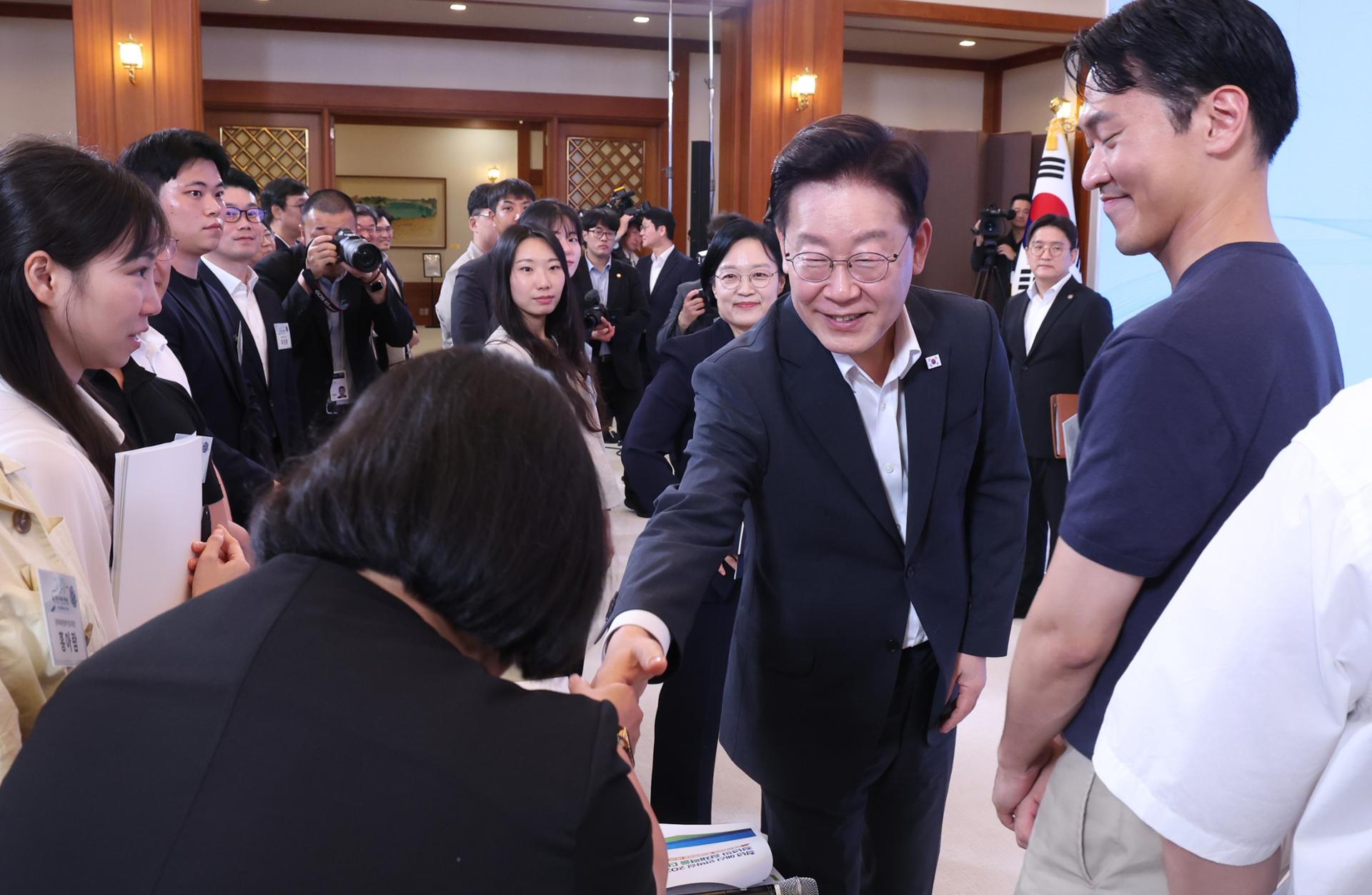
Lee administration must address livelihood and policy confusion in his second year in office
President Lee Jae Myung, whose approval ratings stayed in the high 60 percent range for much of his first year in office after his June 2025 snap election win, is now watching those numbers slide. The decline has come faster than expected, an indication that public discontent is growing with an administration that began on a high note following the impeachment of former President Yoon Suk Yeol.
A Gallup Korea poll released Friday showed that approval of Lee's handling of state affairs has fallen to 42 percent, while 50 percent assessed his performance negatively — the lowest approval rating the president has recorded in a Gallup poll to date.
An earlier Realmeter survey, commissioned by Energy Economic News and released on Aug. 24, put Lee's approval rating at 40.2 percent, with 56.9 percent viewing his administrative affairs negatively. A third survey, commissioned by The Straight News and conducted by Jowon C&I, placed the president's approval rating even lower, at 38.9 percent. The consistent direction across three separate pollsters suggests the downtrend reflects a real shift in public sentiment rather than an outlier result.
A second-year drop in approval is not unusual, as the optimism of a new administration's first year gives way to public demands for tangible results. Korean presidencies have repeatedly seen early honeymoons fade as livelihood pressures reassert themselves in voters' priorities. The irony is that dissatisfaction with the president appears to run deeper because the goodwill he initially enjoyed — a combination of Lee's political style and the moral authority that followed Yoon's December 2024 martial law declaration — now seems to be fading.
Since taking office, Lee has vowed, among other things, to catapult Korea into the ranks of the world's top three AI powers, pursue pragmatic national interests, and promote balanced regional growth as part of his vision for a government that serves the people. His handling of U.S. tariffs, along with the sharp rise in Korean stocks following efforts to address the so-called "Korea discount," appeared to reinforce the view that the president's confidence and moral authority were well-founded.
What followed, however — a DPK leadership race that overshadowed livelihood policies, the lackluster performance of the once-hot market, and a housing policy that was more about raising taxes than delivering stable housing — left a bitter impression with constituents. As Myongji University professor Shin Yul recently told this newspaper, Korean people are putting their "personal interests ahead of their political beliefs."
The administration's recent policy moves have also raised questions about its ability to implement major reforms effectively. Its prosecutorial reform, which will give investigative authority to the police, has come under scrutiny amid a series of scandals involving police investigations into the murder of a Gwangju schoolgirl and missing persons cases on Jeju Island. The push to strip prosecutors of investigative powers is a long-standing progressive reform goal in Korea, but the controversies have handed critics ammunition at an awkward moment.
Lee also rejected Supreme Court Justice Cho Hee-dae's nominee to fill a vacant seat on the court, saying Cho did not follow due process in making the recommendation. Separately, the Ministry of Health and Welfare on Thursday abruptly delayed the announcement of the National Pension reform, prompting further scrutiny; the pension overhaul is widely viewed as one of the most consequential fiscal decisions facing Korea given its rapidly aging population. On the foreign affairs and security front, U.S. President Donald Trump's sudden decision to scale back joint Korea-U.S. military exercises raised questions about the state of the alliance and prompted uneasiness about Korea's military readiness.
To be fair, no administration can be effective all the time, and it is still early days for the Lee government. Public sentiment can also shift like a reed in the wind. But initial broad support for a new administration is no guarantee of blind forgiveness — especially when the issues hitting closest to home concern livelihoods and affordability, and when the administration appears more intent on pursuing politically driven reforms than addressing tangible concerns.
New DPK leader Kim Min-seok has stressed that the party will work to support the success of the Lee administration. To that end, he has pledged to turn the DPK into a party focused on affordability, a broader support base, and political competence. The ruling bloc is surely aware of the challenges ahead, but as always, recognizing what needs to be done is easier than delivering results. Bridging that gap may be among the toughest challenges facing the Lee administration.
The president's reshuffle of six Cabinet members on Sunday may be a real step toward tackling livelihood issues and policy confusion. He and the new Cabinet members should now prove that their policy goals will not become vulnerable to partisan interests and the administration's political orientation.
Source: The Korea Times
