DoorDash Faces Congressional Probe Over Use of Chinese AI Model Kimi K2.6
Key Takeaways
- •House Select Committee on China Chairman John Moolenaar and Homeland Security Committee Chairman Andrew Garbarino sent a letter to DoorDash requesting information about its evaluation and deployment of Chinese-developed AI models.
- •The inquiry was triggered by a DoorDash founder's public post describing the use of Kimi K2.6, a model built by Beijing-based Moonshot AI, for lower-level AI tasks.
- •Lawmakers acknowledged that American firms turn to Chinese open-weight models because they offer competitive capabilities, lower costs, and greater customization compared to proprietary U.S. providers.
- •The committees are investigating whether Chinese models may have been developed through unauthorized distillation of leading American AI systems and whether open-weight designs pose cybersecurity risks.
- •The DoorDash probe is one of several concurrent efforts across the executive and legislative branches examining Chinese AI adoption, as Washington remains divided over whether to restrict open-weight models.
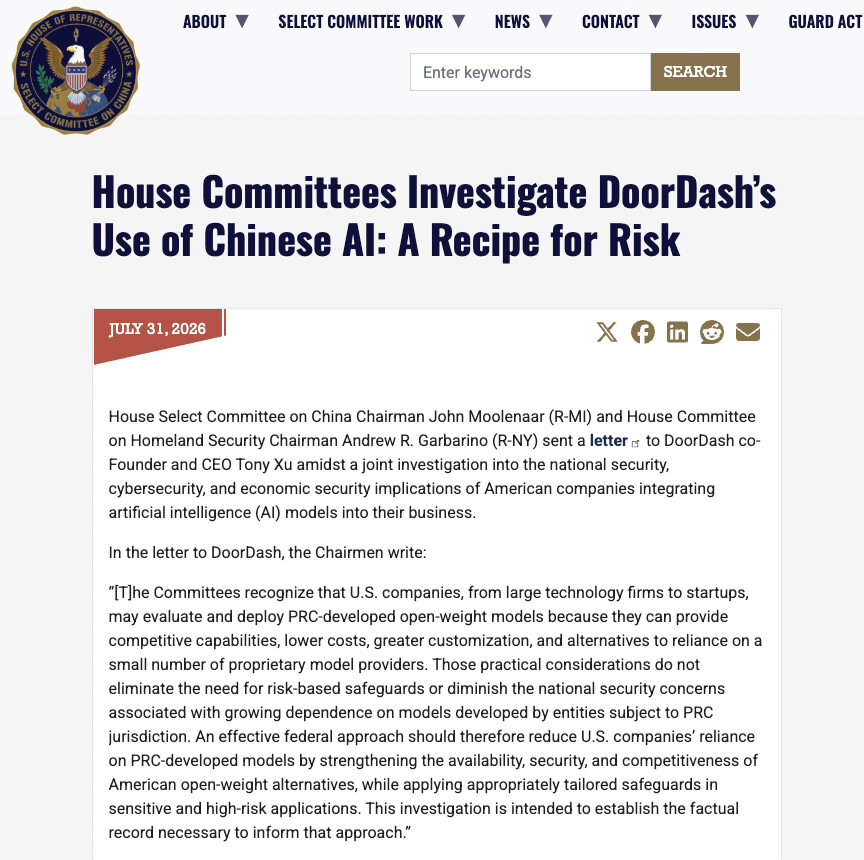
House Select Committee on China Chairman John Moolenaar and Homeland Security Committee Chairman Andrew Garbarino have sent a letter to DoorDash co-founder and CEO Tony Xu requesting information and documents regarding how the company evaluates and deploys Chinese-developed AI. The probe reflects intensifying congressional scrutiny of how Chinese AI systems are entering U.S. commercial pipelines at a time when Washington is already restricting advanced chip exports to China and weighing broader limits on Chinese software.
The inquiry stems from an X post by DoorDash founder Andy Fang describing the delegation of lower-level AI tasks to Kimi K2.6, a model built by Beijing-based Moonshot AI, according to CNBC. Moonshot AI, founded in 2023 and one of China's most heavily funded AI startups, has positioned its Kimi model family as a competitor to leading Western systems.
DoorDash is not accused of violating any law. U.S. companies are free to operate Chinese AI models, though federal agencies have prohibited certain systems, including DeepSeek, on government devices. The gap between federal restrictions and the absence of equivalent rules for private-sector adoption is one the committees may seek to narrow through legislation or oversight hearings.
A DoorDash spokesperson stated the company "proudly supports American AI leadership" and looks forward to engaging with the committees.
Lawmakers Cite U.S. Model Pricing as a Contributing Factor
The chairmen acknowledged the business rationale in their own letter. American firms may deploy Chinese open-weight models because they deliver "competitive capabilities, lower costs, greater customization" and provide an alternative to relying on a small number of proprietary providers, the letter states.
However, the chairmen wrote, those considerations do not eliminate the need for risk-based safeguards.
The committees assert that "U.S. policies need to ensure that open-weight designs offered by the U.S. become more accessible, safer, and competitive for businesses to discourage them from using Chinese options."
The central argument: American businesses and cybersecurity professionals should not have to choose between expensive or restrictive U.S. options — namely those from Anthropic and OpenAI — and cheaper Chinese alternatives.
Open-Weight Chinese Models Raise Security Concerns
The committees highlighted a specific concern: open-weight models can be downloaded, modified, and deployed by virtually anyone because their core model weights are publicly available. According to the committees, these models lack guardrails against bad actors injecting malicious code or launching attacks on other AI systems.
That portability has enabled Chinese-origin models to reach American enterprise environments, including through cloud services offered by Amazon, Microsoft, and Google. The committees are examining where the models were trained, whether their capabilities were derived from unauthorized distillation of leading U.S. systems — a technique in which a model is trained on outputs from another developer's model without permission — and how they have spread domestically.
As previously reported by Cryptopolitan, White House science director Michael Kratsios accused Moonshot of covertly distilling Anthropic's Fable to develop Kimi K3, based on an Anthropic report revealing more than 3.4 million Claude conversations conducted through fake accounts.
DoorDash Benchmark Also Highlights U.S. Model Gains
DoorDash's own data helps explain the appeal. The company's AI research lab posted on X that both Kimi K2.6 and Anthropic's Fable 5 outperformed the Anthropic models DoorDash had previously been running, at a lower cost. The committees cited only the Kimi result. The same benchmark showed an American frontier model beating its predecessor on both price and capability — precisely the outcome the letter's supply-side argument calls for.
Washington Remains Divided on Open AI Rules
On July 24, Nvidia CEO Jensen Huang used his first post on X to share an open letter signed by Nvidia, Microsoft, Dell, and Palantir, arguing that open-weight models strengthen safety, cybersecurity, and sovereignty.
The Little Tech Association — comprising roughly 200 startups including Y Combinator and Proton — along with investors Bill Gurley and Ben Horowitz, has argued that restricting the category would primarily entrench Anthropic and OpenAI.
The Trump administration has separately weighed barring U.S. companies from running advanced Chinese open-source models. Treasury Secretary Scott Bessent said on July 21 that the U.S. could sanction China over AI model theft. The DoorDash inquiry is one of several concurrent efforts across the executive and legislative branches examining how Chinese AI models are being adopted inside U.S. companies.

