Landstar says it could benefit in post-Montgomery environment
Key Takeaways
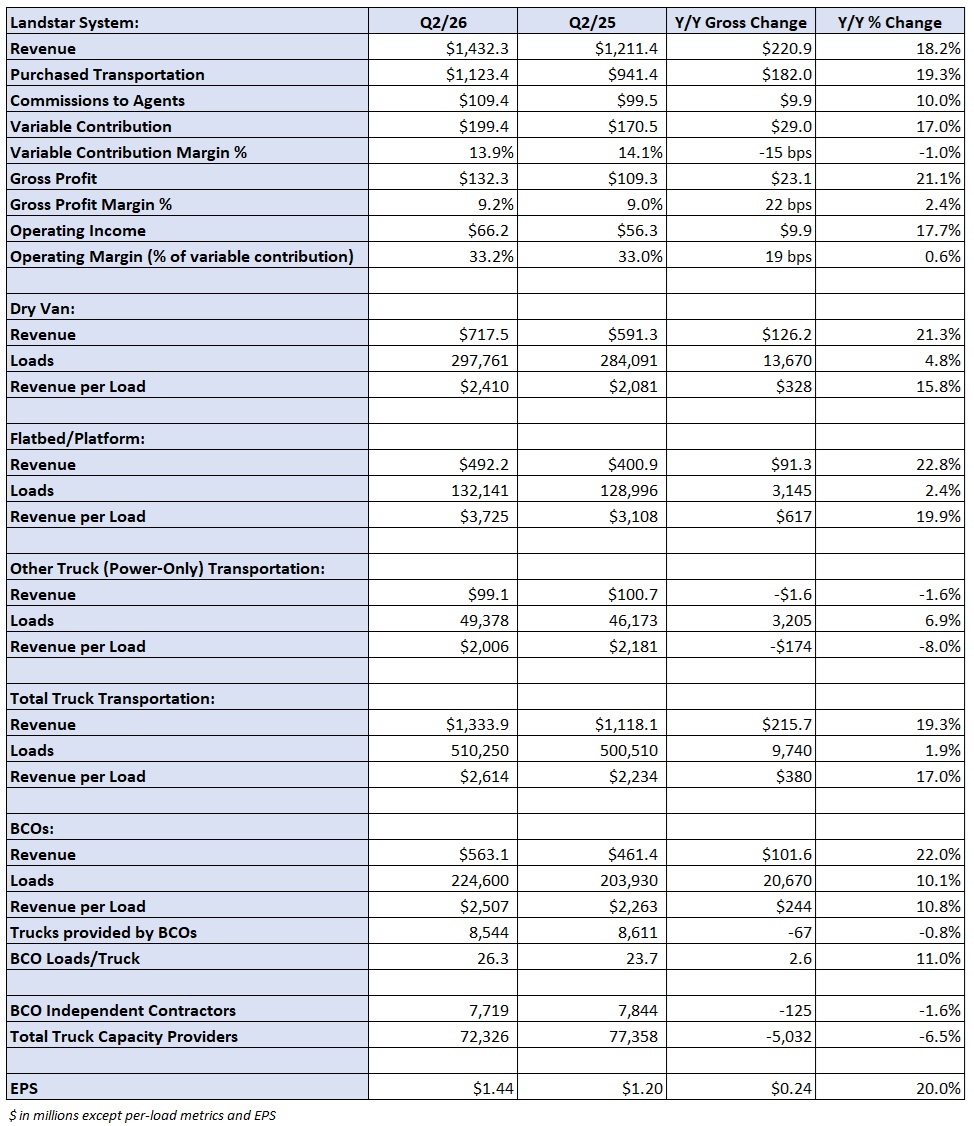
- •BCO revenue rose 22% year over year to $563 million, helped by more loads and higher revenue per load.
- •Landstar’s BCO truck count increased to 8,544, the largest quarterly gain since the first quarter of 2022.
- •Second-quarter EPS was $1.44, which was above last year but 4 cents below consensus, while revenue increased 18% to $1.43 billion and beat estimates.
- •The company said unfavorable prior-year claims developments reduced earnings by 23 cents per share.
- •Landstar said its insurance renewal was favorable, with the auto liability tower unchanged and the broker liability policy up 3%.
Freight broker Landstar System said Tuesday that its larger scale and long safety record may become more appealing to shippers in a post-Montgomery environment. The company also reported a more notable operational improvement in the second quarter, although its results still came in below Wall Street expectations.
Revenue generated by Landstar’s (NASDAQ: LSTR) business capacity owners (BCOs) rose 22% year over year to $563 million, supported by a 10% increase in loads and an 11% increase in revenue per load. BCOs are owner-operators who haul almost exclusively for Landstar. Changes in this segment of capacity have historically been viewed as an early signal for broader truckload market trends, which makes the latest gains notable for an industry still watching how broker liability and shipper carrier-selection standards evolve.
The number of trucks provided by BCOs increased by 68 sequentially to 8,544 units in the second quarter, the largest quarterly increase since the first quarter of 2022. The tractor count has risen by another 49 units so far in July. BCO turnover improved 310 basis points year over year to 28.3%, while utilization increased 12% year over year.
BCO revenue per mile, Landstar’s preferred truckload pricing metric because it excludes fluctuations in diesel fuel prices, increased 11% year over year overall and rose 10% year over year for dry van and flatbed shipments.
Management said it sees this part of the capacity market potentially growing faster after the Supreme Court’s Montgomery v. Caribe Transport II ruling, which widened liability exposure for freight brokers found negligent in their driver hiring practices. The company also said it is having success attracting smaller brokers that want to work with partners offering stronger technology, vetting processes and insurance programs. That shift is relevant because broker liability and insurance requirements can affect which carriers and intermediaries shippers are willing to use, especially when compliance and claims history are part of the selection process.
Landstar recently signed a Midwest broker to become a Landstar agent. The broker generates about $18 million in annual revenue, significantly more than most new Landstar agents, which typically produce less than $5 million in revenue.
The company has also reduced its approved carrier list from more than 100,000 in 2022 to 64,600 in the most recent quarter. Landstar said the effort initially began as a way to combat cargo theft. Its approved truck brokerage carrier list was down another 7% year over year in the second quarter after declining 19% in the first quarter.
Q2 EPS miss explained
Landstar reported second-quarter earnings per share of $1.44, up 24 cents from a year earlier but 4 cents below the consensus estimate. Consolidated revenue rose 18% year over year to $1.43 billion, topping the $1.34 billion consensus estimate.
The company said $10.5 million, or 23 cents per share, in unfavorable developments on prior-year claims weighed on second-quarter EPS. In addition, Yahoo Finance data showed that the consensus EPS estimate rose from $1.35 to $1.48 over the 90 days before the report, as analysts lifted forecasts for carriers and brokers while truckload spot market conditions firmed during the quarter.
Total truck revenue increased 19% year over year to $1.33 billion, driven by a 2% increase in loads and a 17% jump in revenue per load. Higher diesel fuel prices and stronger truckload rates drove the yield increase. Management said both truck volumes and revenue per load exceeded normal seasonal patterns in the quarter.
The company said it typically sees little sequential change in truck revenue from the second to the third quarter, but July truck loads and yields are both above normal seasonal trends, with loads up 5% year over year and yields up 26% year over year.
In the second quarter, dry van loads rose 5% year over year and revenue per load increased 16%. Flatbed loads grew 2%, while yield increased 20%.
Variable contribution, or net revenue, increased 17% year over year to $199 million. The figure represents revenue remaining after purchased transportation expenses and agent commissions are paid. Variable contribution margin was 13.9%, down 20 basis points year over year.
Operating margin, measured as a percentage of variable contribution, improved 20 basis points year over year to 33.2%.
Insurance and claims expenses, as a percentage of BCO revenue, increased 40 basis points to 7%, even though Landstar said it experienced a lower DOT accident frequency of 0.62 reportable accidents per one million miles during the first half of 2026. The company said unfavorable developments on prior claims were the main drag.
Management said it “did quite well” in the June insurance renewal. The auto liability insurance tower renewed unchanged, and the broker liability policy rose only 3%.
Shares of LSTR fell 4.2% in after-hours trading Tuesday.
Landstar’s comments on how it is adjusting to the Supreme Court’s broker liability ruling offer a look at how parts of the industry are adapting. Still, most brokers are unlikely to secure insurance coverage on terms as favorable as those Landstar recently reported.
More FreightWaves articles by Todd Maiden:

