Landstar Cuts More Than 35,000 Carriers From Approved Network Amid Safety and Liability Focus
Key Takeaways
- •Landstar removed more than 35,000 carriers from its approved network over four years, reducing the pool from over 100,000 in mid-2022 to approximately 64,600 by the end of Q2 2025.
- •The U.S. Supreme Court's Montgomery v. Caribe Transport II ruling overturned decades of precedent that had shielded freight brokers from negligent selection claims, heightening industry concerns about carrier vetting practices.
- •Landstar reported approximately $10.5 million in unfavorable prior-year claims adjustments during the second quarter, with three of the five claims driving that adjustment tied to truck brokerage operations.
- •The company's total truck revenue grew 19% year over year to $1.33 billion in Q2 as truckload capacity tightened and market conditions shifted in favor of transportation providers.
- •Landstar's broker liability insurance costs increased approximately 3% at its June 1 renewal following the Supreme Court decision, while auto liability coverage remained effectively flat.
Landstar System has dramatically reduced the number of motor carriers approved to haul its brokered freight, cutting its carrier pool by approximately 35% over the past four years — a reduction that coincides with a documented surge in freight fraud and cargo theft across the trucking industry, including double brokering and carrier identity theft schemes that have cost brokers and shippers tens of millions annually.
Matt Miller, Landstar's vice president and chief safety and operations officer, disclosed the reduction during the Jacksonville, Florida-based company's second-quarter earnings call on July 28.
"Over more than 20 years in brokerage, we've always looked for ways to enhance our carrier vetting with people, process, technology, and information," Miller said. "Over the past four years, we've gone from over 100,000 approved carriers in the second quarter of 2022 to just over 64,000 at the end of the second quarter or a 35% reduction."
Landstar officials said the goal of the reduction was to sharpen the company's focus on safety, security, and service. The cuts represent more than 35,000 carriers removed from Landstar's approved network since mid-2022.
Commercial Carrier Journal first highlighted the scale of the reduction. Overdrive, a sister publication of CCJ, reported that Landstar's effort initially targeted cargo theft and freight fraud, with the company deploying enhanced vetting technology, identity checks, and stricter compliance measures.
Jacksonville, Florida-based Landstar (Nasdaq: LSTR) is a major asset-light transportation logistics company operating through a network of independent freight agents and third-party capacity providers.
Landstar's approved carrier pool stood at approximately 64,600 at the end of the second quarter, down another 7% year over year after declining 19% in the first quarter, according to previous FreightWaves reporting.
Miller indicated that the company has no intention of easing its scrutiny of carriers.
"As new technologies and information become available, we're going to continue to do just that, exactly what we've been doing," Miller said. "We're always looking for opportunities to drive safety, security, and service."
Carrier Vetting Takes on Greater Significance After Montgomery
Landstar's multiyear carrier reduction carries additional weight following the U.S. Supreme Court's May ruling in Montgomery v. Caribe Transport II, which widened the potential liability exposure facing freight brokers over the selection of motor carriers.
The ruling overturned decades of precedent under which brokers had largely been shielded from negligent selection claims by federal preemption doctrine. The decision has heightened concerns across the brokerage industry about how companies select and monitor carriers, potentially increasing the importance of documented vetting procedures.
Landstar CEO Frank Lonegro said during the earnings call that the company believes federal regulators need to provide clearer standards for the industry. The Federal Motor Carrier Safety Administration, which oversees motor carrier safety regulations, has not issued specific carrier-vetting mandates for brokers, leaving individual companies to establish their own qualification protocols.
"We believe greater Federal clarity around carrier vetting and selection standards would help support a more predictable operations, insurance, and claims environment for truck brokers, carriers, and shippers," Lonegro said.
Landstar reported approximately $10.5 million in unfavorable adjustments to prior-year claims during the second quarter. Three of the five claims responsible for nearly all of that adjustment involved truck brokerage operations.
The company has also said its scale, safety record, technology, and insurance programs could become competitive advantages following Montgomery. Landstar recently signed an $18 million Midwest freight broker as an independent agent, and Lonegro said inquiries from prospective agents have accelerated since the Supreme Court decision was released in mid-May.
Landstar CFO Jim Todd said the decision means broker liability cases that previously may have been dismissed on federal preemption grounds could now have to be litigated.
"I think there's certainly going to be some element of plaintiffs being more emboldened to pursue these cases," Todd said during the Q2 earnings call.
Landstar nevertheless reported a relatively favorable insurance renewal after the Montgomery decision. Its auto liability coverage was effectively flat at its June 1 renewal, while broker liability costs increased about 3%, according to Miller.
Fewer Carriers Enter a Tightening Freight Market
The removal of tens of thousands of carriers from Landstar's approved pool also comes as the truckload market shows signs of tightening.
Lonegro said truck capacity "tightened significantly" during the second quarter and that conditions that had favored shippers since late 2022 were "shifting rather rapidly in favor of the transportation provider."
Landstar's total truck revenue increased 19% year over year to $1.33 billion during the second quarter, while loads increased approximately 2% and revenue per load jumped 17%.
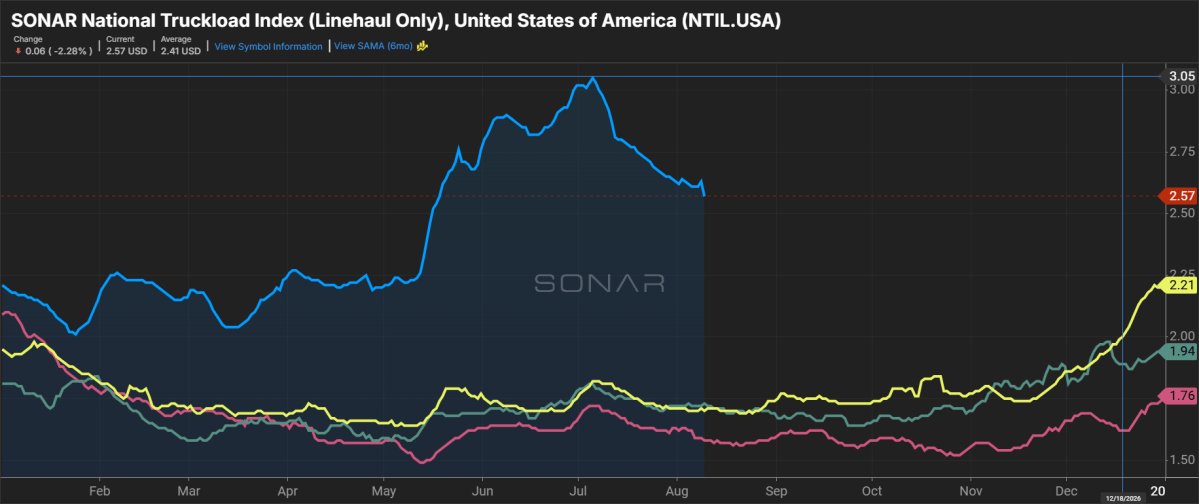
National dry van spot rates — tracked via the SONAR National Truckload Index (linehaul only – NTIL.USA) — showed a seven-day moving average of linehaul spot rates excluding fuel. As of Monday, rates remained significantly higher on a year-over-year comparison from February through August.
Landstar's decision to eliminate roughly one-third of its approved carrier network illustrates how safety, fraud, and liability concerns are reshaping broker-carrier relationships — and the Montgomery ruling could accelerate the pressure on brokers to become even more selective about which trucking companies haul their customers' freight.

