Berlin-Based Nigerian Developer Turns Lagos Traffic Into Viral Browser 'Lagos Run'
Key Takeaways
- •Lagos Run attracted more than 20,000 players within two days of its public release according to its creator.
- •Developer Opeyemi Adeniran, a Berlin-based senior frontend engineer, conceived the game after moving to Germany, modeling it on the Ojuelegba area of Lagos where he grew up.
- •The game was built in approximately four to five weeks, with AI-generated graphics and Anthropic's Claude assistant helping accelerate the process.
- •Lagos Run requires no login, sign-up, or payment, spreading solely through shared links, with players providing only a non-identifying username for the leaderboard.
- •Nigeria's gaming revenue is forecast to reach $226.6 million in 2026, and Adeniran argues AI tools could help developers turn more ideas into games, potentially encouraging investor interest.
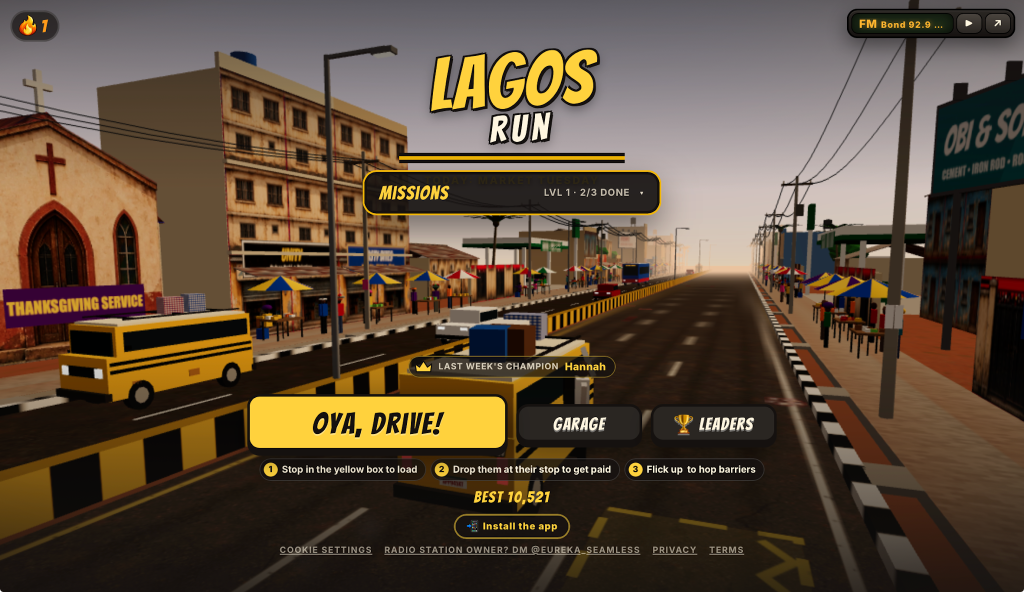
Swipe left to dodge the car ahead. Swipe right to swerve around a heap of tyres blocking the road. Hit the brake as you approach the yellow-lined bus stop — passengers tumble out, new ones climb in, and you hit the gas to keep going. When a 3D figure carrying a tray steps into the road, you hit the horn and the familiar pom-pom-pom rings out.
That is Lagos Run, a browser-based endless runner that has taken over Nigerian social media timelines over the past two days. Built by Opeyemi Adeniran, a Berlin-based senior frontend engineer who posts on X as Eureka, the game has drawn more than 20,000 players within two days of its public release, according to him.
Like most endless runners — a format popularised globally by mobile hits such as Temple Run and Subway Surfers — the rules are simple. Players use swipe gestures to steer a danfo — the yellow, black-lined public bus particular to Lagos, Nigeria's most populous city, and a fixture of the city's daily commutes — collecting coins and boosters along the way. They must pull over at bus stops to drop off and pick up passengers, dodge other vehicles and pedestrians crossing the road, swerve around roadblocks, and navigate the traffic without crashing.
There are road signs, missions and levels to complete, a leaderboard to compete on, and a radio playing in the background. The result is a digital Lagos, rooted in Ojuelegba, the Surulere suburb where Adeniran grew up and one of Lagos's busiest bus interchanges.
Bringing Lagos to Berlin
Speaking to TechCabal in an interview on Tuesday, Adeniran said he spent much of his early life around Lagos, where he developed an interest in games. He still plays regularly, with Call of Duty Warzone, FIFA and mobile titles such as Candy Crush in his rotation.
"I play games almost every day of my life," he said.
He recalled first encountering game development at the beginning of his career as a frontend engineer in 2017. Since then, he has experimented with different tools, including Unity, the game development software, while exploring ways to build games on the web.
The idea for Lagos Run came after he moved to Germany, and it began partly as an exploration of what was possible with game development.
I missed home. I needed to go home, so I asked, 'Why don't I bring home to myself?'," he said. "It all started as a side project, but at the moment I see a big picture around it."
Reaching the version now being played by thousands took several attempts, according to Adeniran. The first build offered a flatter, two-dimensional visual experience, unlike the current 3D one. The radio feature was not part of the original plan, he said; it emerged from an attempt to recreate the familiar experience of riding in a danfo inside a virtual Lagos.
"When you are in danfo, you usually hear these guys playing radios…," he said. "So, why don't we bring the same experience you get when inside danfo into the game as well?"
From the first line of code to the versions now on players' screens, Adeniran estimates the build took about four to five weeks.
Lagos Run currently requires no login or sign-up, and because it runs entirely in the browser, a shared link is the only entry point — a setup that matches how the game is spreading, as players pass it around social media alongside their scores. The only information players provide is a non-identifying username for the leaderboard. The game has no paywalls, though Adeniran noted that it has commercial potential.
AI made the build faster
Adeniran told TechCabal that he used artificial intelligence, which has become common in software development. A 2025 study by Game Oracle, a market research platform for indie game developers, found that 20.9% of the 16,554 games released between January 2025 and November 2025 included an AI disclosure statement identifying where and how generative AI tools were used in development. Adeniran said he used AI-generated graphics for the game's visual assets and Claude, Anthropic's AI assistant, during development.
"If I were to create this game four, five years ago, it would have taken me months," he said, "but with AI, anyone could spin up something to work on."
That faster development cycle could matter for Nigeria's growing gaming industry. Nigeria's gaming revenue is forecast to reach $226.6 million in 2026, and mobile gaming accounts for the largest share of Africa's gaming market. Adeniran argued that AI could help close the gap between the number of ideas developers have and the number of games they can build.
"If we have more people creating stuff and more people testing it out for us and giving us feedback, it would encourage investors to come in and put in some money," he said.
Lagos Run already offers a small test of that audience. Players on social media began sharing their scores online, challenging friends and comparing themselves on the leaderboard. Some have also suggested new features, prompting Adeniran to set up a WhatsApp channel where players can contribute ideas.
"This is my first time playing a Nigerian-made game," said Ola Lateef, a player who scored over 800,000 points in Lagos Run. "It was new, funny, and had a variety of music on the radio. Trending songs, to be specific. I mean, it was very different and enjoyable."
The attention has also given Adeniran ideas for what could come next. He said he has more games in mind, all rooted in what it feels like to live in Lagos and what people experience there. For Lagos Run itself, the plan is to keep iterating: he is working through bug fixes, new features and possible collaborations, while taking suggestions from the WhatsApp channel he set up for players.
"When I created the project, it was intended as a side project and for me to see what's possible around this game development, around this idea I have," he said. "I feel grateful for the love Nigerians have for helping their people."

