Reducing Employment Growth
Key Takeaways
- •About 350,000 Temporary Protected Status recipients from Haiti and other countries are set to lose their work permits in the first wave of effects from the Supreme Court ruling.
- •Roughly 190,000 Salvadoran beneficiaries could lose their status when it expires in September.
- •Alexander Arnon of the Penn Wharton Budget Model said the loss of workers could be a major hit for specific places and industries.
- •The article argues that slower labor force growth, not just weak demand, may be shaping recent employment trends.
- •Health care and social services, along with construction, are identified as the sectors most likely to be affected by the migrant crackdown.
One explanation for the “new normal” in employment growth is not weak aggregate demand, but slower labor force growth. The New York Times article “Employers Fear Labor Shortage as Many Immigrants Lose Protected Status” describes the issue:
… on Monday, about 350,000 T.P.S. recipients from Haiti and several other countries will lose their work permits in the first wave of fallout from the Supreme Court ruling. About 190,000 Salvadoran beneficiaries could be next to lose their status when it expires in September. “For particular places and particular industries, tens of thousands of workers no longer able to legally work is going to be a very big hit,” said Alexander Arnon, the director of policy analysis at the Penn Wharton Budget Model, a nonpartisan research organization that has analyzed the economic impacts of T.P.S. workers.
The NYT report said that about 350,000 T.P.S. recipients from Haiti and several other countries will lose their work permits on Monday in the first wave of fallout from the Supreme Court ruling. It also said about 190,000 Salvadoran beneficiaries could lose their status when it expires in September.
Alexander Arnon, director of policy analysis at the Penn Wharton Budget Model, said, “For particular places and particular industries, tens of thousands of workers no longer able to legally work is going to be a very big hit.” The Penn Wharton Budget Model is a nonpartisan research organization that has analyzed the economic impacts of T.P.S. workers.
That context matters because employment growth is being shaped not only by business demand for workers, but also by how many people can legally stay in the labor force. In sectors with persistent hiring needs, even modest reductions in available workers can show up in the payroll data more quickly than in broader measures of activity.
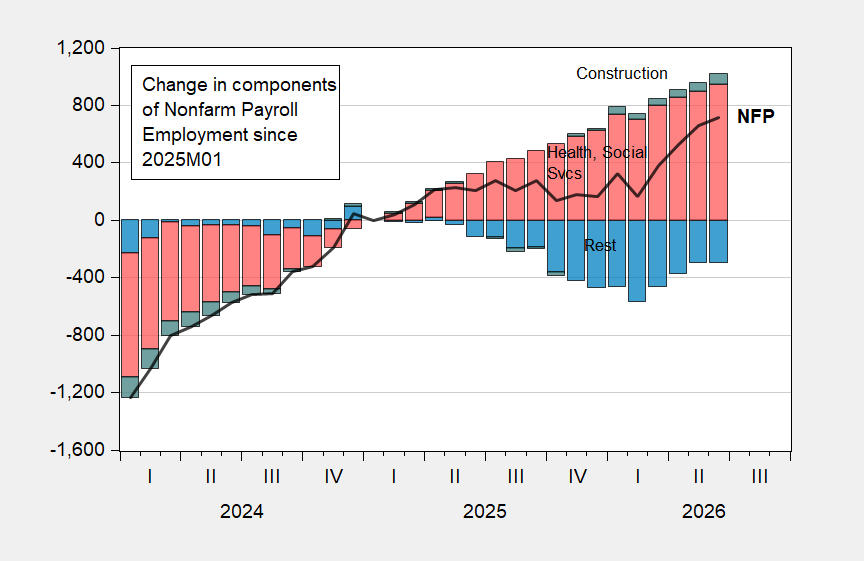
This comes on top of the administration’s crackdown on migrants. The sectors most affected by these measures would be health care and social services, as well as construction. Health care and social services have been a major contributor to employment growth over the past year.
The accompanying figure shows the change since 2025M01 in total nonfarm payroll employment, health care and social services employment, construction, and the rest of nonfarm payroll employment, all in thousands and seasonally adjusted. Source: BLS and the author’s calculations.

