Self-Employed Workers, Part-Time Workers, and Multiple Jobholders Offer a Broader View of the Labor Market
Key Takeaways
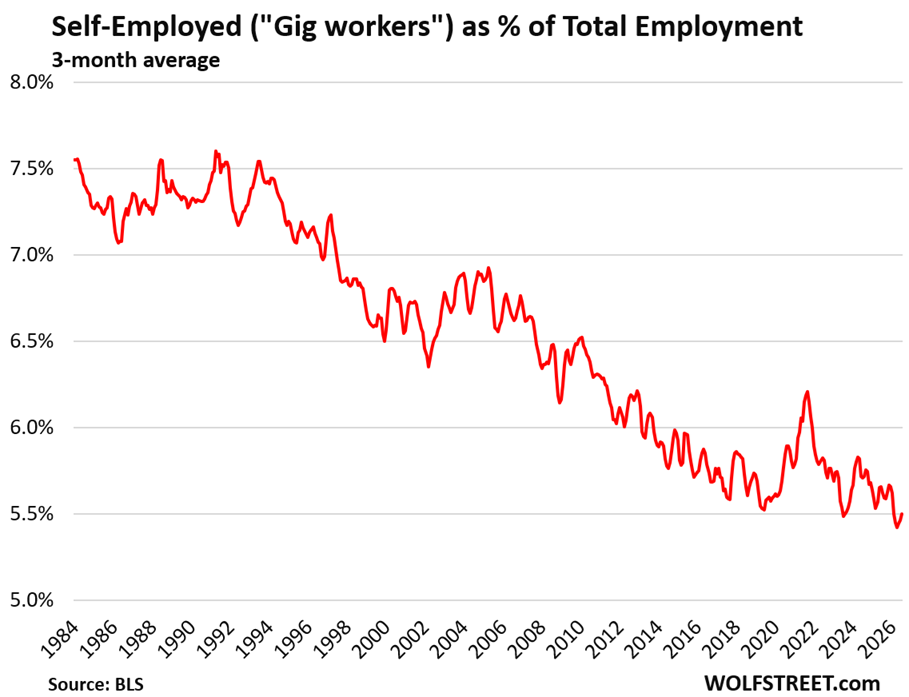
- •Self-employed non-agricultural workers edged up to 9.07 million in July, representing 5.6% of total employment and remaining at a historically low share.
- •The number of Americans working part-time for economic reasons rose to 4.8 million in July, equal to 3.0% of total employment, which is above the 2.5% level typically seen during hot labor markets.
- •Multiple jobholders totaled 8.58 million in July on a non-seasonally-adjusted basis, the lowest figure since late 2024 and sitting in the middle of the 40-year historical range.
- •Among multiple jobholders, 55% held a full-time job alongside a part-time job, while 25% held two part-time jobs and 5.5% held two full-time positions.
- •The Federal Reserve has historically cited part-time employment for economic reasons as one of the indicators used to assess whether labor market slack is tightening or loosening.
Looking at them in the context of the rest of the labor market.
These three categories of workers can help illuminate the complexity of the labor market in the context of today's employment report from the Bureau of Labor Statistics (discussion here ).
While the headline payroll and unemployment numbers dominate coverage each month, these underlying categories — drawn from the BLS Household Survey — offer a granular view of how Americans are actually engaged with the workforce, capturing arrangements that the separate Establishment Survey of payrolls does not fully reflect.
Self-employment remains at a historically low share of total employment. The number of self-employed non-agricultural, non-incorporated workers — including "gig workers" — edged up to 9.07 million in July, equal to 5.6% of total employment, a historically low share. The charts below show three-month averages to smooth out monthly fluctuations.
The self-employed include everyone from professionals who have gone out on their own to be their own boss to rideshare drivers.
Part-time employment is defined as working up to 34 hours per week, so the upper end of part-time is not far from full time, which begins at 35 hours or more.
There were 28.76 million people working part time in July, accounting for 17.7% of total employment.
Part-time workers fall into two categories:
For "noneconomic reasons." This is part-time work that fits a worker's circumstances, such as childcare problems, family or personal obligations, school or training, staying connected in retirement, Social Security limits on earnings, and other reasons.
There were 22.8 million people in July working part time for noneconomic reasons. This figure does not really indicate labor market conditions.
For "economic reasons." These workers want to work more hours but cannot find a full-time job, or their full-time hours were reduced to 34 hours or less.
Part-time employment for economic reasons is driven by labor market conditions and provides additional insight into those conditions, so it is a measure worth watching. This metric is one of the indicators the Federal Reserve has historically cited when assessing whether labor market slack is tightening or loosening.
The number of people working part time for economic reasons rose to 4.8 million in July, equal to 3.0% of total employment.
That 3.0% share is historically low, but there have been periods when it was lower: during the Dotcom Bubble; briefly in 2006; from mid-2019 to January 2020; and then again since the labor shortages that began in late 2021, except for a couple of months late last year.
In a hot labor market, this share would be expected to fall into the 2.5% range, where it stood in prior hot labor markets, including the late-1990s Dotcom Bubble period and the labor-shortage period of 2021-2022.
Multiple jobholders are defined as people holding two or more jobs during the survey reference week, with at least one of those jobs being a wage and salary job. This category also includes unpaid family workers — people who work without pay on a family farm or business for one job — if they also hold a wage and salary job.
Multiple jobholders cover a wide range of situations. For example, about 15 million single-family rental properties are owned by mom-and-pop landlords with one to 10 properties. Among the millions of owners who manage their own rentals and also have a wage and salary job, many count as multiple jobholders. A person working for a tech company on salary and stock options, while also consulting or coding part time, is a multiple jobholder. So is a teacher who drives for Uber, a salaried engineer who also works unpaid at a family business or farm, or a grocery store cashier who waits tables in the evening.
Multiple jobholders are not automatically a sign of economic distress, low pay, or difficulty making ends meet, although some do fall into those categories. More broadly, the data reflect the dynamic complexity of people's lives and interests, the American spirit of working, and the ability to build multiple income streams.
There were 8.58 million multiple jobholders in July, not seasonally adjusted, equal to 5.3% of total employment.
That level is the lowest since late 2024 and sits in the middle of the 40-year historical range.
Of those multiple jobholders:
- 55% had a full-time job and a part-time job.
- 25% had two part-time jobs and no full-time job.
- 5.5% had two full-time jobs.
- 13% had varying hours in either job.
Enjoy reading WOLF STREET and want to support it? You can donate. I appreciate it immensely. Click on the mug to find out how:
