Hyperliquid US Launch Brings HIP-3 Markets to American Traders via Payward
Key Takeaways
- •The proposed US offering would cover selected HIP-3 perpetual markets, not Hyperliquid’s entire offshore exchange.
- •Payward would manage the US-facing customer relationship, including onboarding, jurisdictional restrictions, disclosures, and leveraged-product controls.
- •HIP-3 deployers set market parameters such as oracle rules, leverage limits, margining, order books, and settlement conditions.
- •Hyperliquid reported approximately $9 billion in average open interest in the second quarter of 2026.
- •The timing and scope of access remain undetermined pending details on registrations, state coverage, market selection, and operating controls.
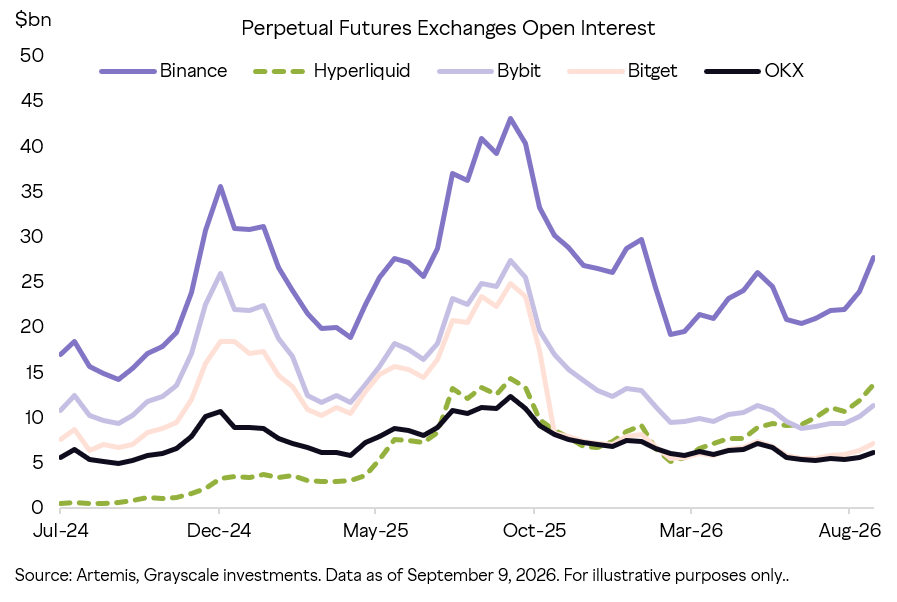
Payward, the parent company of US cryptocurrency exchange Kraken, has outlined plans to bring a selection of Hyper's HIP-3 perpetual futures markets to traders in the United States through a permissioned structure. According to Grayscale research, Hyperliquid, a 24/7 perpetual futures exchange, averaged roughly $9 billion in open interest during the second quarter of 2026, and the platform has continued to expand even as its offshore model limits access for US customers.
The proposal would create a permissioned route for selected Hyperliquid perpetuals, connecting a US-facing operator with Hyperliquid's builder-deployed framework and giving eligible American customers access to a defined subset of markets rather than the full offshore venue. Perpetual futures are derivative contracts without a fixed expiration date, an instrument category that has developed largely on offshore venues and remains difficult for US customers to reach directly. The proposal does not confirm a launch date or approvals in every state, and it also serves as a test of US market infrastructure. Actual access will depend on product design, registrations, and market controls.
Hyperliquid US Expansion Takes Shape Through Payward
Grayscale identified Payward as the company behind the proposed US channel. Payward, which has expanded its derivatives and infrastructure operations, would connect its corporate platform with Hyperliquid's onchain order books.
The expansion targets HIP-3 markets rather than the entire offshore exchange. Hyperliquid's documentation describes HIP-3 as builder-deployed perpetuals: a deployer defines each market, sets the oracle rules that govern its price feeds, chooses leverage limits, and manages settlement. That design gives every perpetual venue separate margining, its own order book, and deployer-specific settings. The framework runs on the HyperCore trading stack and offers a unified API for HIP-3 assets, allowing market creators to establish contracts outside the core listing process and operate each venue with its own parameters.
For US traders, the distinction matters. A permissioned product can apply eligibility checks, market limits, and operating controls before customers access contracts, and the markets ultimately offered would depend on the final arrangement between Payward and Hyperliquid.
Hyperliquid's design does not shift compliance responsibility onto individual market deployers. The US-facing operator would still need to establish customer onboarding, restricted-jurisdiction rules, disclosures, and controls for leveraged contracts. Those requirements could shape the number and type of markets available at launch, and initial access may involve fewer US markets.
The proposed route therefore differs from direct access to the offshore platform. It would place the customer relationship, compliance process, and market interface inside a US-facing structure, a setup that could also determine how customers handle collateral, liquidations, and account restrictions.
Hyperliquid US Markets Will Follow HIP-3 Builder Rules
US access plans have grown alongside demand for perpetual futures. Grayscale said the venue averaged approximately $9 billion in open interest in Q2 2026. Open interest measures outstanding contracts rather than trading volume, but it reflects the scale of positions held across the platform. The proposed channel would connect eligible American customers to a venue already operating at that scale. The exchange operates around the clock and supports crypto, commodities, indices, foreign exchange, and real-world asset markets, products that Hyperliquid describes as onchain and non-custodial.
HIP-3 venues are distinct from the core exchange. Under the published specification, each HIP-3 deployer must stake 500,000 HYPE on mainnet and maintain that stake for at least 183 days after deployment. Validators can slash the stake if market operations create protocol risks or violate listed conditions.
The framework allows any qualifying deployer to launch one perpetual DEX. The first three asset listings do not require auction participation, while additional assets are allocated through a shared Dutch auction — in which the price descends until a participant accepts — with deployers receiving defined reserve deployments.
These rules would shape any US rollout. Payward could select markets that fit its customer and risk framework, while Hyperliquid's rules would govern oracle design, leverage, margining, and settlement. The arrangement would not make every HIP-3 market available to US customers.
The market access plan also faces regulatory and operational questions. A US launch would need to address customer eligibility, disclosures, collateral, liquidations, surveillance, and state-level restrictions. None of those details appears in the reported announcement, leaving the timing and scope of any launch undetermined.
For now, the Hyperliquid US plan signals a distribution route rather than a completed product launch. The exchange's $9 billion average open interest gives the proposal scale, HIP-3 supplies the market-building framework, and Payward's final structure will determine which perpetual contracts reach US traders. Any fuller picture of timing and scope will have to come from follow-up disclosures on registrations, state coverage, and market selection.
Source: Blockonomi

