Kraken Warns Seven Delisted Tokens May Yield Zero Proceeds Amid Low Liquidity
Key Takeaways
- •Kraken warned that selling the seven delisted tokens could yield zero proceeds due to low liquidity rather than any platform outage or wallet fault.
- •The exchange characterized zero proceeds as a possible outcome rather than a certainty, framing the notice as a caution about execution risk for those specific assets.
- •Delisting removes a token's primary trading venue, which can thin order books so severely that even small sell orders move prices sharply or find no executable bids at all.
- •Holders may still recover value if the affected tokens are listed on other centralized or decentralized exchanges, though liquidity on those platforms is not guaranteed to be better.
- •Kraken's explicit acknowledgment that proceeds could round down to zero goes beyond the typical delisting announcements issued by other major exchanges such as Binance and Coinbase.
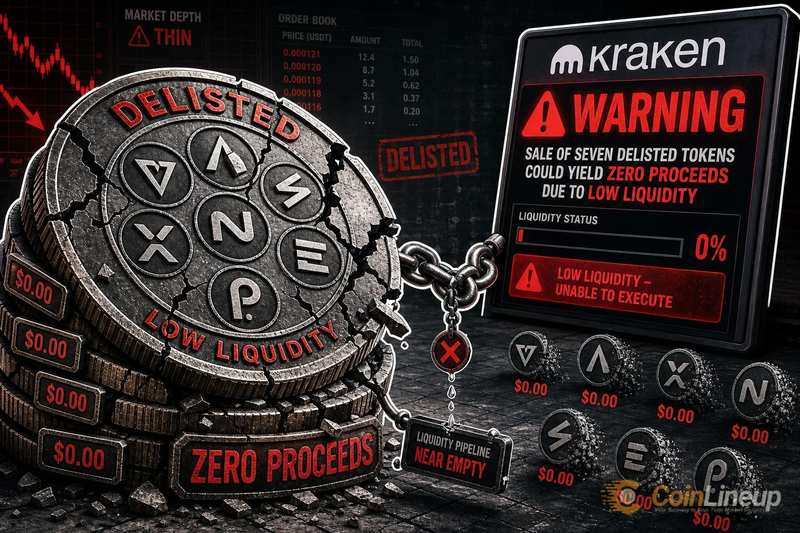
Kraken has warned that selling seven delisted tokens could yield zero proceeds due to low liquidity, meaning affected account holders may be unable to recover meaningful value from the assets once trading support ends.
Kraken's Warning on the Seven Delimited Tokens
The exchange stated that an attempt to liquidate the seven delisted tokens on behalf of users could return little or no value, citing low liquidity as the cause rather than any platform outage or wallet fault. The disclosure appeared in Kraken's scheduled delisting notice.
In this context, low liquidity means there may be too few buyers or insufficient order-book depth to execute a sale at a usable price. Under such conditions, a forced sale can clear at close to nothing.
Kraken framed zero proceeds as a possible outcome, not a guaranteed result. The warning is a caution about execution risk for these specific assets, not a statement that every holder will end up with nothing.
Periodic delistings are standard practice across major crypto exchanges. Binance, Coinbase, and other platforms routinely remove tokens that fall below trading volume thresholds, fail to meet updated listing criteria, or carry elevated compliance risk. What makes Kraken's disclosure notable is the explicit acknowledgment that proceeds could round down to zero — a level of candor that goes beyond typical delisting announcements.
Why Low Liquidity Can Leave Delisted Token Holders With Nothing
Delisting typically removes an asset's primary trading venue, shrinking the pool of active buyers and sellers. With fewer participants, price discovery weakens and exit options narrow.
Once the order book becomes thin, even a small sell order can move the price sharply against the seller. In extreme cases, there are no executable bids at all, leaving the position unsellable at any meaningful level.
Trading fees and slippage compound the problem. If the limited demand that remains sits far below the last quoted price, net proceeds after costs can effectively round down to zero — the scenario Kraken described.
This exit risk is distinct from security-driven warnings that exchanges and hardware providers sometimes issue. Here, the risk is purely about market depth after a token loses its primary venue. It also underscores a structural feature of crypto markets: unlike traditional equities, which typically have multiple regulated trading venues and market makers obligated to provide liquidity, many smaller tokens concentrate their order flow on a single exchange. When that venue disappears, no comparable alternative may exist.
What Affected Kraken Users Should Watch
The immediate task for holders is to confirm which of the seven tokens they own and what options remain once the delisting takes effect. The affected tokens are detailed in Kraken's own notice, which users should verify directly.
Users should monitor Kraken's published platform status page and service updates alongside the delisting notice for timelines and any token-specific changes to withdrawals or trading windows.
If a token remains listed on other centralized exchanges or available on decentralized exchanges, holders who withdraw before Kraken closes withdrawals may still have an exit path — though liquidity on those venues is not guaranteed to be better.
Separately, Kraken continues to expand other areas of its business, including an institutional crypto lending model with Maple and a program allowing eligible users to use tokenized stocks for leveraged crypto trades. Those developments are unrelated to the delisting and do not affect the liquidity risk on the seven tokens in question.
For holders, the practical questions center on execution: whether a sale can clear at all, whether to act before liquidity thins further, and whether withdrawing the tokens to another platform is a better option than selling into a shallow market.
Disclaimer: This article is for informational purposes only and does not constitute financial or investment advice. Cryptocurrency and digital asset markets carry significant risk. Always conduct your own research before making decisions.

