Kospi Falls Below 5,300 as Selloff Deepens for Second Straight Day
Key Takeaways
- •The Kospi fell as much as 12.63% on Wednesday to 5,262.77, after briefly trading higher at the open.
- •A circuit breaker was triggered on the benchmark for a second consecutive day, and the Kosdaq was also halted for the second straight session.
- •Retail investors sold nearly 2 trillion won of Kospi shares, while foreign investors sold a net 1 trillion won as of 2:30 p.m.
- •Semiconductor stocks led the decline, with Samsung Electronics and SK hynix both falling by double digits at one point.
- •SK hynix reported second-quarter operating profit of 60.5 trillion won, below market expectations of about 64 trillion won.
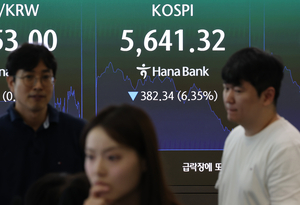
Benchmark tumbles nearly 13%, triggering circuit breaker for second straight day
South Korean stocks extended their historic selloff on Wednesday, with the Kospi plunging nearly 13 percent to below 5,300 and triggering a circuit breaker for a second straight day amid heavy selling by retail and foreign investors.
The Kospi was trading around 5,600 at 2:30 p.m., down about 7 percent, after opening 1.09 percent higher at 6,089.11.
The benchmark quickly reversed course and fell as low as 5,262.77, down 12.63 percent from the previous close. The drop pushed the index below the 5,300 level for the first time in nearly six months.
A circuit breaker was triggered on the Kospi at 12:32 p.m., marking the first time the measure had been activated for two consecutive sessions on the benchmark market.
Trading on the secondary Kosdaq market was also halted after the index fell more than 8 percent, marking the first time circuit breakers had been triggered on both markets for two consecutive sessions.
Retail and foreign investors were net sellers on the Kospi, with retail investors offloading nearly 2 trillion won ($1.38 billion) and foreign investors selling a net 1 trillion won as of 2:30 p.m. Institutional investors were net buyers of around 2.9 trillion won.
Selling was concentrated in heavyweight semiconductor stocks, with Samsung Electronics and SK hynix both falling by double digits at one point and exerting outsized pressure on the benchmark. Because those shares carry significant weight in the index, moves in the chip sector have an amplified effect on the broader market.
SK hynix extended its losses after reporting second-quarter operating profit of 60.5 trillion won, more than six times the year-earlier figure but about 5.5 percent below market expectations of roughly 64 trillion won. Its earnings did not ease concerns that valuations and investment spending across the artificial intelligence industry had outpaced near-term returns.
The renewed losses followed Tuesday's global semiconductor selloff, fueled by concerns over China's growing competitiveness in memory chips and progress in domestically produced chipmaking equipment. The strong market debut of Chinese memory chipmaker ChangXin Memory Technologies further unsettled investors in Korean chipmakers.
"Today's plunge goes well beyond what can be considered a normal market move," said Han Ji-young, an analyst at Kiwoom Securities. "The selloff appears to be driven largely by capitulation, as hopes for a rebound after Tuesday's 10 percent drop faded and investors rushed to cut their losses."
Han said weaker-than-expected earnings from SK hynix, reduced expectations for shareholder returns and renewed uncertainty over US-Iran negotiations had helped trigger the decline. Worsening sentiment and surging trading in single-stock inverse products were further amplifying volatility, he added.
"Sentiment has deteriorated so sharply that many investors now doubt the current level marks the bottom, even though valuations have fallen to unprecedented lows," Han said.
Wednesday's decline came after the Kospi tumbled almost 11 percent on Tuesday to close at 6,023.66, its steepest daily fall since early March. Foreign investors sold nearly 5 trillion won of Kospi shares that day, while retail investors absorbed much of the selling with net purchases of about 4.3 trillion won.
The latest slide deepened a sharp reversal from the AI- and semiconductor-driven rally that had lifted the Kospi to an intraday record of 9,385.59 on June 19. At Wednesday's low, the index was down 44 percent from that peak.

