Seoul Shares Rebound as Retail Buying Offsets AI, Geopolitical Concerns
Key Takeaways
- •The benchmark KOSPI rose 1.62 percent to close at 6,358.95 on Tuesday, bouncing back from Monday's 5.12 percent drop that followed Friday's record 18 percent surge.
- •Retail investors bought a net 818.4 billion won worth of stocks, while institutional and foreign investors sold a net 539.2 billion won and 370.56 billion won respectively.
- •Defense stocks posted strong gains, with Hanwha Aerospace surging 9.25 percent and Korea Aerospace Industries soaring 11.16 percent as investors responded to heightened global security risks.
- •US equities rose overnight after Amazon reported better-than-expected earnings, with the Dow Jones gaining 1.32 percent and the Nasdaq climbing 2.13 percent.
- •The Korean won weakened to 1,432.5 against the US dollar, down 2.9 won from the previous session's close.
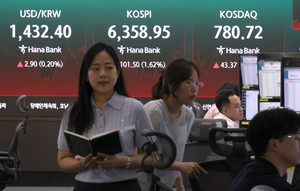
Seoul shares closed higher on Tuesday, recovering from the previous session's steep sell-off as retail investors stepped in to buy stocks. However, gains were tempered by persistent concerns over artificial intelligence investment returns and geopolitical tensions in the Middle East, even as overnight gains on Wall Street provided some support.
The Korean won weakened against the US dollar.
After a volatile session, the benchmark Korea Composite Stock Price Index (KOSPI) trimmed its earlier advances to finish at 6,358.95, gaining 101.50 points, or 1.62 percent. During the session, the index dropped as low as 6,080.25. The rebound follows Monday's 5.12 percent plunge, which came on the heels of a record 18 percent surge on Friday, underscoring the heightened volatility that has characterized Korean markets in recent sessions.
Trading volume was moderate, with 310.58 million shares changing hands valued at 27.87 trillion won ($19.4 billion). Advancing issues dominated decliners by a wide margin, with 786 winners compared to 95 losers.
Overnight in the United States, equities rose after Amazon reported better-than-expected earnings, gaining 4.5 percent and lifting shares of companies poised to benefit from AI demand. The Dow Jones Industrial Average added 1.32 percent to close at 53,178.41, while the tech-heavy Nasdaq composite climbed 2.13 percent to 25,913.90.
In Seoul, retail investors purchased a net 818.4 billion won worth of stocks. Institutional and foreign investors, by contrast, offloaded a net 539.2 billion won and 370.56 billion won, respectively, continuing a pattern in which domestic individuals have absorbed shares sold by overseas funds during recent market swings.
Concerns linger over whether the massive capital pouring into AI infrastructure will translate into sustained growth and profitability. For South Korea, the stakes are particularly high: Samsung Electronics and SK hynix are among the world's leading memory chip suppliers, and KOSPI's performance is closely tied to the global semiconductor cycle that underpins AI computing. Market participants are also monitoring geopolitical developments and forthcoming US employment data for signals about the Federal Reserve's interest rate trajectory, according to analysts. As a trade-driven economy, South Korea is sensitive to shifts in global demand that Fed policy decisions may influence.
Technology stocks led the broader market higher. Samsung Electronics, the country's largest company by market value, edged up 0.21 percent to 240,000 won, while rival chipmaker SK hynix gained 0.64 percent to 1,577,000 won.
Defense names posted sharp advances. Hanwha Aerospace surged 9.25 percent to 1,004,000 won, and Korea Aerospace Industries soared 11.16 percent to 137,500 won, as investors positioned around elevated global security risks including the Middle East tensions.
On the downside, Hyundai Motor, South Korea's leading automaker, slipped 0.13 percent to 392,500 won. National flag carrier Korean Air declined 0.38 percent to 26,100 won.
The Korean won was quoted at 1,432.5 against the US dollar as of 3:30 p.m., down 2.9 won from the previous session's stock market close. (Yonhap)

