KOSPI Falls Again as Samsung and SK Hynix Lead Monday's Chip Stock Losses
Key Takeaways
- •The KOSPI fell more than 5% on Monday and traded near 4,600 at its lowest point, compounding Friday's 5.21% loss that had left the index about 21.4% below its November 2 close.
- •Samsung Electronics dropped between 5.5% and 6% during the session, while SK Hynix lost between 4.9% and 6%, with both chipmakers down roughly 20% and 18% respectively over the past month.
- •The government is preparing a 10 trillion won market stabilization fund, about $6.8 billion, that officials said could be deployed immediately but has not yet been used to purchase shares.
- •Regulators will ease daily limits on share buyback orders for listed companies for three months beginning Tuesday and will intensify checks on illegal short selling, while Finance Minister Lee Hyoung-il ruled out new short-selling restrictions.
- •Foreign investors are on track for a seventh consecutive month of net selling, with total outflows reaching $115.2 billion according to LSEG data.
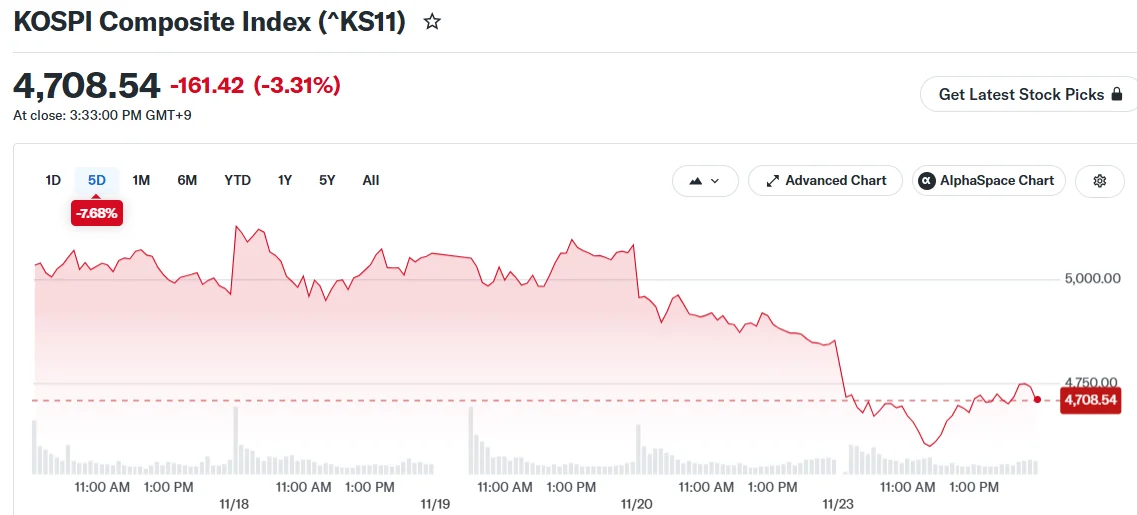
South Korean stocks tumbled for a second straight session on Monday, with chipmakers Samsung Electronics and SK Hynix at the forefront of the decline, even after the government said it stood ready to step in. The KOSPI dropped more than 5% during the session and traded near 4,600 at its lowest point, compounding Friday's 5.21% loss, which had left the benchmark about 21.4% below its November 2 close. Program selling was halted for five minutes after the index plunged 5% — a temporary brake meant to slow computer-driven orders — despite the emergency stabilization measures announced by Seoul.
🚨BREAKING: ₩316,000,000,000,000 wiped out from South Korean stocks as the KOSPI crashes to a 10-month low. Program selling halted for 5 minutes after the index plunged 5%, despite emergency stabilization measures. The KOSPI is now just 274 points (6.1%) away from turning… pic.twitter.com/UWKo7Iad5w
— Coin Bureau (@coinbureau) November 23, 2026
Finance Minister Lee Hyoung-il said officials would decide on action based on market conditions, though he did not announce any share purchases.
Seoul Prepares a Fund but Holds Back
Authorities are preparing a 10 trillion won market stabilization fund, worth about $6.8 billion. On Sunday, they said it could be deployed immediately if conditions worsened. Speaking on Monday, Lee said any steps would come at an appropriate time, and so far the fund has not been used to buy shares.
The government will also ease daily limits on share buyback orders for listed companies. The change lasts three months and takes effect Tuesday, giving companies more room to repurchase their own stock during that window.
Regulators will step up checks on illegal short selling and market manipulation, and will also monitor margin loans and possible forced selling — channels through which falling prices can push investors into unwanted sales and deepen a decline. Lee ruled out new short-selling limits, opting instead for stronger enforcement of existing rules. South Korea ended a 17-month short-selling ban in March 2025 after setting up a central detection system.
Chip Stocks Lead the Drop
Samsung Electronics fell between 5.5% and 6% during the session, while SK Hynix lost between 4.9% and 6%. Over the past month, Samsung is down about 20.1% and SK Hynix about 18.1%. Both companies carry heavy weight in the index, so their movements pull the entire market with them.
Other large firms also fell on Monday. Hyundai Motor dropped 4.90%, Kia lost 4.42%, and Samsung Biologics declined 5.61%.
The selling followed a sharp drop in US technology and chip stocks on Friday. Investors are questioning whether enormous AI spending will pay off, and tighter US limits on advanced chip access have added to the worries.
Foreign investors are on track for a seventh straight month of net selling, with total outflows reaching $115.2 billion, according to LSEG data.
Funds that track Korea took heavy losses in November. The Direxion Daily MSCI South Korea Bull 3X ETF fell 54.10% through November 20, while the iShares MSCI South Korea ETF lost 18.70%. Chip-focused funds also dropped, with the KICK Korea Semiconductor Index ETF down 26.90%. A defense-focused fund fell a smaller 13.51%.
Lee said economic growth could reach the upper-3% range if current trends hold. The International Monetary Fund forecasts growth of 3.9% this year and 3.3% in 2027. He warned that AI regulation, geopolitical tension and higher global interest rates remain risks, and said chip market volatility could spill into the wider economy — a warning that carries weight given Samsung's and SK Hynix's outsized pull on the KOSPI and their double-digit declines over the past month.
Kiwoom Securities analyst Han Jiyoung said the market needs a catalyst to bring foreign buyers back. The new buyback limits take effect Tuesday, and the stabilization fund has not yet bought any shares — leaving those two levers, looser buyback rules and an unused 10 trillion won fund, as the most concrete near-term markers of how Seoul's response unfolds.
This article originally appeared on CoinCentral.

