South Korean Retail Investors Pour $4.6B Into US Equities Amid Domestic Market Collapse
Key Takeaways
- •South Korean retail investors allocated $4.6 billion to US equities in July 2026, nearly double the $2.7 billion monthly average recorded throughout 2025.
- •The KOSPI index fell approximately 40% from its June peak, marking its worst monthly performance since the 2008 global financial crisis.
- •Single-stock leveraged ETFs introduced on May 27 resulted in estimated retail losses of $38.7–39 billion and margin calls for over 1.2 million accounts.
- •Foreign institutional investors sold a record $30.72 billion in Korean stocks and bonds in the month preceding the retail shift overseas.
- •The combined capital outflows intensified weakness in the Korean won, creating a self-reinforcing dynamic that poses a policy challenge for the Bank of Korea.
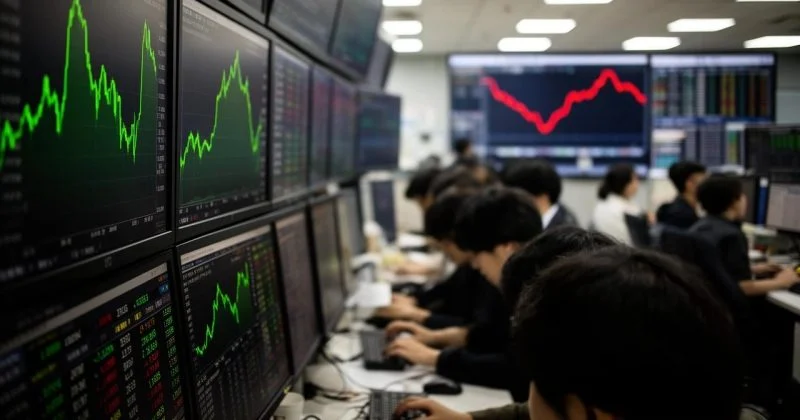
South Korean retail investors, widely referred to as "ants" for their collective strength in numbers, directed $4.6 billion into US equities during July — the largest monthly outflow since January 2026 and nearly double the $2.7 billion monthly average recorded throughout 2025.
The surge in overseas investment coincided with a severe domestic market downturn. South Korea's KOSPI index posted its worst monthly decline since the 2008 global financial crisis, falling approximately 40% from its June peak. The decline was concentrated in the chip and AI-hardware names that dominate the KOSPI, sectors where Korea's export-dependent economy has staked much of its growth trajectory — making the selloff as much a macroeconomic signal as a market event.
Domestic Market Turmoil
South Korea introduced single-stock leveraged ETFs on May 27, drawing immediate and heavy retail participation. These products attracted approximately 14 trillion won in net retail buying, equivalent to $9.4 billion to $9.7 billion depending on prevailing exchange rates.
When underlying stocks — particularly AI-sector leaders such as Samsung Electronics and SK Hynix — reversed sharply, the leverage amplified losses on the downside. Estimated retail losses from leveraged positions ranged between $38.7 billion and $39 billion. More than 1.2 million accounts received margin calls, affecting over 3.4% of South Korea's adult population. The episode echoes longstanding concerns among Korean financial regulators about retail exposure to complex leveraged products, a category the country has periodically tightened rules on after past episodes of concentrated retail losses.
Foreign institutional investors accelerated the sell-off. In the month preceding the retail shift, foreign investors sold a record $30.72 billion in Korean stocks and bonds.
The "Seohak Ant" Phenomenon
Korean retail investors who purchase overseas equities are commonly called "seohak ants," a term meaning "ants who study abroad."
By June 2026, Korean retail holdings in US equities had reached nearly $200 billion, positioning South Korean individual investors as one of the largest foreign ownership groups in American stocks. July's $4.6 billion inflow added to that already substantial position.
The shift marked the first time since February 2026 that net Korean retail inflows into US equities exceeded new domestic equity investment.
Currency Pressures
Data from the Korea Securities Depository flagged the increasing volatility of retail-driven capital flows as a systemic concern. Each dollar invested in US equities such as Tesla or Nvidia requires conversion from won, intensifying selling pressure on the local currency.
The combined effect of $4.6 billion in retail outflows and more than $30 billion in foreign institutional selling contributed to sustained weakness in the won. A depreciating won creates a feedback loop: as the currency declines, Korean investors holding US-denominated assets see amplified returns in local currency terms, further incentivizing capital outflows. The dynamic poses a policy challenge for the Bank of Korea, which must balance currency stability against the need to support a domestic economy already under pressure, with limited capacity to stem retail-driven capital movement without measures that risk deterring foreign inflows.

