Korean Budget Coffee Chains Expand Overseas as Domestic Market Reaches Saturation
Key Takeaways
- •Ediya Coffee opened its first Laos store through a master franchise agreement with Kolao Group, adding to existing international locations in Guam, Malaysia, and Canada.
- •Compose Coffee and The Venti both launched their first Philippine stores last week, with Compose Coffee partnering with Jollibee Group's Fresh N' Famous Foods under a master franchise agreement.
- •Mega Coffee currently operates eight stores in Mongolia and has established a Japanese subsidiary, with a potential US launch under consideration.
- •Paik's Dabang operates 17 stores in the Philippines and two shop-in-shop locations in China, and recently opened its first Tokyo store with plans to expand into China, Taiwan, and the US.
- •Industry officials emphasize that building stable local supply chains and strong localization strategies will be more critical to overseas success than maintaining the low prices that drove domestic growth.
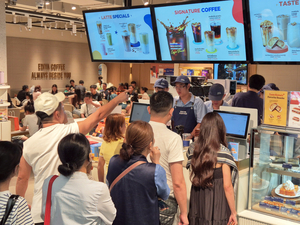
South Korea's budget coffee chains, long built on affordability and accessibility, are accelerating overseas expansion as the domestic market nears saturation and rising coffee bean prices combined with currency pressure squeeze profit margins.
The saturation is starkly visible in numbers: South Korea ranks among the world's most densely saturated coffee markets, with Seoul alone hosting tens of thousands of coffee shops — more per capita than most major cities globally. For budget chains that grew by undercutting premium brands on price, adding stores in such an environment increasingly yields diminishing returns.
Rather than retreating, these chains are betting on international markets — leaning on Korean cultural identity as a competitive edge, capitalizing on growing global interest in K-food and Korean content. The broader Hallyu wave, which has driven international consumption of Korean drama, music, and food over the past decade, has created a halo effect that these brands aim to convert into foot traffic.
A wave of new international openings has already taken place this month, with several launches occurring just a day apart.
Ediya Coffee opened its first store in Laos on Saturday through a master franchise agreement with Kolao Group, adding to its earlier international entries in Guam, Malaysia, and Canada.
Compose Coffee and The Venti both launched their first Philippine stores last week. Compose Coffee opened on Friday at a mall in Manila, backed by a master franchise agreement with Jollibee Group's Fresh N' Famous Foods — a partnership with the Philippines' largest and most established food service company — following what the company described as a strong pre-opening period. The Venti opened the previous day under a master franchise agreement with JJR Brothers Food Corp., with a second location planned later this year.
Underpinning these expansions is a shared belief that an identity rooted in Korean culture will resonate with consumers abroad. Ediya Coffee, for example, carried domestic favorites such as the dalgona latte into Southeast Asia, tailoring its offerings to the region's preference for milk-based coffee and extending Korean flavors into its dessert lineup.
"We are also rolling out tumblers with traditional Korean patterns and keyrings modeled on traditional ornaments," an Ediya Coffee company official said.
Mega Coffee and Paik's Dabang have been laying similar groundwork in other markets. Mega Coffee currently operates eight stores in Mongolia and has established a Japanese subsidiary. A US launch is being planned, though the company noted that nothing has been confirmed regarding timing or format.
Paik's Dabang operates 17 stores in the Philippines and runs two shop-in-shop locations in China. It recently opened its first Tokyo store under a new brand identity that retains "dabang," the traditional Korean word for coffeehouse.
The company framed its overseas push as a demonstration of global competitiveness rather than an exit from a cooling domestic market. "Starting with Japan, we plan to bring the brand to China, Taiwan, and the US," a Paik's Dabang official said.
According to industry officials, South Korea's budget coffee sector has reached an inflection point where opening additional stores no longer translates into proportionally higher profits, driving chains toward overseas expansion and menu diversification to broaden their revenue base. The margin pressure is compounded by global arabica and robusta prices that have climbed as adverse weather in major producing countries such as Brazil and Vietnam has constrained supply.
Going forward, brand value and menu strength are expected to matter as much as the low prices that originally fueled growth, with features such as smart ordering systems also entering the competitive landscape, they noted. How these chains compete against entrenched local players and global giants in each target market — while maintaining the cost advantages that defined them at home — will be a key factor shaping the next phase of their expansion.
"Low prices alone won't be enough to sustain popularity abroad," one industry official said. "Success will depend on building a stable local supply chain to optimize cost structure, along with a strong localization strategy."

