Korea's New Labor Rules Draw Fire From Both Sides, Clouding Chip Investment Projects
Key Takeaways
- •The labor ministry's guidance states that management decisions like plant construction, overseas investment and AI adoption are excluded from mandatory collective bargaining and lawful industrial action.
- •Bargaining and labor disputes remain possible when management decisions lead to concrete changes in employment conditions such as worker relocations, work arrangement changes or restructuring.
- •Business groups warn the ambiguity could delay large semiconductor projects, which may require relocating thousands or tens of thousands of workers.
- •Both major umbrella unions criticized the guidance, with the Federation of Korean Trade Unions vowing to challenge it in court.
- •Labor experts expect disputes over the guidance's interpretation to end up in court, potentially years later, while the ministry says concerns about strikes or delays are premature.
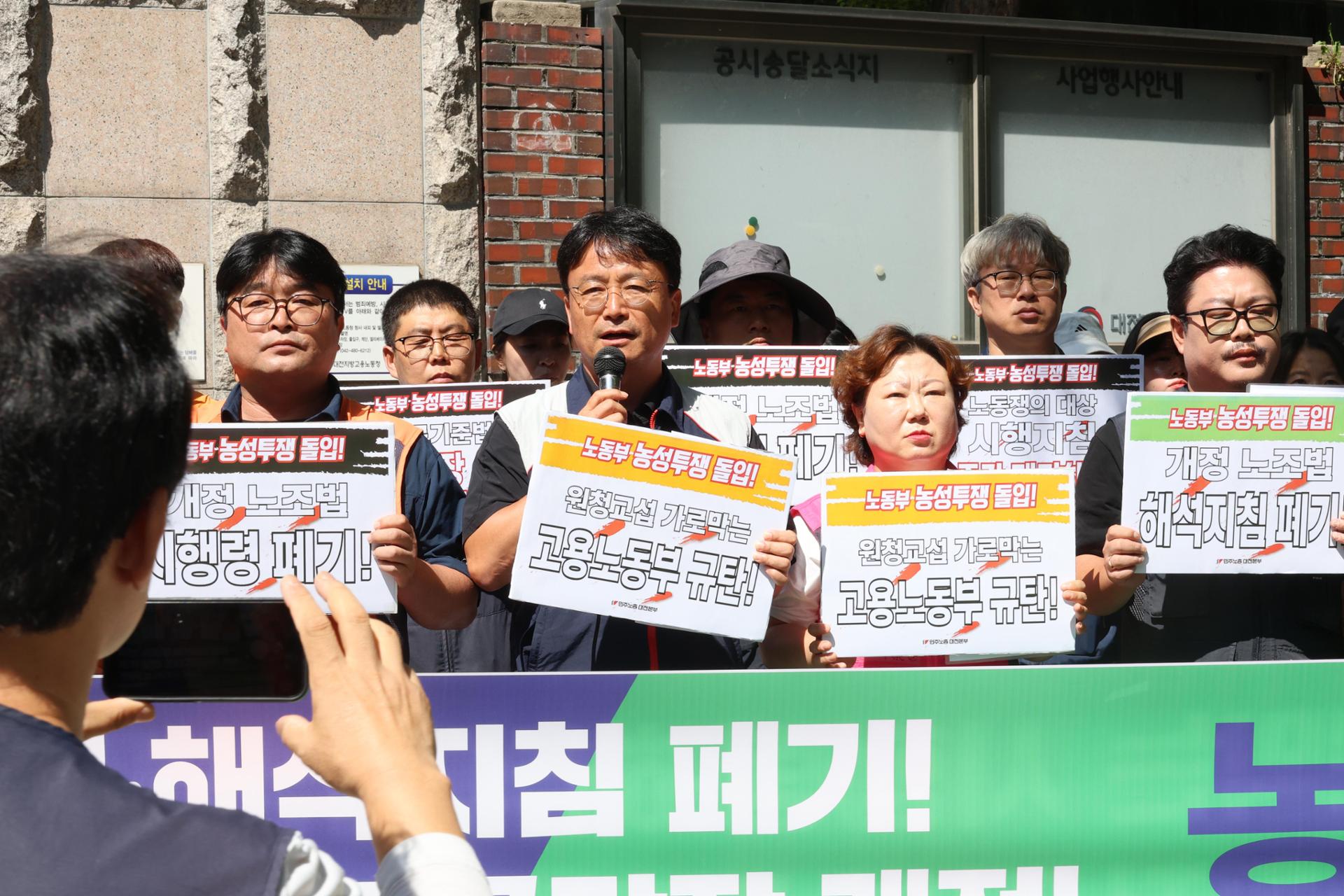
Experts warn vague rules could delay projects, trigger lawsuits
Korea's new labor guidance, designed to draw a line between corporate management rights and workers' collective bargaining rights, is instead drawing criticism from both sides, with its ambiguity casting doubt over major government-backed chip investment projects.
The Ministry of Employment and Labor issued implementation guidance last week for what is known as the pro-labor "yellow envelope law," a revision to the Trade Union Act passed under the previous administration that expanded the scope of matters subject to mandatory collective bargaining. Under the guidance, management decisions themselves — such as building or relocating plants, making overseas investments and adopting artificial intelligence — do not fall under mandatory collective bargaining or lawful industrial action.
The guidance also states, however, that bargaining and labor disputes may be possible when such decisions lead to concrete changes in employment conditions, including relocations of workers, changes in work arrangements or restructuring.
This seemingly contradictory stance has created confusion among both businesses and workers, who have voiced competing concerns over the guidance's potential impact on management decisions, job security and the large-scale semiconductor investment projects being planned in the nation's southwestern coastal region.
Business concerns
Business groups argue that workforce management is inseparable from major investment decisions, noting that a semiconductor plant cannot begin operations without experienced engineers, technicians and production workers.
"Even after a company decides to build a new plant, skilled experts and research personnel cannot be secured through new hiring or outside recruitment alone. If collective bargaining over workforce deployment is delayed or industrial action occurs, the plant could become impossible to bring into operation," the Korea Enterprises Federation said in a statement.
Speaking to The Korea Times on Monday, business sources said the ministry's guidance was understandable in principle but difficult to apply in practice, given the potentially large scale of workforce transfers required for major chip projects.
"If the project goes ahead, several thousand — or possibly tens of thousands — of workers would have to be relocated," one source said.
Another source said the new guidance was unlikely to provide clear support for moving the project forward, noting that it adds uncertainty. The sources say companies cannot plan multibillion-dollar projects with confidence if the relevant legal boundary remains vague.
Labor backlash
Labor groups, for their part, criticized the guidance as undermining the core purpose of the revised law: expanding workers' ability to bargain over decisions that significantly affect their working conditions.
"The guidance is a toxic administrative directive that violates the intent of the revised Trade Union Act and infringes on the constitutionally guaranteed three labor rights," the Korean Confederation of Trade Unions, one of the nation's two largest umbrella unions, said during a press conference Monday.
The Federation of Korean Trade Unions, the other major umbrella labor group, accused the ministry of improperly narrowing the scope of the law by excluding investments such as plant construction, even where changes to working conditions are foreseeable.
"Restricting the law's scope through a guideline will only deepen confusion in workplaces," the group said, vowing to challenge the measure in court.
Court battles ahead?
Labor experts said the dispute could ultimately move from the workplace to the courts once companies begin implementing specific projects.
Employers are likely to cite the guidance in arguing that investment decisions are outside the scope of collective bargaining as they push projects such as the semiconductor initiative planned for the southwestern Jeolla region, said Park Jin-ho, a certified labor attorney.
"But some unions may reject that interpretation and demand negotiations from the outset … If talks fail, they could go on strike, and the legality of such action would ultimately have to be decided by the courts, possibly many years later," he added.
The ministry dismissed concerns that the guidance could hinder major investment projects.
"It is premature to assume that the guidance will lead to strikes or project delays," a senior official said. "The purpose of the revised (yellow envelope) law is to encourage labor and management to resolve disputes through dialogue."
