Naver's Dunamu Takeover Faces Test in Korea's Upcoming Shareholder Stake Rules
Key Takeaways
- •The National Assembly Research Service warned in a report to Democratic Party lawmaker Park Min-kyu that antitrust requirements could contradict pending digital asset legislation affecting Naver Financial's acquisition of Dunamu.
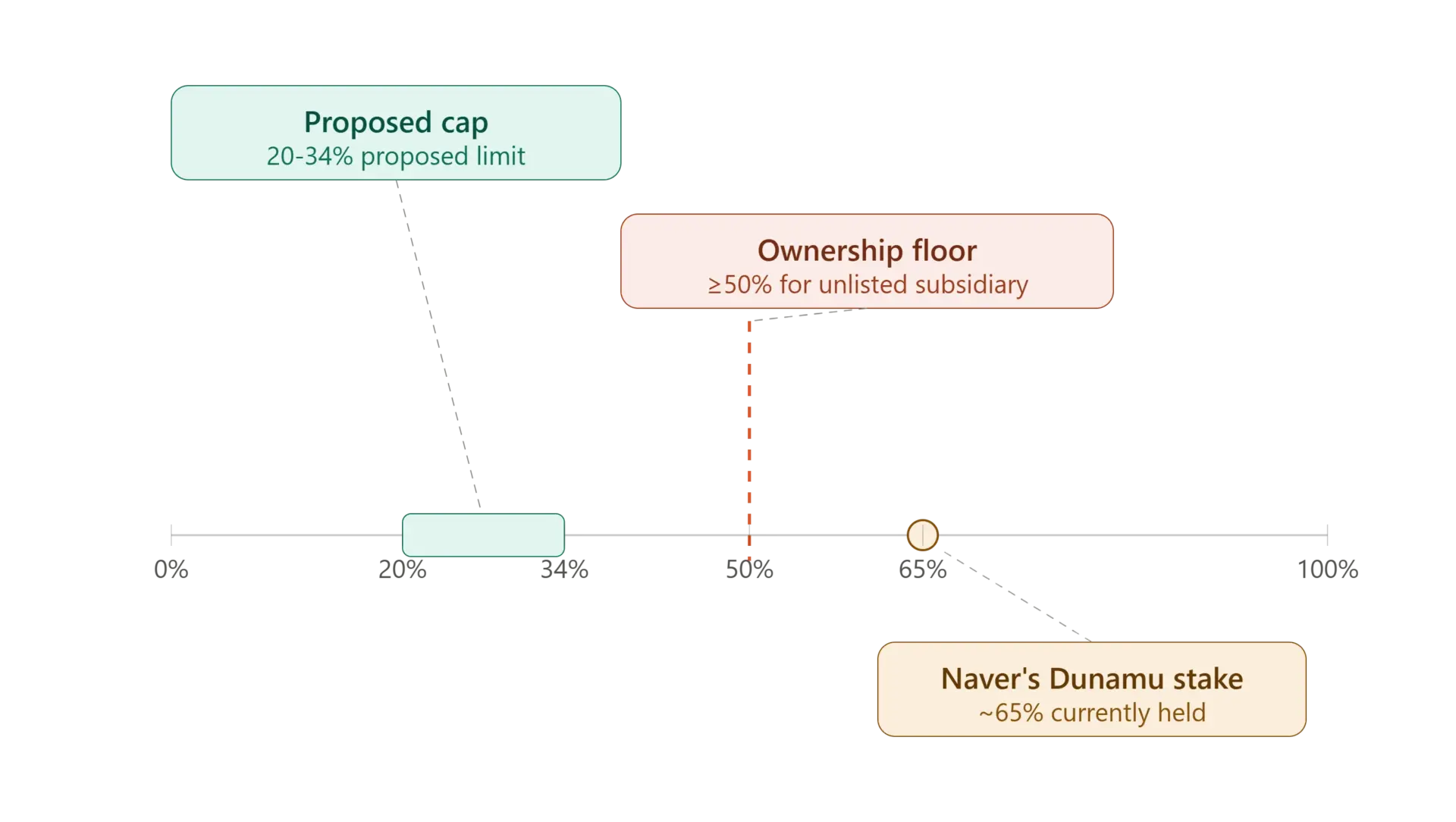
- •The Monopoly Regulation and Fair Trade Act requires holding companies to own at least 50% of an unlisted subsidiary, while the draft Framework Act on Digital Assets would cap how much a single major shareholder can hold in a virtual asset exchange.
- •Naver Financial and Dunamu a comprehensive share swap in late November 2025 at a ratio of 1 to 2.54, valuing the combined entity at approximately 20 trillion won.
- •Under the deal, Dunamu Chairman Song Chi-hyung is set to become the largest shareholder with a 19.5% stake as Naver's holding falls to 17%, alongside a commitment to invest 10 trillion won over five years in AI and blockchain development.
- •Dunamu's Upbit remains Korea's dominant crypto exchange, processing about $1.04 billion in daily spot volume in late August, more than its three nearest domestic rivals combined.
South Korea's National Assembly Research Service has identified a regulatory contradiction that could force a governance overhaul at Naver Financial if it completes its takeover of Dunamu, the operator of cryptocurrency exchange Upbit.
The potential conflict sits between two rules under the Fair Trade Act framework: one that requires holding companies to maintain minimum stakes in their subsidiaries, and a proposed ceiling on how much of a crypto exchange a single major shareholder may own. For Korea's crypto market, the question reaches beyond one deal: how the two rules interact will shape how the country's dominant exchange can be owned.
Will Naver Financial complete its acquisition of Dunamu?
In a report handed to Democratic Party lawmaker Park Min-kyu, the National Assembly Research Service warned that certain antitrust requirements could contradict legislation currently under review.
At the center of the issue is the Monopoly Regulation and Fair Trade Act, which requires holding companies to own at least 50% of an unlisted subsidiary and % of a listed one. Venture holding companies are legally required to hold a minimum of 20%.
On the other side is the Framework Act on Digital Assets, the second phase of Korea's crypto legislation, which is still being debated in the National Assembly. Lawmakers have spent months weighing a provision that would cap the stake a single major shareholder can hold in a virtual asset exchange.
The research office noted that the two systems do not conflict in every case, but said a floor and a ceiling applied to the same stake "could be seen as a conflicting structure."
Naver Financial is not a holding company, meaning the Fair Trade Act's subsidiary rules do not yet apply to it.
Terms of the Naver-Dunamu deal
Naver Financial and Dunamu approved a comprehensive share swap in late November 2025 that places Dunamu under Naver Financial's full ownership. The share-swap ratio was set at 1 to 2.54, valuing the combined entity at roughly 20 trillion won.
Under the arrangement, Dunamu Chairman Song Chi-hyung is set to become the largest shareholder with a 19.5% stake, while Naver's holding falls to 17%.
The deal also includes a commitment to invest 10 trillion won ($6.8 billion) over five years into the development of Korea's AI and blockchain technology.
Dunamu remains Korea's dominant exchange operator. As Cryptopolitan reported, the Upbit operator handled about $1.04 billion in daily spot volume in late August, more than its three nearest domestic rivals combined. The proposed cap in the Framework Act on Digital Assets would apply to virtual asset exchanges generally, placing Upbit squarely within the scope of the debate. With the bill still moving through the National Assembly, the final wording of that cap is the detail to watch as the share swap moves toward completion.

