Kospi's July Volatility Sparks Calls for Stricter Brokerage Forecasts and Margin Lending Rules
Key Takeaways
- •The Kospi plunged 22.19% in July following a 101.14% surge in the first half of the year, with circuit breakers triggered on two consecutive trading days for the first time before a record 17.91% rebound on Friday.
- •Retail investors sold a combined 106 trillion won ($73.46 billion) worth of shares over five trading days, including net selling of 9.9 trillion won even during the record rebound session.
- •Samsung Electronics' second-quarter operating profit of 89.5 trillion won beat the FnGuide consensus of 84.98 trillion won but fell short of brokerage projections reaching up to 100 trillion won, causing shares to decline more than 6%.
- •Samsung Electronics, Samsung Electronics preferred shares, SK hynix, and SK Square accounted for over 40% of the Kospi's margin loan balance, and forced liquidations of retail investors exceeded 60 billion won during the sell-off.
- •Of 17 brokerages issuing reports on SK hynix after earnings, only two raised their target prices, seven lowered them, and eight left them unchanged, with Mirae Asset Securities cutting its Samsung Electronics target from 550,000 won to 370,000 won.
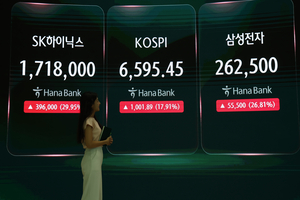
South Korea's stock market experienced extreme volatility in July, prompting industry officials to call for tighter oversight of bullish brokerage research and stricter margin-lending regulations. Critics argue that inflated earnings expectations and heavily leveraged trading magnified retail investors' losses during the sharp market swings.
According to the Korea Exchange, the Kospi plunged 22.19 percent in July, following a remarkable 101.14 percent surge in the first half of the year. Circuit breakers were triggered on two consecutive trading days for the first time, before the benchmark index rebounded a record 17.91 percent on Friday.
The repeated volatility triggered panic selling among retail investors, who dumped a combined 106 trillion won ($73.46 billion) worth of shares over the previous five trading days. Even on Friday, when the Kospi surged, retail investors sold 28 trillion won worth of shares, resulting in net selling of 9.9 trillion won in a single session. Retail investors account for a substantial share of daily trading volume on the Korea Exchange, giving their collective actions significant influence over market direction.
A market insider, speaking on condition of anonymity, said brokerages had fueled excessive expectations by repeatedly raising earnings forecasts and target prices for AI-related semiconductor stocks during the rally. Critics contend that such optimistic projections encouraged investors to build aggressive positions in AI-related stocks, leaving them exposed when actual earnings failed to meet elevated expectations. Samsung Electronics and SK hynix, the world's two largest memory chipmakers, are central to this dynamic as leading suppliers of high-bandwidth memory chips used in AI accelerators.
Samsung Electronics reported a second-quarter operating profit of 89.5 trillion won, beating the FnGuide consensus of 84.98 trillion won by more than 6 percent. However, several brokerages, including KB Securities and Kiwoom Securities, had projected earnings of up to 100 trillion won. As a result, shares fell more than 6 percent as investors interpreted the actual results as disappointing.
SK hynix exhibited a similar pattern. The consensus estimate from 14 brokerages stood at 64.09 trillion won, while actual operating profit came to approximately 60.5 trillion won. Analysts attributed the gap to overly aggressive AI-related forecasts that had inflated market expectations.
Target prices also diverged following earnings reports. Korea Investment & Securities raised its target for SK hynix to 4.7 million won, while BNK Investment & Securities cut its target to 1.48 million won. Of 17 brokerages issuing reports after earnings, only two raised their targets, seven lowered them, and eight left them unchanged.
Samsung Electronics also experienced downward target revisions. Mirae Asset Securities reduced its target price to 370,000 won from 550,000 won. Critics noted that these revisions suggested brokerages were following rather than leading the market.
"Most brokerage earnings estimates exceeded actual results, and higher target prices tended to encourage investor participation," a securities industry official said on condition of anonymity.
Industry officials also identified margin lending as a key factor that amplified volatility. Samsung Electronics, Samsung Electronics preferred shares, SK hynix, and SK Square accounted for more than 40 percent of the Kospi's margin loan balance. Forced liquidations of retail investors who failed to meet repayment obligations exceeded 60 billion won during the sell-off. The debate over margin lending rules adds to broader regulatory discussions in South Korea, where the Financial Services Commission and the Korea Exchange share responsibility for overseeing market stability and investor protection.
The forced selling repeatedly struck large-cap semiconductor stocks such as Samsung Electronics and SK hynix as their share prices declined sharply, further intensifying downward pressure on the broader market.
"Hedge funds and retail investors had built unusually aggressive leveraged positions in SK hynix. When AI concerns emerged and the market fell 15 to 20 percent, forced liquidations intensified the selling pressure," a financial industry source said.
"In the end, brokerages benefit from increased trading activity, including forced liquidations. Margin lending requirements for retail investors should be tightened."

