Global Investors See Buying Opportunity in South Korea After Leverage-Driven Sell-Off
Key Takeaways
- •Foreign investors became net buyers of South Korean equities during Friday's record rally, purchasing 7.2 trillion won ($5 billion) worth of stock, more than double the previous one-day record.
- •Samsung shares lost nearly half their value from a June peak to a late-July trough despite the company reporting a 250-fold increase in chip profit, as the decline was driven by leveraged ETF unwinding rather than fundamental weakness.
- •Assets in leveraged ETFs tied to Samsung and SK Hynix collapsed from $50 billion in late June to $17 billion last week, with Citi estimating total retail investor losses at approximately $38.7 billion.
- •J.P. Morgan analysts believe the leveraged ETF unwind in South Korea is complete and hedge funds are roughly 90% through deleveraging, returning exposure to acceptable levels.
- •South Korea's Finance Minister Koo Yun-cheol issued a public apology for introducing single-stock leveraged ETFs without sufficient deliberation and announced new measures to rein in leveraged products.
By Ankur Banerjee, Summer Zhen and Laura Matthews
SINGAPORE/NEW YORK, Aug 3 (Reuters) — Global investors retreated from South Korean equities during a turbulent July, yet many are maintaining confidence in the country's major chipmakers, betting that their growth trajectory remains intact and that the leveraged positions which destabilized the market have largely unwound.
The stakes extend well beyond a single market. Samsung Electronics and SK Hynix together dominate the global memory chip industry, supplying the DRAM and high-bandwidth memory that underpin artificial intelligence infrastructure, data centres, and consumer electronics worldwide. Their performance is widely viewed as a barometer for the broader semiconductor cycle that drives global tech earnings.
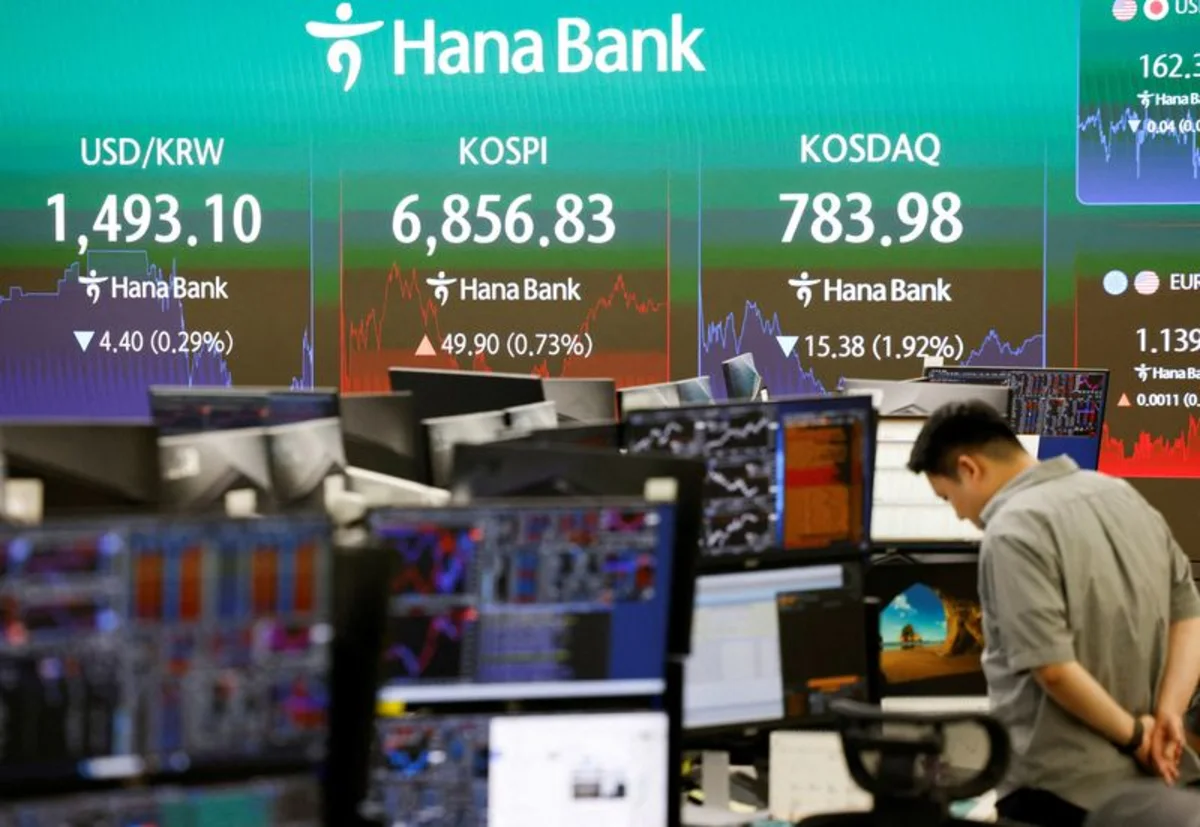
Reflecting the shifting sentiment, foreign investors—who had been net sellers of South Korean shares throughout the year—became net buyers during Friday's record rally, purchasing 7.2 trillion won ($5 billion) worth of stock, more than double the previous one-day record.
This optimistic stance stands in stark contrast to the frustration among domestic retail traders, who endured a roughly 40% drawdown from June's peak.
Assets in leveraged exchange-traded funds (ETFs) tied to Samsung and SK Hynix plummeted from $50 billion in late June to $17 billion last week, according to J.P. Morgan research.
"This was a leverage event, not an earnings event," said Steve Lawrence, chief investment officer of U.S.-based Balfour Capital Group.
"I'll say it plainly: I'm a bull on Samsung here. It got sold for carrying half the index's weight, not for anything in the business," said Lawrence, who manages over €400 million. "The memory cycle and the AI capex story are intact, and the unwind is handing it to you at a discount the fundamentals don't justify."
Analysts noted that the market decline was exacerbated by forced selling at the struggling hedge fund Situational Awareness, a process that now appears to have concluded after Citadel acquired the bulk of the fund's remaining equities portfolio.
Samsung shares lost nearly half their value from a June peak to a late-July trough, even as the company reported a 250-fold increase in chip profit and issued a solid outlook driven by data centre demand. Rival SK Hynix shares followed a comparable trajectory, with both rebounding sharply during Friday's highly volatile session.
Data from analytics firm EPFR shows that average allocations to South Korea by active global emerging market funds rose sharply over an 18-month period before flattening in June as volatility surged.
"In Korea, we believe the leveraged ETF unwind is complete and hedge funds are ~90% through deleveraging — back to acceptable levels," wrote J.P. Morgan analysts led by Rajiv Batra, head of Asia and co-head of global emerging markets equity strategy.
"If a durable bottom forms here, history is supportive," they said in a July note, noting that the median 12-month return following previous emerging-market corrections has been approximately 28%.
An Accident Waiting to Happen
Leverage has been central to both South Korea's remarkable rally and its dramatic reckoning. Single-stock leveraged ETFs, which use derivatives to multiply the daily returns of an individual share and reset each trading day, transformed the market and amplified volatility in both directions.
The rally that more than tripled the KOSPI benchmark over the 12 months leading to June's peak accelerated after single-stock leveraged ETFs launched in South Korea in May—those same products then intensified the subsequent slide from the highs.
"Long only investors just don't want to have to manage positions in stocks which are moving as violently as these stocks are moving," said William Brattan, head of cash equity research for APAC at BNP Paribas.
The severity of the decline prompted a public apology from South Korea's Finance Minister Koo Yun-cheol for introducing the ETFs without sufficient deliberation, along with new measures to rein in leveraged products.
Citi's trading strategies desk estimated last week that total losses for retail investors in leveraged ETFs reached approximately $38.7 billion, fueling mounting anger at policymakers for permitting single-stock leveraged funds to launch.
"The amount of money that went into SK and Samsung was staggering," said Pierre Hoebrechts, deputy CIO at East Eagle Asset Management. "The number of accounts opened in Korea, combined with local leverage and very concentrated exposure, with the cherry on the cake being large 2x-levered foreign ETFs, just made it an accident waiting to happen."
Hoebrechts said his firm had been short—betting on declines—in the KOSPI and Japan's Nikkei since the end of June but closed out those positions last week, believing the washout phase may be nearing its end.
Average short interest for South Korea, weighted by positions' value, stands at roughly 4.3%, down from a recent peak of approximately 5.3%, according to data from S3 Partners.
To be sure, significant risks remain. For many observers, Friday's record-breaking 17.9% surge in the KOSPI was just as unsettling as some of the previous month's sharp declines. The index fell nearly 5% on Monday.
However, Larry Hatheway, head of research at Franklin Templeton Institute, noted that U.S. institutional investors, while cautious about entering a falling market, "may be willing to take another look at some of these (Korean) names now."
($1 = 1,442.0900 won)
Reporting by Ankur Banerjee in Singapore, Summer Zhen in Hong Kong and Laura Matthews in New York. Additional reporting by Cynthia Kim and Jihoon Lee in Seoul, Suzanne McGee in Rhode Island and Saqib Iqbal Ahmed in New York. Writing by Tom Westbrook; Editing by Sonali Paul

