Korea Blockchain Week 2026 Returns to Seoul With a Sharper Institutional Focus
Key Takeaways
- •KBW2026 runs from September 29 to October 1 at Walkerhill Hotels & Resorts, opening with an invite-only Upbit Institutional Summit before the public conference on September 30 and October 1.
- •The main program is structured around six themes covering policy and market structure, the next market cycle, on-chain capital markets, 24/7 decentralized trading venues, settlement and payments, and AI-crypto convergence.
- •The speaker roster brings US digital asset officials such as Patrick Witt together with Korean figures including Upbit CEO Kyoungsuk Oh and Bank of Korea digital currency director Sungguan Yun.
- •BitGo Korea became a registered Virtual Asset Service Provider in August after Korea Financial Intelligence Unit acceptance, allowing it to offer custody and transfer services to institutional clients under the VASP framework in place since 2021.
- •South Korea's government and major corporate groups have outlined a plan to secure more than 260,000 of Nvidia's latest GPUs, a national AI push that intersects with the conference's AI and crypto track.
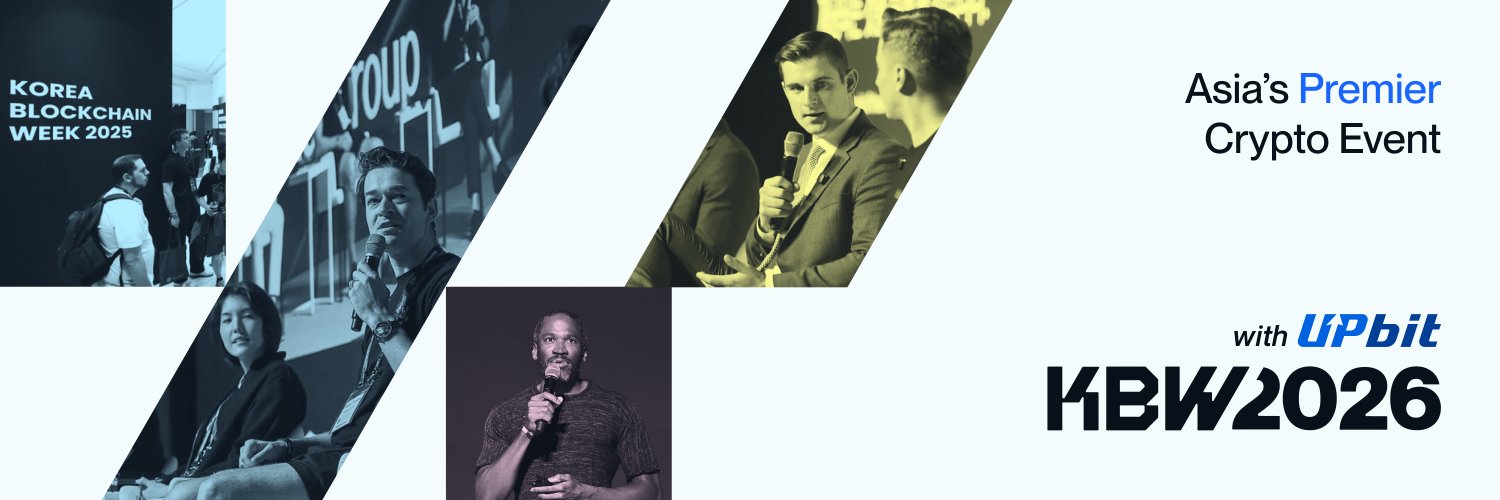
Korea Blockchain Week is set to open in Seoul with a heavier institutional orientation than in its previous editions, as banks, policymakers, Web3 executives, and market operators converge to discuss stablecoins, tokenization, real-world assets, custody, settlement, infrastructure, and the intersection of artificial intelligence with on-chain finance.
The 2026 edition, organized by FACTBLOCK and presented in partnership with Upbit, runs from September 29 to October 1 at Walkerhill Hotels & Resorts. Day one is reserved for the invite-only Upbit Institutional Summit, while the public main conference takes place on September 30 and October 1. Dinners, private meetings, side events, and networking sessions are scheduled across the city throughout the conference.
Six Core Themes Shape the Agenda
The main program of keynote speeches and panel discussions at KBW2026 is organized around six themes: policy and market structure, the next market cycle, on-chain capital markets, 24/7 decentralized trading venues, settlement and payments, and the points where AI and crypto converge and interact.
The tracks are set to draw a mix of US policy officials, Korean and international market operators, senior technology executives, and protocol founders.
A Deep Bench of US Policy Figures
Patrick Witt, executive director of the White House President's Council of Advisors for Digital Assets, is listed among the speakers, alongside Brian Quintenz, a former CFTC commissioner who later led policy at a16z crypto and now sits on the boards of firms including Kalshi and Sui Group Holdings.
Caroline D. Pham, the former acting chairman of the CFTC, will attend in her capacity as chief legal officer and chief administrative officer of MoonPay, as well as chief executive of MoonPay Institutional. Harry Jung, a former deputy executive director of the White House digital assets council and a former CFTC chief of staff, is also on the roster. For readers tracking US digital asset rulemaking, the lineup puts the officials shaping market-structure policy in direct conversation with the exchanges, custodians, and payment companies operating under those frameworks.
Korean Institutions Take the Stage
From the host country, Kyoungsuk Oh, chief executive of Upbit and its parent company Dunamu, is scheduled to speak, including at the institutional summit on September 29. Sungguan Yun, director general of the Bank of Korea's Office of Digital Currency, will bring the central bank's payments and settlement policy work into the same room. That pairing gives attendees a side-by-side view of the private-sector stablecoin and custody work described below and the central bank's own tokenized-money experiments.
Familiar Market Names Across the Tracks
The market-facing speaker lineup includes names familiar to both professional and everyday crypto users. Arthur Hayes, chief investment officer at Maelstrom and co-founder of BitMEX, and Tom Lee, chairman of BitMine Immersion Technologies and co-founder of Fundstrat, are listed on the cycle and macro track. Jeff Yan, co-founder and chief executive of Hyperliquid Labs, will join the real-time markets discussion track.
Joseph Lubin, co-founder of Ethereum and Consensys, is returning to Korea for the first time since 2019. Following the planned split of Consensys Software announced earlier this month, he will serve as chairman and chief executive of MetaMask and as executive chairman of the new Consensys entity that will house protocol and institutional infrastructure work.
Other confirmed speakers include Bo Hines, chief executive of Tether USA and a former White House crypto council official; Yuval Rooz, co-founder and chief executive of Digital Asset and a co-founder of the Canton Network; author and entrepreneur Balaji Srinivasan, the former Coinbase CTO and a General Partner at a16z, who will join as a virtual speaker; Monica Long, president of Ripple; and Johann Kerbrat, who leads crypto at Robinhood.
Last year's conference drew more than 14,000 attendees, over 340 speakers, more than 110 sponsors, and over 400 side events, setting a strong baseline for the 2026 edition.
Sponsor Lineup Mirrors the Industry
The commercial lineup backing Korea Blockchain Week reflects the event's six core themes. Upbit is the presenting partner, represented on stage by CEO Kyoungsuk Oh. 0G and BRV Capital Management serve as official conference partners; Stable, Tria, and GOAT Network are diamond sponsors; and BitGo is the official institutional sponsor.
Michael Heinrich, co-founder and chief executive of 0G Labs, is scheduled to discuss decentralized infrastructure for AI agents, covering verifiable compute, AI-native chains, private inference, and decentralized storage. Brian Mehler, chief executive of Stable, will speak about blockchain rails for stablecoin transfers and payments. John Lilic, Tria's co-founder and chief strategy officer, will participate in sessions on financial infrastructure that enables businesses and AI software agents to transact across multiple chains and assets.
GOAT Network, a Bitcoin-native Layer 2 network built to expand Bitcoin's liquidity and smart-contract functionality, rounds out the diamond tier alongside Stable and Tria. Mike Belshe, co-founder and chief executive of BitGo, is also scheduled to speak.
FACTBLOCK conceived and launched Korea Blockchain Week in 2018, and the event has since become one of the most popular and highly anticipated conferences on the industry's global calendar. The company, a Web3 ecosystem builder that actively supports Korean crypto and digital asset businesses, focuses on strategic advice and consultancy services, building bridges between the Korean market and international companies, and reducing information asymmetry. It also operates FABLO, a reward-based platform that helps Web3 users discover and engage with blockchain, crypto, and digital asset projects.
Korea's Web3 Sector Shifts From Trading to Infrastructure
South Korea has long ranked among the world's most active digital asset markets by retail participation, with millions of people trading cryptocurrencies, using DeFi services, and engaging with other popular Web3 verticals. That activity has prompted institutions and builders to pursue a new wave of projects: banks are developing stablecoins, digital asset custody solutions, token real-world assets, tokenized deposits, and other financial products; securities firms are preparing for security token offerings (STOs); and regulators are drafting rules for longer-term institutional use.
Dedicated virtual-asset custody is becoming an established part of the country's regulated market. BitGo Korea, for example, became a Virtual Asset Service Provider (VASP) in August after the Korea Financial Intelligence Unit accepted its registration, allowing the firm to offer custody and transfer services to institutional and enterprise clients in South Korea. Korea's VASP framework, in place since 2021, requires virtual asset businesses to register with the KoFIU before serving the local market.
Major Korean banks have also been studying won-linked stablecoins, custody, and blockchain settlement, while the Bank of Korea has advanced its digital currency work through the Office of Digital Currency and Project Hangang, which tested tokenized deposits and tokenized central bank money with commercial banks.
KBW2026 sessions will place Korean banks and regulators alongside global exchanges, protocol teams, and policy officials, covering programmable money, on-chain assets, real-time settlement, licensing, liquidity, settlement rails, decentralized trading platforms, legal and regulatory compliance, new rules and frameworks, capital formation, and market infrastructure.
Korea's AI Ambitions Intersect With Crypto
The AI track is likely to be among the most popular this year, given that South Korea is home to Samsung Electronics and SK hynix, two of the largest memory and semiconductor suppliers in the AI supply chain. Following talks tied to the 2025 APEC meetings, the government and major Korean groups set out a plan to secure more than 260,000 of Nvidia's latest GPUs across public and private-sector projects, including allocations for a national computing effort and corporate "AI factories" at Samsung, SK Group, Hyundai Motor Group, and Naver.
Korea thus occupies an unusual, highly influential, and lucrative position in which high-volume retail crypto activity, a banking system testing on-chain products, and a national push for AI compute capacity are all converging. The conference's AI and crypto track will examine how AI models and systems can initiate transactions and payments and manage digital assets, rather than serving merely as tools for analysis and research. It will also address the emergent risks arising where the two technologies intersect, reflecting concerns that are becoming increasingly mainstream in 2026.
The Week Ahead
The Upbit Institutional Summit opens the conference on Tuesday, September 29 at Walkerhill Hotels & Resorts, with access restricted to designated attendees and institutional investors by invitation only. The main KBW2026 conference follows on Wednesday and Thursday.
The public days will feature sessions across the six tracks: market structure and policy, the next crypto market cycle, capital markets moving on-chain, real-time exchanges operating 24/7, settlement and payments infrastructure, and AI-crypto convergence. In-depth discussions are also scheduled on won-denominated stablecoins, tokenized deposits, digital asset custody, cross-border settlement and remittances, security token issuance, and the opportunities and risks introduced by the overlap between AI systems and on-chain finance. Korean bank and central bank officials will appear throughout the program alongside a lineup of experts, policy staff, and executives representing global exchanges, protocol teams, and more. As the day-one summit is closed to general attendees, those public sessions will offer the clearest view of where Korea's stablecoin, custody, and tokenization conversations currently stand.
FACTBLOCK has run Korea Blockchain Week in Seoul since its creation in 2018. With an extensive slate of side events, private meetings, dinners, and other networking opportunities continuing across the city alongside the main program, KBW2026 could prove to be the most significant edition yet.

