Kazakhstan's Flared-Gas Bitcoin Mining Decree Draws AI Compute Comparisons
Key Takeaways
- •Kazakhstan's July presidential decree allows oil producers to use otherwise-flared gas for off-grid electricity generation that can supply crypto mining operations, when the resources are not needed for state purposes.
- •The decree, issued by the Ministry of Artificial Intelligence and Digital Development, proposes a personal income tax exemption for regulated crypto income and infrastructure for settling cross-border trade with stablecoins.
- •US firm Crusoe, which pioneered converting waste gas into power for Bitcoin mining, sold its mining and flare-mitigation operations to NYDIG in 2025 and now manages a pipeline of more than 10 gigawatts of AI data center projects.
- •Under the proposed 70/30 model, data centers and digital miners could access up to 70% of the new power capacity created by infrastructure upgrades.
- •Kazakhstan's regulated crypto market has grown more than 30-fold in three years to exceed $10 billion, and Binance has selected the country for a regional settlement hub.
A decree signed by Kazakhstan's President Kassym-Jomart Tokayev in July opened the door oil producers to funnel flared gas directly into off-grid electricity for the country's crypto mining industry. It has since raised a more existential question: whether the more lucrative AI compute sector could eventually hijack that same infrastructure.
The question has gained weight as companies continue the jump from digital asset mining to AI computing — among them Crusoe, the United States energy-and-computing firm that pioneered the strategy Kazakhstan is now exploring and abandoned Bitcoin mining for AI infrastructure in July 2025.
Kazakhstan's new decree to optimize Bitcoin mining
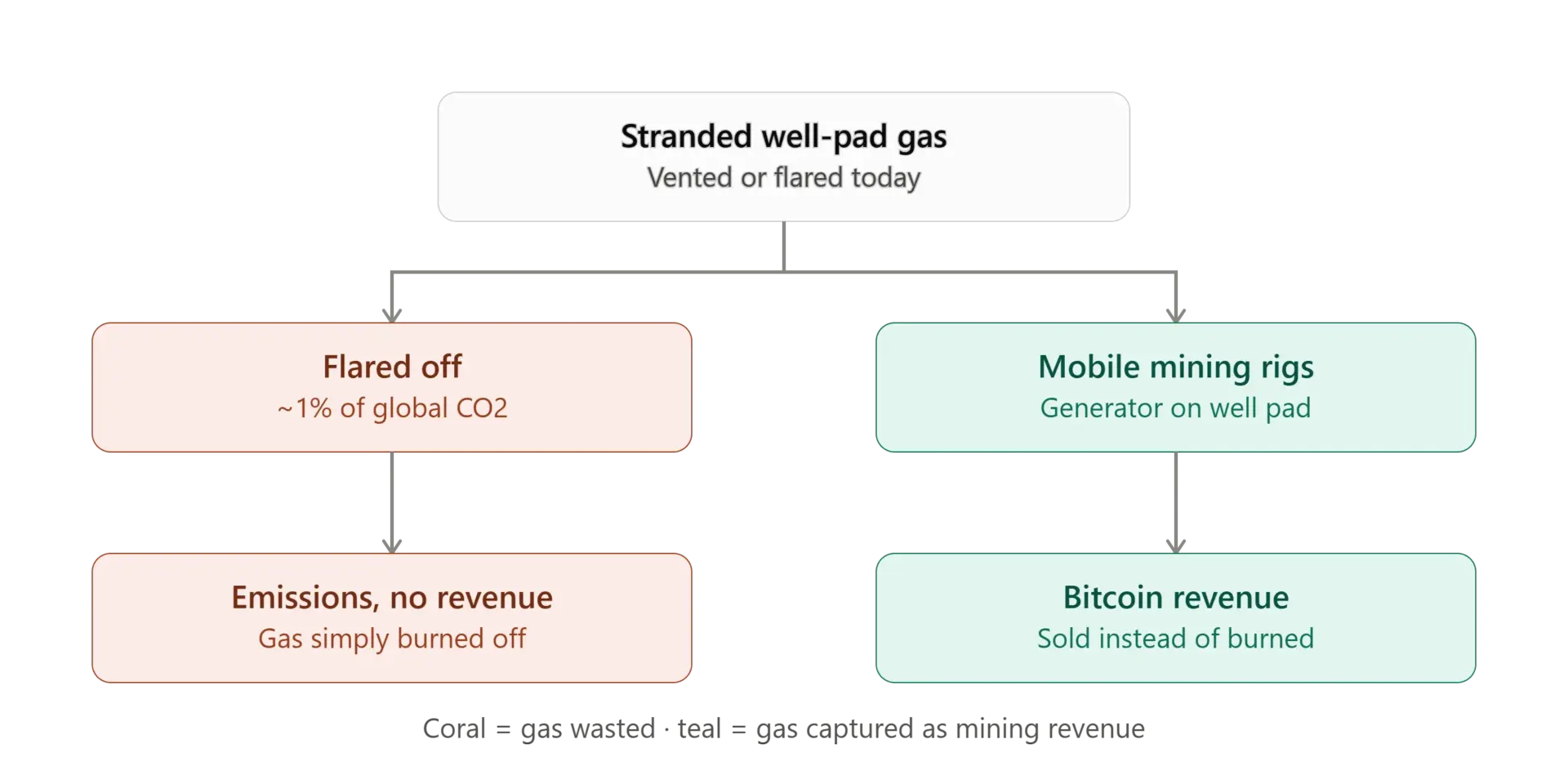
According to Interfax-Kazakhstan, the decree gives oil producers the green light to burn otherwise-flared gas for off-grid generation that can then supply electricity to digital mining. That redirection of excess power is only on the table when the resources are not needed for state purposes.
The decree was put out by the Ministry of Artificial Intelligence and Digital Development (MAIDD), and it also proposes carving out an exemption for regulated crypto income from personal income tax, as reported by Cryptopolitan.
The central bank and the Astana International Financial Centre contributed to the order, which additionally proposes building the infrastructure to use stablecoins to settle cross-border trade.
"Our goal is to make Kazakhstan a point of attraction for global capital and expertise while ensuring maximum transparency and protection for every participant in this market," MAIDD Minister Zhaslan Madiyev said in the announcement.
How Kazakhstan is redirecting stranded gas to crypto mining
Crusoe built its early business on turning waste gas into revenue — gas that for generations had simply gone up in flames through a process called flaring. Inefficient and responsible for roughly 1% of man-made atmospheric carbon dioxide, flaring has long been a necessity for disposing of the gas that oil wells vent in areas pipelines often cannot reach.
The company turned that strategy into mobile data center sites across the North Dakota and Montana shale fields, and it worked with producers such as Equinor, Devon Energy and Kraken Oil & Gas, according to the company in 2021.
"Bitcoin mining is the best buyer of last resort," Crusoe CEO Chase Lochmiller said, describing how the firm arrived at the idea of turning stranded power into mining.
By 2025, however, Crusoe had sold its Bitcoin mining and digital flare-mitigation operations to NYDIG as it fully pivoted to AI infrastructure. The company now operates a pipeline of more than 10 gigawatts of AI data center projects, and its founders wrote in a 2025 blog post: "What started with capturing waste methane in the oilfield to power Bitcoin mining has evolved into finding new and creative ways to power AI data centers."
Will Kazakhstan also abandon Bitcoin mining for AI?
The pieces line up more neatly than the country may intend. The ministry steering the decree is literally named for artificial intelligence. The 70/30 rule bundles "data centers and digital miners" into one category of power buyer. And Kazakhstan ranked among the top three countries by Bitcoin mining hash rate after China's 2021 ban, according to Cambridge Centre for Alternative Finance data.
Under the "70/30" model, data centers and miners would be able to tap up to 70% of the new power capacity created by infrastructure upgrades.
The demand side is real as well. Kazakhstan's regulated crypto market has grown more than 30-fold in three years to top $10 billion, Cryptopolitan reported this month, and Binance has picked the country for a regional settlement hub. Stranded gas, interruptible compute and a government courting global capital add up to the same recipe Crusoe rode from mining to AI.
So does Kazakhstan's mining play become an AI compute playbook? The honest read is a qualified yes. Nothing in the decree names AI training as the goal, and Kazakhstan's grid has strained under miners before. But the infrastructure it is authorizing — off-grid power at the wellhead feeding container-scale compute — is exactly the on-ramp that turned one flare-gas Bitcoin operation into a multi-gigawatt AI builder. The decree's own proposals double as the markers to watch: whether the personal income tax exemption for regulated crypto income is enacted, whether the stablecoin settlement infrastructure advances beyond the proposal stage, and how the 70/30 allocation of new power capacity is applied in practice.
The question is less whether the path exists than whether Astana chooses to walk it.
Reporting via Cryptopolitan.

