Kava Lend Loses $3.8 Million Overnight to Attacker Exploiting Missing Zero Check
Key Takeaways
- •An attacker drained approximately 55.2 million KAVA from Kava Lend by exploiting a dormant BUSD market and a missing check for tiny balances, inflating collateral value roughly 243,000-fold.
- •About 49.2 million of the stolen KAVA was bridged to BNB Chain through LayerZero and sold for approximately $2.09 million, while another 4.58 million KAVA moved to five unlabeled addresses.
- •The protocol's pooled deposits collapsed from 55.33 million KAVA to nearly zero within about 90 minutes, placing the loss directly on depositors.
- •KAVA's price fell more than 40% on Nov. 14, prompting Upbit, Bithumb and Coinone to suspend KAVA deposits and withdrawals, with Upbit also placing the token on its delisting watchlist.
- •Kava acknowledged the incident more than seven hours after it began, stating it was not an infinite mint and was contained within Kava Lend, but has not yet released an official loss figure or post-mortem.
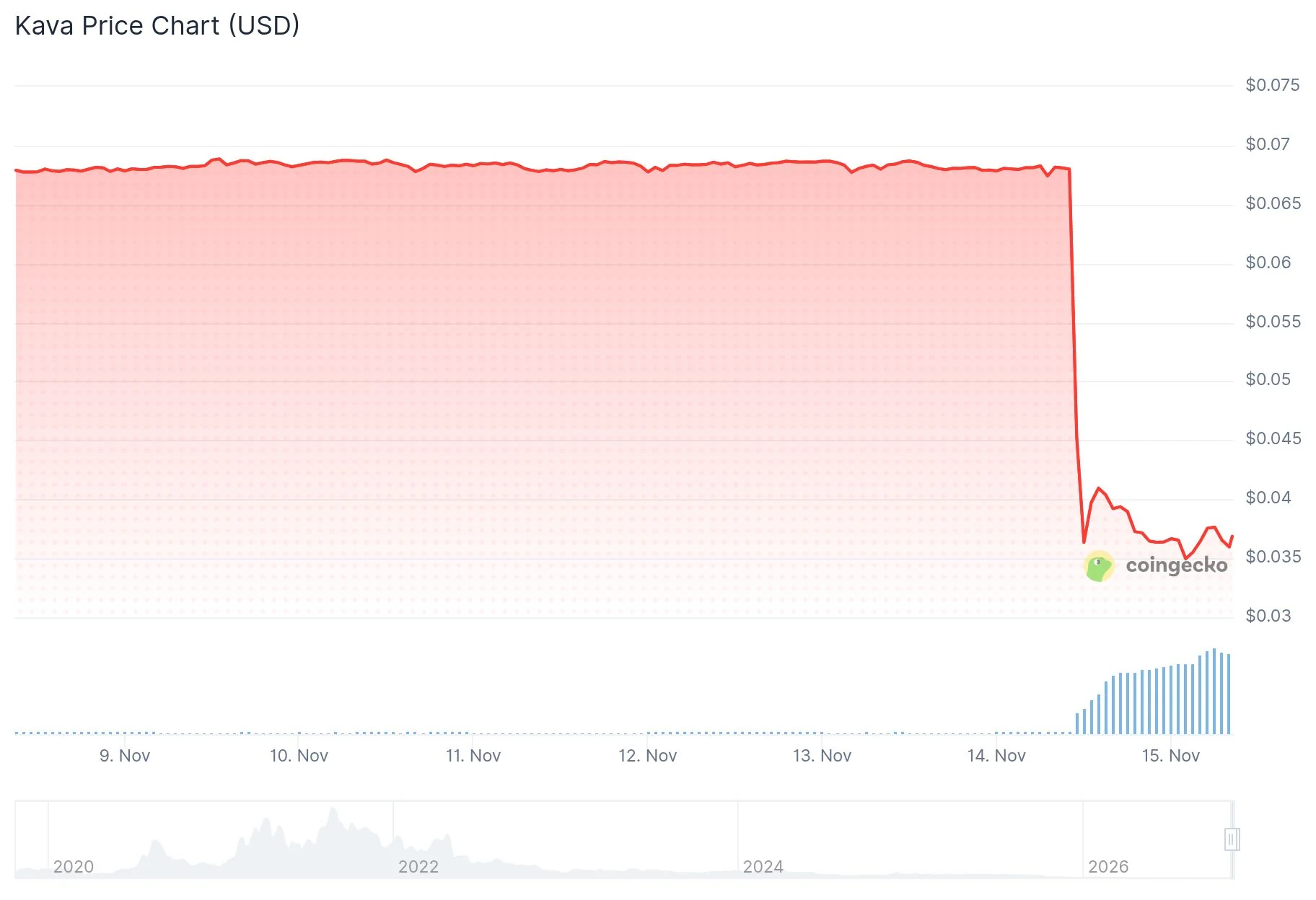
An attacker drained approximately 55.2 million KAVA from Kava Lend late Friday, according to on-chain data reviewed by The Block. At the pre-attack price of $0.068, the stolen tokens were worth about $3.76 million. The exploit leveraged a dormant BUSD market and a missing check for tiny balances, letting the attacker inflate the value of their collateral roughly 243,000-fold. About 49.2 million of the stolen KAVA was subsequently bridged to BNB Chain and sold for approximately $2.09 million, and the token's price fell roughly 40% in a single day.
Kava addressed the incident in a statement posted on X on Saturday:
Update on the situation: We are aware of recent on-chain activity involving the bridging and sale of KAVA tokens on BSC. To clarify: This is not an infinite mint. The event is isolated and contained within Kava Lend. Partner exchanges have paused deposits/withdrawals as a…
— Kava (@KAVA_CHAIN), November 14, 2026
Background
Kava Lend is the native lending protocol of the Kava blockchain, a Layer 1 network that links the Ethereum and Cosmos ecosystems. The KAVA token is used for staking, transaction fees, and governance. On-chain data shows the protocol's pooled deposits collapsed from 55.33 million KAVA to nearly zero within about an hour and a half during the incident. That collapse means the loss landed directly on depositors: the KAVA the attacker walked away with was drawn from the pooled funds lenders had placed in the protocol.
How the Attack Worked
The attacker targeted Kava Lend's market for BUSD, a stablecoin that Paxos stopped minting in 2023. That market stood almost empty before the attack. Even so, it remained live and functional — a deprecated asset that no longer had new issuance still anchored an operational lending market that could accept deposits and process borrows.
Kava Lend calculates depositor earnings by dividing borrower interest by a market's net supply. The code skips this calculation when supply is exactly zero, but it performs no check for tiny amounts above zero — meaning even a dust-sized balance could distort how depositor earnings are distributed. In effect, zero was the only safe boundary the code recognized, and anything above it counted as a working market.
At 11:01 p.m. ET on Friday, the attacker used a small BUSD loan to cut the market's net supply to two hundred-millionths of a dollar ($0.00000002). Within three minutes, the value of every BUSD deposit had grown approximately 243,000-fold. The attacker's earlier deposit was then counted as roughly 1.25 billion BUSD in collateral, against which they borrowed KAVA 127 times. A second account cleared each loan to get around the cap on KAVA borrowing.
On-chain records show repeated deposit and borrow cycles in the BUSD market beginning Nov. 8, in the days before the exploit.
Sales and Market Reaction
Starting at 4:59 a.m. ET on Saturday, the attacker bridged about 49.2 million KAVA to BNB Chain through LayerZero. Most of it was sold within the hour for 3,006.5 BNB and 231,557 USDT, worth roughly $2.09 million combined. The BNB proceeds have since been moved elsewhere. Another 4.58 million KAVA went to five unlabeled addresses on Kava.
KAVA fell more than 40% during the day on Nov. 14. CoinGecko data shows the price dropping from about $0.068 to $0.041.
Upbit, Bithumb and Coinone suspended KAVA deposits and withdrawals. Upbit also issued a caution notice and placed the token on its delisting watchlist. The suspensions block KAVA deposits and withdrawals on those venues until they are lifted.
Company Response
Kava first acknowledged the incident on X at 6:28 a.m. ET on Saturday, more than seven hours after it began, saying it was tracking unexpected behavior from a dApp in its ecosystem. About half an hour later, the team said the event was not an infinite mint and that the incident was isolated and contained within Kava Lend.
Kava paused its Axelar bridge as a precaution, though the stolen tokens left through LayerZero. The team has not given an official loss figure or published a post-mortem, but said it will share a full incident report when it is ready. Until then, several threads remain open to watch: an official loss figure, the contents of that report, what happens to the 4.58 million KAVA sitting at unlabeled addresses, and whether the exchanges that paused KAVA transfers restore them.
KAVA traded near $0.042 at publication, down about 39% over 24 hours.
This article is based on reporting originally published by CoinCentral.

