Kalshi's 2026 Government Shutdown Odds Fall 33 Points to 4% as Senate Talks Progress
Key Takeaways
- •Kalshi's October 1 government shutdown market fell 33 points overnight to 4% on September 1, 2026, down from 37%.
- •Senate negotiators from both parties were nearing a stopgap funding deal that would extend funding to December 4, 2026, alongside limits on a pending OMB regulation.
- •Senate Appropriations Chair Susan Collins led opposition to the proposed OMB rule, writing to Director Russ Vought with concerns about its impact on grants, rural areas, and scientific research.
- •The House passed its own short-term spending bill on July 21, 2026, but Senate Majority Leader John Thune was expected to set it aside in favor of the Senate's continuing resolution.
- •The Kalshi reading is a point-in-time snapshot of trader expectations and does not forecast either a shutdown or how Bitcoin and crypto prices will move.
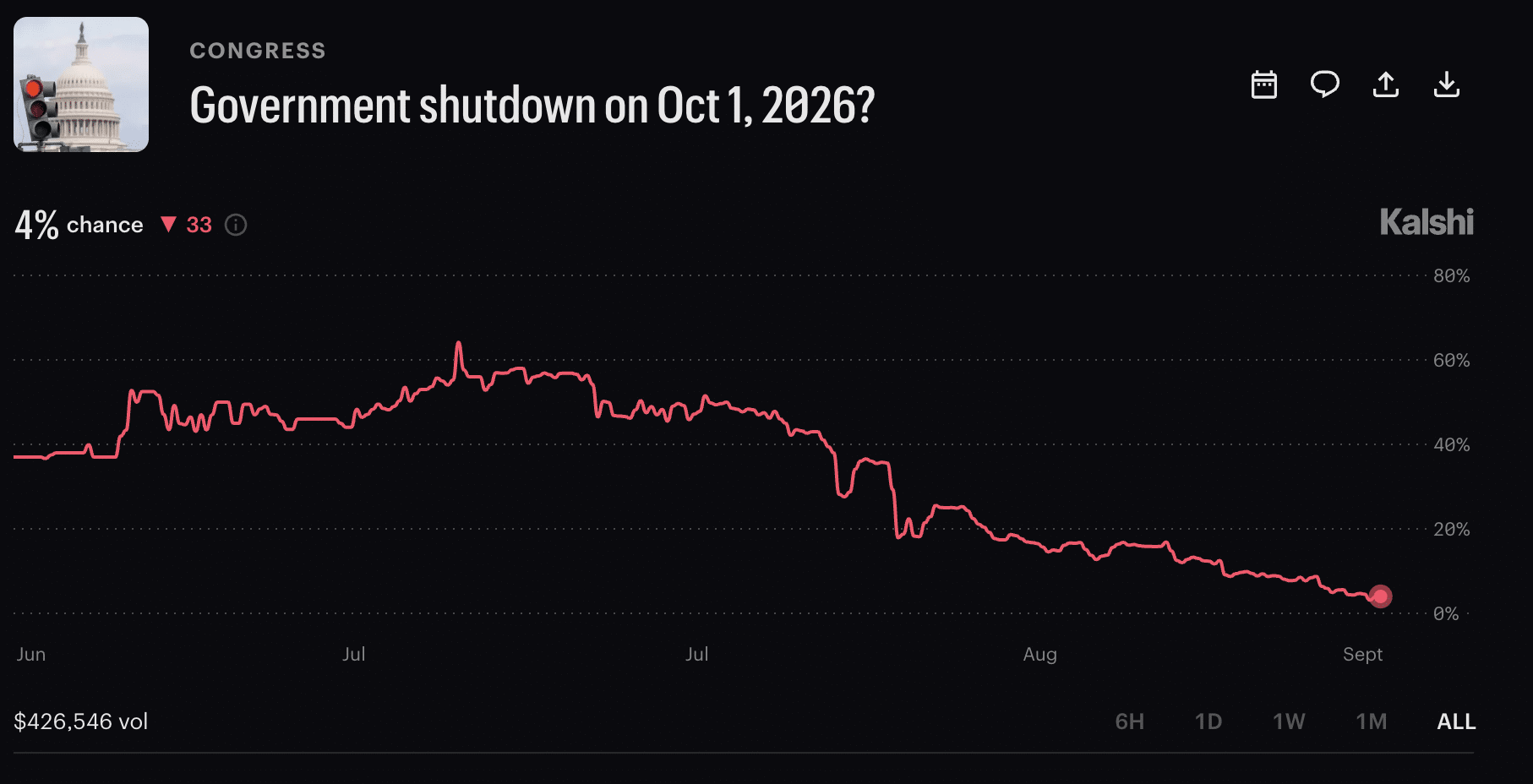
Kalshi's market-tracking betting odds of a government shutdown in 2026 dropped 33 points overnight to just 4% on September 1, according to the exchange's October 1 shutdown market. The sharp move lower came even as Senate negotiators said they were making progress toward a stopgap funding deal.
Kalshi is a regulated event contracts exchange where traders can put real money on the outcomes of events like government funding deadlines, so its pricing reflects aggregated participant expectations rather than an official forecast. A government shutdown occurs when Congress fails to pass and the president fails to sign appropriations legislation before existing funding expires, which in this case would be the start of the new fiscal year on October 1.
For Bitcoin and crypto readers, the market provides a snapshot of uncertainty surrounding the funding deadline. It does not, on its own, establish how Bitcoin or other crypto assets will trade if negotiations succeed or fail.
Why Shutdown Risk Fell Despite Signs of a Senate Deal
The decline came alongside positive signals from the Senate. According to The Hill, negotiators from both parties were nearing an agreement that paired a short-term spending package with new limits on a pending Office of Management and Budget regulation. Under the working framework, funding would extend to December 4, which would set up another funding deadline before the end of the year even if a deal is reached.
As described in the Kalshi report, the proposed OMB rule would allow political appointees to block spending that lawmakers had already approved. Senate Appropriations Committee Chair Susan Collins said the authority would conflict with Congress's control over the federal funding process.
Collins led Republican opposition to the proposed rule and wrote to OMB Director Russ Vought. She raised concerns about the rule's effect on grants and awards, rural areas, medical and scientific research, and people who rely on federal grant funding.
Meanwhile, the House passed its own short-term spending bill on July 21, 2026, according to Axios. Senate Majority Leader John Thune was expected to set it aside while senators worked on their own continuing resolution. The gap between the House and Senate tracks reflects the typical dynamic in funding fights, where the two chambers must pass identical legislation before it can reach the president's desk.
Democratic Sen. Jeanne Shaheen and Republican Sen. Roger Wicker expressed optimism about reaching a deal before the deadline, while Sen. Brian Schatz said negotiators were seeking room for a bipartisan agreement but had not reached one.
BREAKING: US Senate unanimously BANS all senators from getting a single paycheck if the federal government is shutdown, filed by Sen. Kennedy
FINALLY! This should've already been the case
Don't give them a DIME if they defund TSA and other crucial agencies. pic.twitter.com/I3I6kFN7ix
— Q Ascension (@QAscension347) September 1, 2026
What the Reading Means for Bitcoin
The September 1 market reading offers context for following the funding talks, but it does not provide a forecast for Bitcoin. The available evidence identifies the shutdown market's movement and the status of congressional negotiations.
However, it does not establish a specific relationship between a government funding lapse and price action across the crypto market, namely Bitcoin.
That distinction matters when interpreting a single market figure. A 4% reading on Kalshi indicated growing certainty about the October 1 deadline at that time, while the eventual funding outcome remained unresolved. Prediction-market prices can also move quickly as new headlines emerge, so the reading is a point-in-time snapshot rather than a stable indicator.
What the 4% Kalshi Market Measures
What is verified is straightforward: Kalshi's October 1 shutdown market read 4% on September 1, 2026, down from 37%, even as Senate negotiators reported progress toward a stopgap deal. The market crashed amid reported progress on Capitol Hill and continuing disagreements over funding policy.
For crypto readers, the figure is a dated measure of expectations around Washington's funding talks, not a forecast of either a shutdown or Bitcoin's next move. The unresolved questions to watch are whether lawmakers finalize a funding agreement before the October 1 deadline, and if so, whether the reported December 4 extension date holds — which would set the next funding fight before year-end.
The post Betting Odds of Government Shutdown 2026 Crashes to 4% on Kalshi appeared first on 99Bitcoins.
