Kalshi Bettors See More Bitcoin Downside as Traders Price in a Drop Below $50,000
Key Takeaways
- •Kalshi traders currently assign a 57% probability that bitcoin will drop below $50,000 before the end of 2026.
- •Kalshi’s year-end bitcoin price-range market has drawn nearly $29 million in volume, with the $60,000 to $70,000 bands priced at about 10% each.
- •Kalshi puts bitcoin’s odds of regaining $100,000 before January 2027 at roughly 12%, while higher targets remain in the low single digits.
- •Polymarket shows about a 36% chance of bitcoin touching $50,000 and a 2% chance of falling to $15,000.
- •Analysts point to fading spot bitcoin ETF inflows, macro uncertainty, and no clear recovery catalyst as reasons for the bearish positioning.
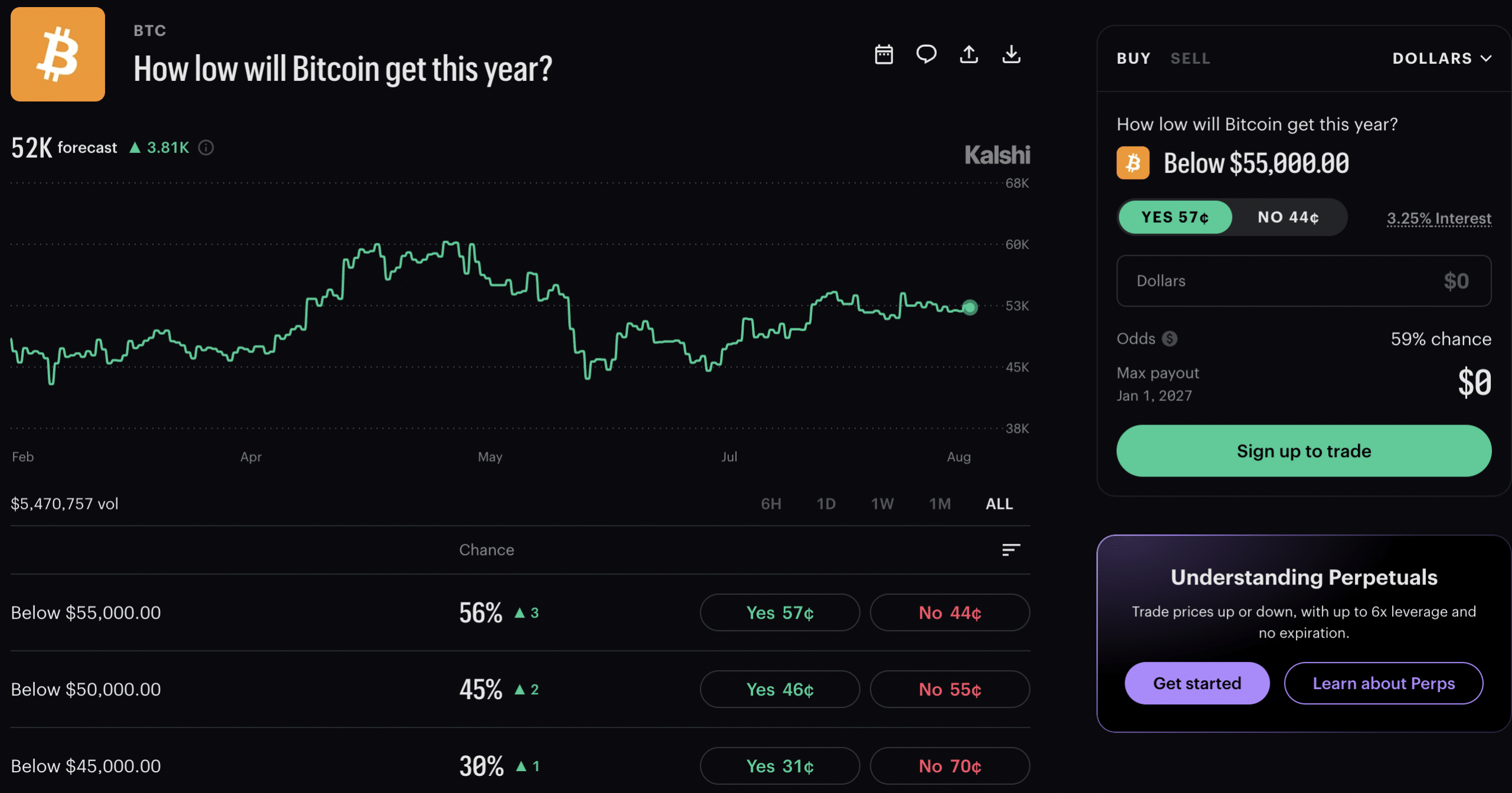
How low will Bitcoin go this cycle? That question is on many investors’ minds as the asset trades at around $63,400, up 1% over the past 24 hours.
Bitcoin has spent 2026 grinding through one of its choppier stretches since the last bear market, and traders on prediction platforms such as Kalshi are now putting real money behind guesses about how far it could still fall before year-end.
As of mid-August, bitcoin was trading in the low-$60,000s, roughly half its October 2025 all-time high near $126,000. That decline has already shaken confidence, and Kalshi’s event contracts, which allow users to bet yes or no on specific price outcomes, are showing clear if measured unease about further downside.
Prediction markets, especially Kalshi, now feature multiple contracts betting on how low Bitcoin will go, and many BTC bulls would rather look away: most traders appear unconvinced that the bottom is in yet.
What the Kalshi odds show
On Kalshi’s “how low will bitcoin get this year” market and related year-end price-range contracts, traders have priced in a 57% chance that bitcoin falls below $50,000 before the end of 2026, according to recent market snapshots.
That is a notable figure. It means more than half of the money wagered on that specific question expects a decline of roughly 20% or more from current levels.
Kalshi’s broader year-end price-range market, which divides bitcoin’s possible finishing price into $5,000 bands, has drawn nearly $29 million in volume. The bands in the $60,000 to $70,000 range are priced almost identically, with each carrying an implied probability of about 10%.
That lack of a clear favorite suggests traders do not have strong conviction about exactly where bitcoin will end the year. Instead, they see a wide range of plausible outcomes, which itself points to elevated uncertainty.
Separate contracts tracking a return to six-figure territory reinforce the bearish tone. Kalshi prices bitcoin at roughly 12% odds of reclaiming $100,000 before January 2027, while the $150,000 and $200,000 markets, which are thinly traded lottery-ticket bets, sit in the low single digits.
Rival platform Polymarket, which uses a different pricing benchmark, reflects a similar mood. It shows about a 36% chance of bitcoin touching $50,000 and just 2% odds of a collapse all the way to $15,000.
Why traders are bracing for more pain
THE NEXT 60 DAYS COULD BE BRUTAL FOR BITCOIN $BTC is still following the 4 year cycle and it could be over in 2 months Historically Bitcoin crashes 15%-20% in its final bear market phase before bottom If that happens BTC will dump to $50K by Q4 2026 pic.twitter.com/0HBSdtrG8B — Sweep (@0xSweep) August 17, 2026
THE NEXT 60 DAYS COULD BE BRUTAL FOR BITCOIN $BTC is still following the 4 year cycle and it could be over in 2 months
Historically Bitcoin crashes 15%-20% in its final bear market phase before bottom
If that happens BTC will dump to $50K by Q4 2026 pic.twitter.com/0HBSdtrG8B
— Sweep (@0xSweep) August 17, 2026
Analysts point to a mix of factors behind the bearish positioning, including fading momentum in spot bitcoin ETF inflows after a strong 2025, persistent macro uncertainty around inflation and trade policy, and the absence of an obvious catalyst that could quickly drive a recovery toward prior highs. In that context, the shift in prediction-market odds matters because it captures where traders are actually putting capital, not just where commentary is trending.
Bitcoin’s late-June plunge to around $58,000, which wiped roughly $40 billion from the broader crypto market in a single day, is still fresh in traders’ minds and helps explain why sub-$50,000 bets remain so heavily subscribed. Episodes like that tend to keep attention on downside risk, especially when the market is already far below its latest peak.
Prediction markets are not crystal balls. They reflect what traders are willing to bet, not certainty about the future. But because real money is involved, Kalshi’s odds often track consensus expectations more closely than social media chatter or individual analyst calls.
For now, that consensus points to a difficult second half of the year: a meaningful chance bitcoin revisits levels last seen in 2024, and only a modest chance it pushes back toward its old highs before the calendar turns.
EXPLORE: Best Crypto Presales With Asymmetric Upside in the Current Market

