Kakao Group and Circle Sign MOU to Explore Won-Backed Stablecoin Payments Infrastructure
Key Takeaways
- •Kakao, Kakao Pay and Kakao Bank will work with Circle to study stablecoin-related payment and financial infrastructure in South Korea.
- •The MOU covers potential uses including domestic payments, cross-border remittances, merchant settlement and tokenized financial services.
- •The agreement is exploratory and does not include a specific stablecoin model, issuance plan, redemption mechanism or launch timeline.
- •South Korean policymakers are still debating rules for won-backed stablecoins, including issuer eligibility, collateral management and internal controls.
- •Other South Korean institutions, including Kbank and KB Financial Group, have also tested blockchain-based remittance and stablecoin-related services ahead of regulatory clarity.
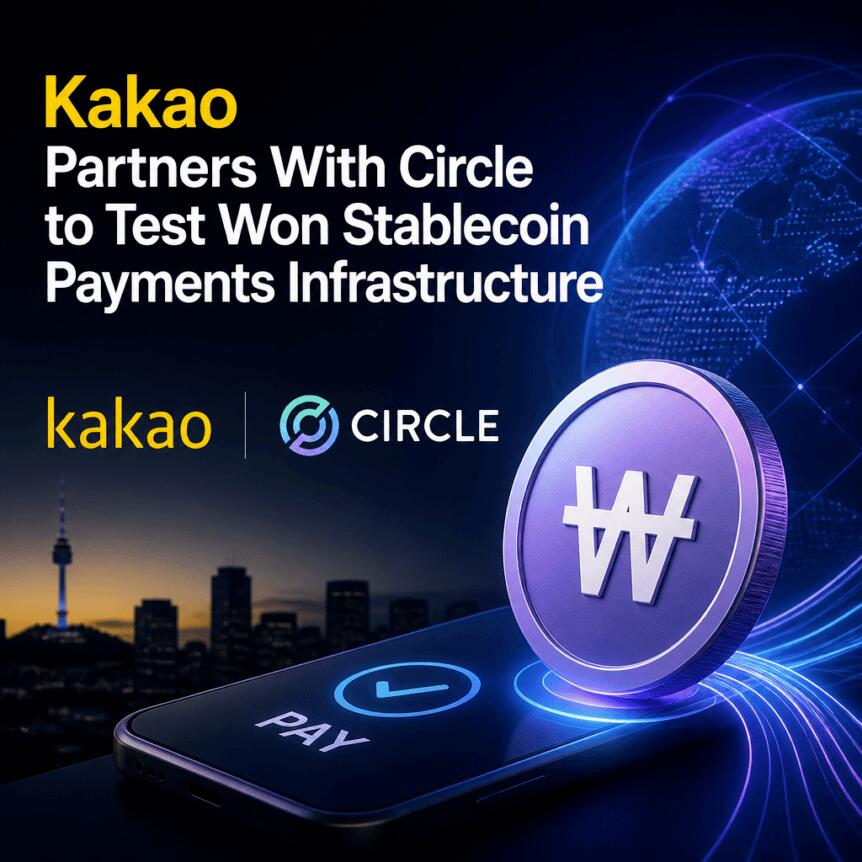
Kakao Group has entered into a strategic partnership with Circle to explore the integration of won-backed stablecoins into South Korea's mainstream payment and financial services ecosystem. The collaboration arrives amid an evolving regulatory landscape, with the South Korean government signaling continued legislative momentum toward a Digital Asset Basic Act.
On Thursday, Kakao, Kakao Pay, and Kakao Bank announced that they had signed a strategic memorandum of understanding (MOU) with Circle Internet Group. Under the agreement, the parties will jointly study how Circle's blockchain technology and global payment infrastructure can be connected to Kakao's consumer-facing platforms and financial services.
Scope of the Partnership
The MOU is centered on integrating won-backed stablecoin payments into Kakao's payment and banking ecosystem. The partners intend to explore multiple use cases, including domestic payments, cross-border remittances, merchant settlement workflows, and integration pathways linking traditional financial systems with blockchain networks. Tokenized financial services are also under consideration, though no specifics regarding products or launch timelines were disclosed.
The agreement is positioned as a technology and infrastructure study rather than a concrete product deployment. Circle's role, as described in the announcement, involves providing blockchain and global payments infrastructure that can be adapted for use within Kakao's services. The MOU does not specify a token model, issuance structure, or redemption mechanism, and no product roadmap was provided.
For large consumer platforms like Kakao, the strategic value lies in distribution and liquidity access. If the regulatory environment permits won-pegged tokens, partners could move to build compliant payment functionality across services already tied to consumer payments and banking. Until then, the commercial significance of the MOU rests less on an immediate launch and more on whether Kakao and Circle can map payment, settlement, and compliance workflows that fit future rules.
South Korea's Unsettled Regulatory Framework
South Korea has been advancing toward legislation for won-backed stablecoins, aiming to foster digital payment innovation while addressing risks related to reserve adequacy, redemption rights, and issuer oversight. Those issues are central to any local-currency stablecoin framework because they determine who can issue tokens, how users can redeem them, and what safeguards apply if tokenized payments become widely used.
According to Cointelegraph's reporting, the government has been preparing a bill that would outline requirements for stablecoin issuance, collateral management, and internal controls. Lawmakers have introduced competing proposals, reflecting an ongoing policy debate over how local-currency stablecoin markets should be structured.
A central point of contention concerns which institutions should be permitted to issue won-based stablecoins. The Bank of Korea has argued that banks should hold a majority stake in stablecoin issuers. The Financial Services Commission, by contrast, has cautioned that overly restrictive eligibility requirements could stifle competition and innovation.
This uncertainty carries practical consequences. Without clarity on issuer eligibility and governance expectations, companies can test technology but may face limitations in launching fully compliant services. This dynamic helps explain why Kakao and Circle have opted for an infrastructure-focused MOU rather than announcing a live stablecoin product.
Legislative Momentum Continues
Even as stablecoin rules remain contested, South Korea's legislative trajectory signals sustained momentum. In its economic growth strategy announced on July 14, the government included advancing the Digital Asset Basic Act among its priorities for the second half of 2026, according to an announcement reported by Korea's official website.
This signals that lawmakers are not retreating from regulation, though the specifics affecting stablecoin issuance and supervision may still shift as agencies debate the appropriate balance between oversight, competition, and systemic risk management.
Partnerships such as Kakao's can be viewed as a strategic hedge: by beginning integration work early, companies reduce dependence on any single regulatory outcome, positioning themselves to deploy once the final legislative framework is settled. For payment companies and banks, that preparation can include testing how blockchain-based settlement connects with existing customer accounts, merchant systems, and compliance controls before products are made available to the public.
Broader Industry Activity in South Korea
Beyond Kakao, other financial and technology firms in South Korea have been conducting pilots and tests while the regulatory groundwork continues. In April, internet bank Kbank partnered with Ripple to test blockchain-based remittances, per earlier coverage by Cointelegraph. The objective parallels what Kakao's MOU envisions—improving payment and cross-border settlement efficiency within local compliance constraints.
In May, KB Financial Group reportedly completed a pilot focused on stablecoin issuance, offline merchant payments, and cross-border remittances using the Kaia blockchain. KB Financial Group stated it plans to introduce stablecoin services once regulations take effect, reinforcing the broader pattern of pre-compliance experimentation followed by product rollout upon legal clarity.
These initiatives highlight a wider trend across South Korea's digital asset economy: established institutions and emerging builders are leveraging pilots and infrastructure research to reduce time-to-market, aiming to be operational as soon as regulators define how won-backed stablecoins should be issued and supervised. The overlap in use cases—remittances, merchant payments, settlement, and tokenized finance—also shows that industry participants are preparing around similar infrastructure questions even before lawmakers settle the final rulebook.
For now, Kakao and Circle's immediate next steps involve technical exploration—payments flows, remittance connectivity, and integration with existing systems—without a stated launch date. The resolution of the stablecoin bill debate, particularly around issuer eligibility and oversight, will likely determine which won-backed stablecoin implementations become legally feasible.
