KAIST and Nvidia Deepen AI Collaboration with Joint Research Labs; Seoul National University in Talks for Similar Facility
Key Takeaways
- •KAIST and Nvidia are launching a $300 million five-year joint research program to develop agentic AI technologies specialized for the Korean language and industrial ecosystem.
- •Nvidia will contribute its full-stack AI technologies, including Nemotron open models, plus $50 million annually in computing resources accessible through domestic cloud partners.
- •KAIST's mechanical engineering department will separately establish a Human Physical AI NVAITC focused on wearable robots, humanoids, digital twins, and a Human Motion Foundation Model.
- •The joint lab will support at least ten KAIST researchers annually, each receiving an Nvidia internship, with the company planning to recruit exceptional participants for full-time roles.
- •Seoul National University has also confirmed it is in separate talks with Nvidia to host an NVAITC facility on its campus.
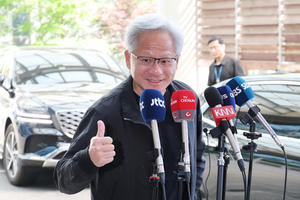
The Korea Advanced Institute of Science and Technology (KAIST) announced Friday that it is significantly expanding its research partnership with U.S. chip giant Nvidia through two major initiatives focused on physical artificial intelligence and agentic AI.
The centerpiece of the cooperation is a $300 million joint research program aimed at developing next-generation AI technology tailored to the Korean language and domestic industries. The deal represents one of Nvidia's largest university-level investments in Asia and comes as countries and institutions worldwide race to build sovereign AI capabilities — developing models tuned to local languages, cultures, and regulatory environments rather than relying solely on U.S.-trained systems.
"This collaboration marks the beginning of a strategic partnership combining world-class AI research capabilities with advanced AI infrastructure," said KAIST President Bae Choong-sik.
The announcements coincide with President Lee Jae Myung's visit to San Francisco for the AI Summit, where he met with Nvidia CEO Jensen Huang on Saturday. They also follow Huang's June visit to Seoul, during which he stated he had "brought four gifts for South Korea," including AI research facilities.
$300 Million Agentic AI Initiative
KAIST will establish the Nvidia-KAIST Joint AI Research Lab at its Kim Jaechul Graduate School of AI, dedicated to advancing next-generation agentic AI technologies specialized for the Korean language and Korea's industrial ecosystem. Agentic AI refers to semi- to fully autonomous AI systems capable of accomplishing specific goals with minimal or no human intervention.
The initiative forms part of KAIST's long-term strategy to secure core AI technologies for Korea and bolster the country's industrial competitiveness. South Korea has made AI a national priority under successive administrations, targeting the sector as critical to maintaining the country's edge in advanced manufacturing, semiconductors, and robotics.
Under the program, Nvidia's full-stack AI technologies and its Nemotron family of open models will be integrated with KAIST's research expertise. Nemotron is Nvidia's suite of open large language models, offered in various parameter sizes for enterprise and research use. The collaboration will span five years with a total investment of $300 million, including AI computing resources valued at $50 million annually. Researchers at the joint lab will gain access to Nvidia's latest AI computing infrastructure through the company's domestic cloud partners.
The lab will support a minimum of 10 KAIST researchers each year, with each participant offered an internship at Nvidia. The company also intends to recruit exceptional KAIST researchers for full-time positions.
Physical AI Research Center
In a separate announcement on Sunday, KAIST said its Department of Mechanical Engineering will collaborate with Nvidia to establish an Nvidia AI Technology Center (NVAITC) on campus, specializing in physical AI.
NVAITC is Nvidia's global research program through which the company partners with universities, governments, and industry on AI research, education, and deployment. Nvidia operates NVAITC facilities at universities in multiple countries as part of a broader strategy to seed adoption of its AI platform in academic and industrial research worldwide.
The new facility, named the Human Physical AI NVAITC, will be built around KAIST's Human Physical AI Research Center. Joint research will focus on areas including wearable robots, humanoids, and digital twin technologies. South Korea ranks among the world's top countries in industrial robot density, making advances in physical AI directly relevant to its manufacturing base and growing robotics sector.
KAIST's research center investigates how humans move in physical environments and maintain balance, with the goal of applying those mechanisms to AI and robotics. A key objective of the partnership is to develop what KAIST calls a Human Motion Foundation Model — a generative AI model designed to learn, predict, and reproduce human movement.
KAIST has formed a steering committee with Nvidia to oversee the program, with research results to be evaluated every six months. The partners also plan to hold an annual symposium convening experts in the field and to operate a student ambassador program offering KAIST students lectures and mentoring from Nvidia specialists.
Meanwhile, Seoul National University said Saturday it is also in talks with Nvidia to host an NVAITC facility on its campus.

