Korea Aerospace Industries Unveils S. Korea's First Homegrown Marine Attack Helicopter, Eyes 2027 Mass Production
Key Takeaways
- •The MAH is South Korea's first homegrown marine attack helicopter and represents KAI's expansion from utility aircraft into dedicated attack platforms after nearly two decades of helicopter development.
- •The aircraft is based on the KUH-1 Surion, uses essentially the same engine, features improved avionics and weapons systems, and has a speed of around 137 knots.
- •Development began in October 2022, the first prototype flew in December 2024, and three prototypes completed weapons firing and shipboard operation tests ahead of targeted mass production in 2027.
- •Its armaments include a 20-millimeter turret-mounted gun with up to 600 rounds, air-to-ground and air-to-air missiles, and guided and unguided rockets, with cockpit protection upgraded to withstand 12.7-millimeter rounds.
- •KAI President Kim Jong-chul said the helicopter offers firepower comparable to the US-made AH-64 Apache at roughly half the price, expressing confidence in its export potential.
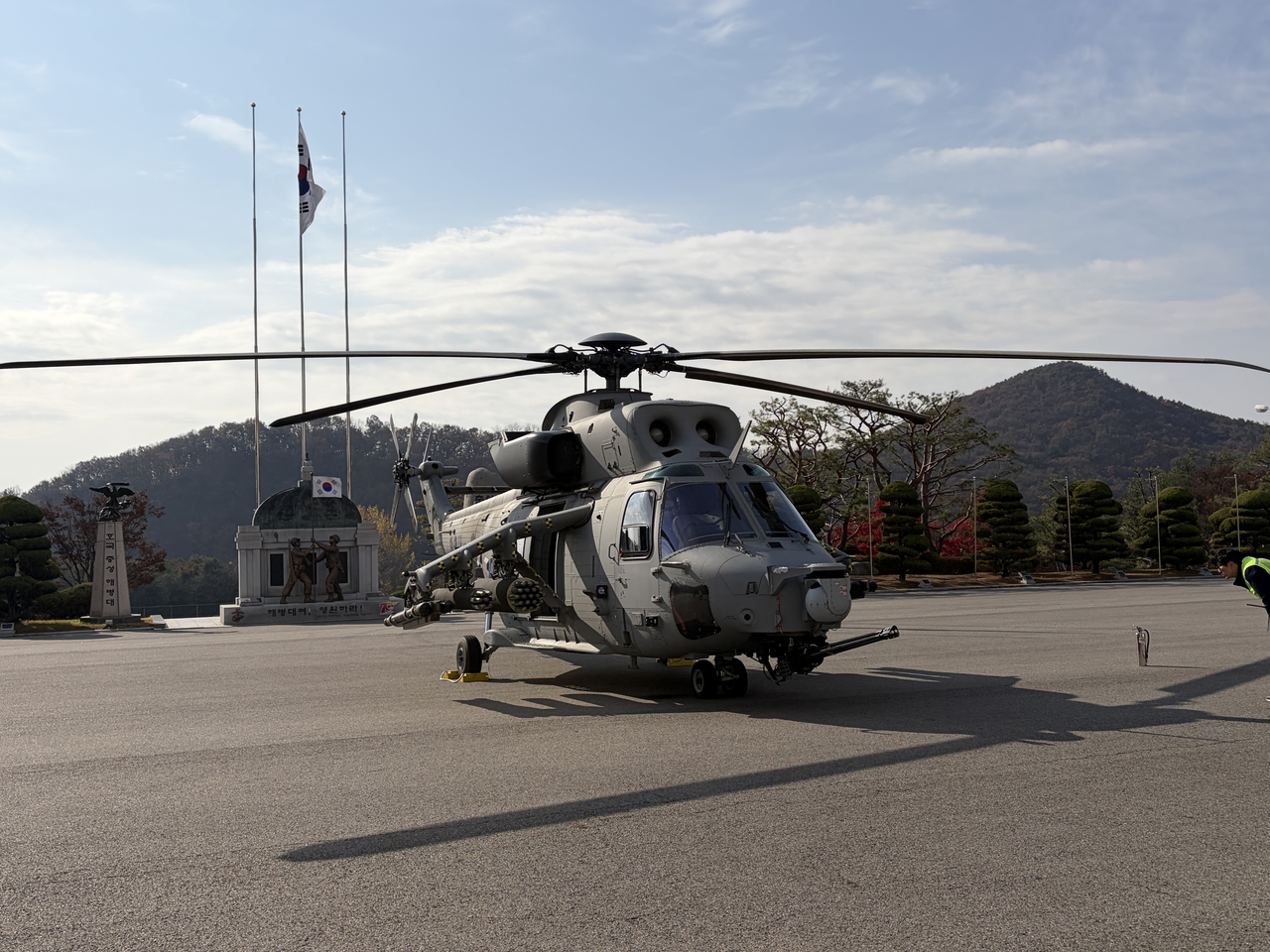
A deafening roar swept across the parade ground at the Marine Corps headquarters in Hwaseong, Gyeonggi Province, on Monday as a heavily armed helicopter descended, sending powerful gusts of wind across the field. Aboard was Kim Jong-chul, president of Korea Aerospace Industries (KAI), who had flown in from the company's headquarters in Sacheon, South Gyeongsang Province, to personally showcase its newly developed Marine Attack Helicopter, or MAH.
The journey covered a straight-line distance of roughly 250 kilometers in just one hour and 15 minutes, according to the company.
"Now that development is complete, I can say we've built a very good helicopter," Kim told reporters after landing.
The Monday event marked the first time the MAH has been unveiled to the public, following a private ceremony on Oct. 28 at which KAI announced the successful completion of its development.
The aircraft represents a milestone on two levels: it is South Korea's first homegrown marine attack helicopter, and for KAI it marks an expansion from utility aircraft into dedicated attack platforms after nearly two decades of helicopter development. The achievement also raises a question: why has it taken so long to develop an attack helicopter based on the KUH-1 Surion, which entered service more than a decade ago?
According to KAI officials, the answer lies in advances in the company's ability to integrate aircraft systems, particularly weapons.
The Surion, which entered service in 2012, was designed to transport troops and equipment. Its Marine Corps variant, the Marineon, was developed to carry Marines from ships to landing zones during amphibious operations. The MAH, by contrast, carries heavier and more varied weapons, allowing it to destroy enemy positions and anti-aircraft weapons while protecting transport helicopters and troops during amphibious assaults — capabilities the Marine Corps believes will reduce the risks faced by Marines landing in hostile territory.
"Weapons integration is not simply about attaching missiles to a helicopter," a KAI official said, emphasizing the complexity of the technology involved. The official explained that mounting weapons on an aircraft requires structural modifications to withstand their weight and firing forces, as well as software to control them without compromising flight stability. KAI has strengthened these capabilities through successive helicopter programs, including both armed and uncrewed aircraft development, building the expertise needed to turn an existing transport helicopter into an attack aircraft, the official added.
The Marine Corps first raised its requirement for attack helicopters in 2009, with the military eventually choosing domestic development in 2021. From that initial requirement to the mass production KAI now targets for 2027, the program spans nearly two decades.
A KAI test pilot who flew Kim to the headquarters said the MAH drew on the experience gained from developing the Surion and the Light Armed Helicopter Miron. "Think of it as combining the Surion and the Miron," he said, adding that the MAH incorporates the latest technology developed in the 2020s.
The pilot said the MAH uses essentially the same engine as the Surion but features improved avionics and weapons systems, with a speed of around 137 knots.
The helicopter measures approximately 19 meters in overall length, including its rotor, stands 5 meters tall and spans 6.1 meters across its weapon-mounting wings, according to KAI. Its armaments include a 20-millimeter turret-mounted gun carrying up to 600 rounds, air-to-ground and air-to-air missiles, and guided and unguided rockets.
Cockpit protection was strengthened to withstand 12.7-millimeter heavy machine gun rounds, compared with the Surion's protection against 7.62-millimeter rounds. The aircraft can remain airborne for approximately four and a half hours with maximum fuel loading.
Development began in October 2022, with the first prototype taking flight in December 2024. Three prototypes were built and underwent weapons firing and shipboard operation tests. KAI aims to begin mass production next year, in 2027.
Kim also expressed confidence in the helicopter's export potential, saying its firepower was comparable to that of the US-made AH-64 Apache, but at roughly half the price. The Apache can cost $50 million or more per aircraft, depending on configuration and procurement arrangements.
"If it offers capabilities comparable to the Apache at half the price, there would be little reason not to buy it," Kim said.
Source: Korea Herald

