Justin Sun Alleges WLFI 'Backdoor,' Warns of Risks Around $WLFI and $USD1
Key Takeaways
- •Justin Sun says a California federal court kept the dispute in the open, instead of sending it entirely to private arbitration.
- •Sun alleges World Liberty Financial built a backdoor into the $WLFI smart contract that could let it freeze, restrict, or burn tokens.
- •Sun claims WLF used those controls against his own $WLFI holdings and threatened criminal referrals when he pursued his rights.
- •Sun says he obtained a court order blocking WLF from burning, destroying, reallocating, or permanently disposing of his $WLFI tokens.
- •World Liberty Financial previously sued Sun for defamation after he alleged the firm used $WLFI as collateral on Dolomite and borrowed stablecoins, including $USD1.
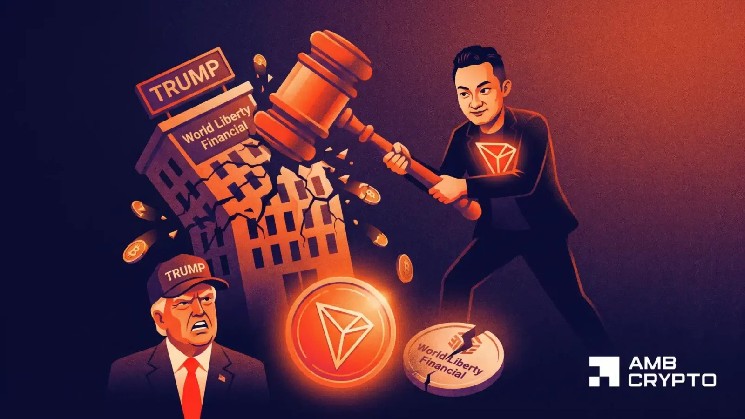
TRON founder Justin Sun has once again taken aim at President Donald Trump-linked World Liberty Financial (WLF), warning investors about the risks he believes exist around $WLFI and its stablecoin, $USD1. The stakes extend beyond the two parties: WLF is one of the most high-profile crypto ventures tied to a sitting U.S. president's family, and $USD1, the dollar-pegged stablecoin WLF launched in March 2025, has been positioned for payments and settlement use — putting the scope of its issuer controls under scrutiny.
In a recent post on X, Sun said his lawyers appeared in a California federal court because WLF wanted the dispute moved out of public view and into private arbitration, and wanted certain documents sealed. Arbitration is a private dispute-resolution process in which filings, hearings, and evidence are generally kept confidential, which is why Sun cast the venue fight as a transparency issue for holders of $WLFI and $USD1.
Justin Sun vs. World Liberty Financial
Sun said he was completely against the idea, insisting that the case remain publicly accessible rather than be decided behind closed doors.
"We argued forcefully that this case belongs in open court—and the Court agreed with us," he said.
The judge, however, also wants Sun and WLF to discuss which company-related claims should remain in federal court and which, if any, should proceed through arbitration. For Sun, the hearing nonetheless represents a milestone in his effort to keep the proceedings in public view.
"This is a significant win," he said — although it does not mean he has won the underlying lawsuit.
For context, Sun was one of WLF's earliest and largest investors, having invested $45 million in the project and received $WLFI tokens in return. He now claims:
"World Liberty secretly embedded a backdoor into the $WLFI smart contract that gave themselves unilateral power to freeze, restrict, and burn any holder's tokens without notice or due process."
Some degree of issuer control is common in token contracts: major stablecoins such as USDT and USDC give their issuers the ability to freeze addresses, functions typically described as compliance and anti-theft safeguards. Sun's allegation is more sweeping — that WLF held unilateral power over any holder's tokens, without notice or due process.
WLF threatens Tron's founder
Sun further alleges that WLF used this capability against his own $WLFI tokens, a step he describes as an unlawful seizure of his property. He also claims that when he attempted to exercise his legal rights, WLF threatened him with criminal referrals.
After filing the lawsuit, Sun says he obtained a court order preventing WLF from burning, destroying, reallocating, or permanently disposing of his $WLFI tokens. He argues the order was necessary because WLF had allegedly threatened to destroy the tokens and had the technical ability to do so.
Beyond $WLFI, Sun has claimed that $USD1 also has administrative controls that could allow WLF to freeze or potentially destroy tokens — a notable allegation for a stablecoin, an instrument whose usefulness depends on holders being able to access and redeem it at par.
Not the first time
The confrontation is not new. Back in April 2026, Sun alleged that WLF had deposited around 5 billion $WLFI tokens as collateral on Dolomite — a decentralized lending protocol where users post assets to borrow against them — and borrowed at least $75 million in stablecoins, including $USD1.
Rejecting those claims, WLF filed a defamation lawsuit against the billionaire crypto investor in May 2026, deepening the legal standoff between the two sides.
This time, Sun put his warning plainly:
"In my opinion, there is serious reason to be cautious about both $WLFI and $USD1."
The exchange leaves the TRON founder openly criticizing the Trump-linked platform over what he calls serious risks around $WLFI and $USD1, including his allegation that WLF threatened him with criminal referrals when he attempted to exercise his legal rights — a dispute now being fought in court as well as on social media, with WLF's defamation suit adding a second legal front. The immediate open questions are largely procedural: how the judge divides claims between federal court and arbitration, and how the order protecting Sun's tokens is applied as the case moves forward.

