US Justice Department Backs OpenAI's Fair-Use Claim, Warns Licensing Could Create AI Oligopoly
Key Takeaways
- •The Justice Department filed a statement of interest arguing that OpenAI's use of copyrighted writing in model training should be protected by fair use.
- •The government warned that mandatory licensing of training text would raise entry barriers, favoring wealthy corporations and established publishers while marginalizing smaller developers.
- •The filing does not provide blanket protection, distinguishing training from outputs reproducing copyrighted material and from how training data is obtained.
- •The New York Times and Authors Guild CEO Mary Rasenberger criticized the government's position, while Judge Sidney Stein remains free to disregard it.
- •Goldman Sachs Research projects global AI-related investment will exceed $1 trillion in 2026, including $581 billion in the United States.
The US Justice Department told a Manhattan federal court on Tuesday that OpenAI's use of copyrighted writing during model training should be protected by fair use — a position that could reshape the economics of the global AI industry as worldwide investment is set to exceed $1 trillion this year.
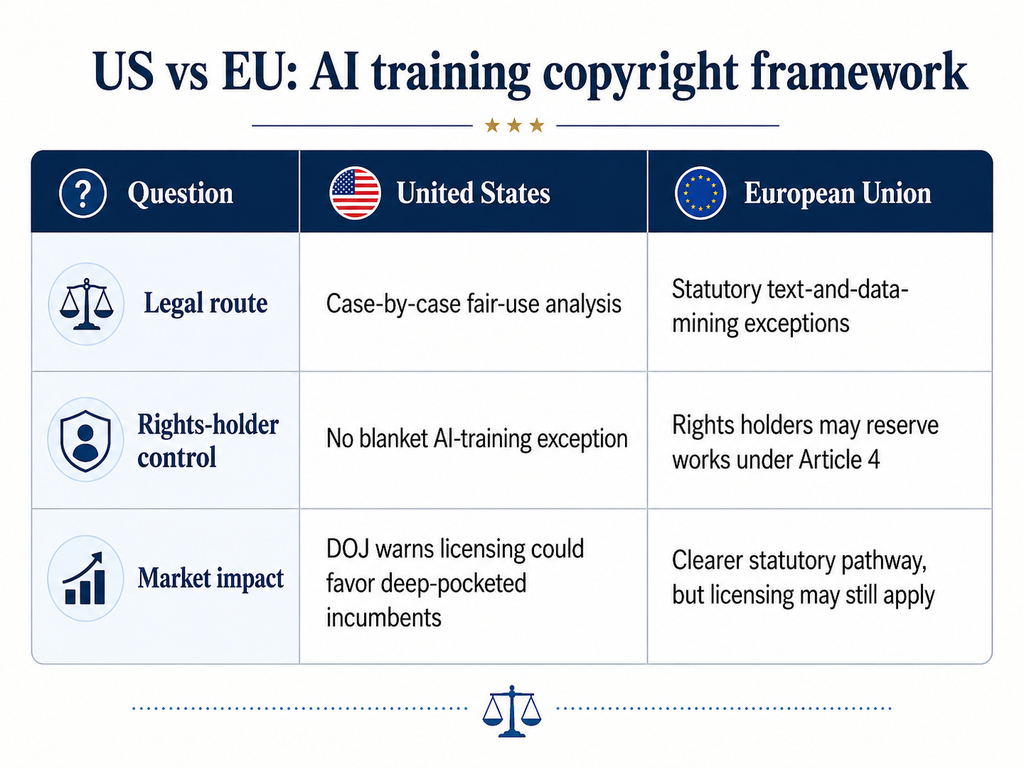
In a statement of interest filed in the consolidated copyright lawsuit against OpenAI, the government warned that if developers were required to license training text, only wealthy corporations would be able to continue building cutting-edge AI technologies.
The government framed its argument in both legal and economic terms: mandatory licensing could create major hurdles to market entry, bolster incumbent tech firms, and transfer much of the resulting profits to established publishers holding the largest archives.
Statements of interest like this one do not decide the case; they let the federal government signal its view on issues pending before a court, and judges remain free to weigh or disregard them.
Why Washington calls a licensing regime an entry barrier
According to the Justice Department, imposing a cost on the information used to train AI could marginalize smaller developers in favor of bigger players. This aligns with an OECD report finding that access to computing power, data, and expertise in the current AI market is already consolidated and will continue to favor well-established companies.
Washington also argued that smaller creators benefit from inexpensive AI tools. Authors, in particular, can use models to generate images they could not otherwise afford, or to find sources and perspectives they would otherwise miss.
The US Copyright Office, however, has taken a more nuanced stance, stating in its own report on generative AI training that some training uses may be covered by fair use while others may not, depending on the source of the material, the purpose of its use, and the market impact.
The transformative-use argument at the center
The Justice Department leaned heavily on the first fair-use factor, describing AI training as "extraordinarily transformative." Under US copyright law, fair use is judged by weighing several statutory factors — including the purpose and character of the use, the nature of the work, the amount used, and the effect on the market for the original. The government argued that training copies serve a different purpose from the original articles and that AI's benefits "far outweigh any competitive harm."
The filing does not, however, grant blanket protection to AI developers. It distinguishes between model training and outputs that reproduce copyrighted material, as well as questions about how training data is obtained.
That distinction is visible in the California cases. A Copyright Alliance analysis of Bartz v. Anthropic and Kadrey v. Meta notes that both courts ruled training was transformative, yet reached different conclusions on piracy and market harm.
Associate Attorney General Stanley Woodward Jr. called the filing a "historic statement of interest," linking the administration's copyright stance to the broader goal of maintaining the US position in AI.
National security and the race against foreign rivals
The filing also casts copyright rules as an industrial-policy and national-security issue, arguing that higher development costs could disadvantage US companies against foreign competitors.
The stakes are substantial. Goldman Sachs Research projects more than $1 trillion in global AI-related investment in 2026, including $581 billion in the United States.
The European Union has taken a different route. Its Digital Single Market Directive provides explicit text-and-data-mining exceptions, although rights holders can opt their works out of certain forms of mining. A US ruling on fair use would therefore unfold against a backdrop in which the world's two largest Western markets have already diverged in how they regulate AI training data.
What publishers and the court say next
The New York Times, which sued OpenAI and Microsoft in 2023, rejected Washington's position.
Authors Guild CEO Mary Rasenberger was equally critical, telling WIRED the filing was "extremely disappointed" territory — "replete with faulty arguments and a gross misunderstanding of the fair use doctrine and copyright law."
Berkeley copyright scholar Pamela Samuelson described the government's intervention more cautiously, calling it "a significant development."
Judge Sidney H. Stein, who is presiding over the case, is not required to follow the Justice Department's position.
A ruling in favor of OpenAI could still leave a crucial question unresolved: how training data is procured. As noted by Cryptopolitan, Anthropic's $1.5 billion settlement with authors concerned pirated copies of training material — not the act of training itself.
That difference may matter a great deal. Even if training is deemed fair use, AI developers still face significant legal risk from illegally obtaining the material used to build their models.

