Jupiter Review 2026: One Front Door to Solana, Six Very Different User Journeys
Key Takeaways
- •Jupiter consolidates spot trading, perpetuals, token research, prediction markets, fixed-term lending, and staking into a single Solana interface, with substantial data available before any wallet connection.
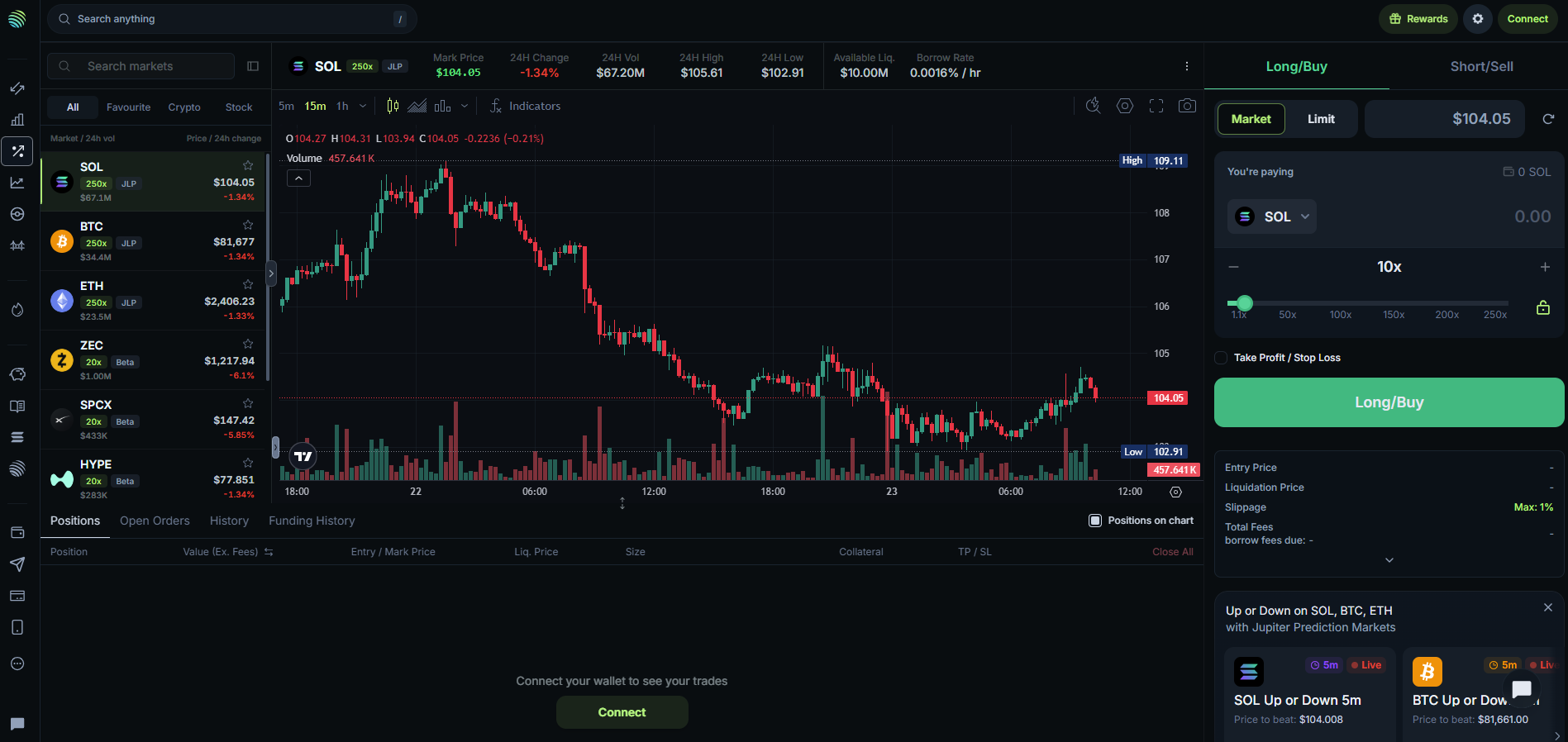
- •Perpetuals markets on the platform expose up to 250x leverage for SOL, BTC, and ETH and 20x for ZEC, HYPE, and JUP, with entry price, liquidation price, borrow fees, and a 1% slippage cap displayed before position sizing.
- •The Offerbook route displayed 652 fixed-term borrowing offers before wallet connection, including a 14, 13.5% APR offer at 42% loan-to-value collateralized by 149,743 PENGU tokens.
- •The JupSOL token page combined a chart, transaction feed, holder concentration showing 60.12% held by the top 10 wallets among 33.3K holders, and a Top Traders table with realized PnL figures reaching $4.94M.
- •The review identified interface density, distinct mental models across products, and a lack of interpretive or onboarding guidance as the platform's primary friction points, particularly for new users.
Jupiter behaves less like a single decentralized exchange and more like an operating system for Solana. That breadth is simultaneously its greatest strength and its first usability problem.
Without requiring a wallet, the public application offers an unusually wide set of paths: discovering tokens, inspecting a token's on-chain activity, browsing perpetuals, comparing fixed-rate borrow offers, exploring prediction markets, and choosing between native SOL staking and liquid staking. The first visit is neither slow nor empty — it is crowded. The strongest screens explain a decision before asking for a connection. The weakest point is context switching: every product carries its own vocabulary, risk model, and layout. The friction has an industry backdrop: Solana activity is spread across specialized protocols for trading, leverage, lending, event markets, and staking, each historically reached through its own front end. A single interface that routes orders across multiple liquidity sources and hosts those journeys side by side changes what day-to-day use of the chain looks like.
This review follows the product in the order a real visitor encounters it — Spot, Perps, token research, Prediction, Offerbook, and Stake — and records the actual controls opened on each route.
First Impression: Jupiter Does Not Behave Like a Swap Widget
The opening Spot screen makes Jupiter's ambition clear. Rather than leading with one oversized "Swap" box, the interface devotes most of its space to Market Pulse, Spotlight, Popular, Trending, Stocks, SmartMoney Buys, and a market-dominance heatmap, with the USDC-to-SOL form docked at the side.
Live capture data from Jupiter Spot on October 13, 2026 showed SOL at $106.64 (-4.8%), JUP at $0.33316 (-8.6%), PUMP at $0.00502, cbBTC at $82,864.18, and ZEC at $1,201.71. The visible SmartMoney Buys rows displayed $576K, $477K, and $290K.
The layout has a practical benefit: market research and the next action happen without a tab change. Market, Limit, DCA, Ultra, Paste CA, V1 transactions, and Connect are all exposed before a wallet enters the picture. A trader can watch a token move, open its detail page, and return to a prepared swap surface quickly.
The trade-off is cognitive load. A newcomer is met with price changes, news, token categories, stock-like assets, wallet controls, and trade modes all at once. Jupiter does not attempt to teach the basics; it assumes the visitor wants breadth first.
That assumption becomes tangible in the token cards. A Popular tile may highlight a low-cap asset with a large multiple, while the SmartMoney area speaks a different language wallets, purchase size, and market cap. Neither surface tells a new user which signal should matter more. The app delivers fast raw context, but the judgment layer is left to the user.
The top navigation reinforces the same personality: Spot, Stocks, Perps, Predict, Gacha, Lend, Offerbook, Stake, Portfolio, Send, and Deposit all sit close together. That is efficient for an experienced Solana user who already knows which route they need. For everyone else, it makes the first question — "what should be done here?" — harder than "where is the button?"
What Changed When Limit Was Selected
Clicking Limit converted the right-hand panel from an immediate-swap mode into a target-price flow while preserving the pair context. That small interaction matters: recurring and price-directed orders are built into the primary interface rather than buried in a separate product. No amount was entered and no order was created, so quote quality and execution are deliberately not claimed. Jupiter's Spot documentation describes the Market, Limit, and DCA mechanics and the platform's multi-source routing model.
Product Screens: What the Public Walkthrough Actually Shows
Perps: Risk Is Disclosed Before the Wallet Prompt
The SOL Perps route is a full trading terminal rather than a simplified leverage card. The header line, chart, market list, order form, positions area, and prediction cross-sell were all visible before connection.
The October 13, 2026 capture of SOL Perps recorded a mark price of $106.73, a 24-hour change of -4.79%, 24-hour volume of $223.32M, a high/low of $113.26 / $101.63, available liquidity of $10.00M, and a borrow rate of 0.0015% per hour.
The first usable insight is not the 250x headline but how much context Jupiter places beside it. The default leverage was 10x, and the slider visibly extended from 1.1x to 250x. Market and Limit sat alongside Long/Buy and Short/Sell. Take Profit/Stop Loss, entry price, liquidation price, total fees, borrow fees, and a maximum 1% slippage setting were all visible before any size was entered.
That is stronger risk disclosure than a terminal that only advertises maximum leverage — and it still does not make 250x sensible. The screen is built for people who already understand why entry, liquidation, borrow, and slippage need to be read together. For scale, most major centralized perpetual venues have historically capped retail leverage around 100x–125x, so the 250x markets sit at the aggressive end of what mainstream crypto interfaces expose.
The market selector makes differences between instruments visible without making the comparison simplistic. In the same public list, SOL, BTC, and ETH carried 250x labels, while ZEC, HYPE, and JUP were marked 20x. That tells a visitor Jupiter is applying different market constraints; it does not tell them a lower leverage cap is safer, since volatility, liquidity, and collateral still matter.
Switching From SOL to BTC and Opening Limit
The next action was selecting BTC, then Limit.
The BTC Perps capture recorded a mark of $82,840.48, a 24-hour change of -0.94%, 24-hour volume of $34.86M, a high/low of $84,265.98 / $80,957.41, available liquidity of $20.00M, and a borrow rate of 0.0013% per hour.
The terminal retained its layout but swapped in the new market context. Selecting Limit revealed a target-price field of $82,844, while order size remained 0 BTC — a useful interface distinction, since the user sees the intended entry price before deciding on quantity. No Long/Buy or Short/Sell submission occurred. Jupiter Perps is the source for the live route.
The SOL-to-BTC switch also showed why a terminal should not be judged on a single headline number. BTC's visible liquidity of $20M was double the SOL capture's $10M, yet its displayed 24-hour volume of $34.86M sat far below SOL's $223.32M at the two capture points. Those figures are snapshots, not an execution benchmark, but they make the comparison more concrete than a generic claim that Jupiter has "deep liquidity."
Token Research: JupSOL Offers More Than a Price Chart
Opening the JupSOL token page moved the journey from broad discovery to asset-specific research. One screen layered a chart, transaction feed, token data, holder concentration, news, swap controls, and multiple research tabs.
The JupSOL capture showed a price of $129.26, a 24-hour change of -4.69%, market cap of $551M, liquidity of $551M, 33.3K holders, an Org Score of 88.0, and 24-hour volume of $3.44M.
The visible transaction stream contained buys and sells at $129.26, $129.24, and $129.21. The information panel displayed 60.12% Top 10 Holders, No Freeze Auth, and Yes Mint Auth. Those are useful prompts for research, not pass/fail safety badges: concentration and mint authority must be interpreted in the context of the asset.
The page also embodies a meaningful product choice. A user can remain on the chart and transaction feed, or move into holder and trader analysis without leaving Jupiter. Traditionally this mix of holder data and trader flow lives in separate block explorers and analytics dashboards; placing it beside the chart and the swap form shortens the distance between noticing a token and interrogating it. The cost is visual overload: price, market cap, liquidity, holders, Org Score, transaction data, wallet tags, news, and a swap form all compete for the same screen. For an active researcher this is efficient; for someone buying a first token, it is probably too much.
From Transactions to Top Traders
Clicking Top Traders replaced the transaction feed with a table of remaining position, bought/entry, sold/exit, realised value, PnL, SOL activity, and funding.
The Top Traders capture recorded a price of $130.33, 24-hour volume of $3.32M, buys of 4.2K / $1.82M, sells of 3.9K / $1.49M, and a displayed net volume of +$324K.
The leading rows displayed realised/PnL figures of $4.94M, $2.50M, $2.68M, and $1.92M. This is strong tooling for studying token flow. It is not copy trading: the table cannot show an address's external hedges, transfer history, or future risk.
A small but useful proof of liveness appeared while switching this tab: the JupSOL price moved from $129.26 on the transaction screen to $130.33 on Top Traders, while 24-hour volume shifted from $3.44M to $3.32M. That does not validate every data point, but it shows the page was not a frozen presentation image.
Prediction: The Real Surface Is Broader Than Crypto
The first brief visit to Prediction did not finish loading; a longer revisit did, and the difference changes the assessment. Jupiter Prediction loaded a proper browse grid spanning politics, crypto, sports, culture, economics, tech, finance, weather, and more.
The Prediction showed a featured trade card of $11,865.52. Visible markets included 95¢/80¢, 18¢/16¢, and 89¢/7¢ outcomes, with card volumes of $1.044M, $45.756M, $65.404M, and $180.406M.
The featured-bet carousel was advanced: the card changed from an $11,865.52 Yes bet on Ken Paxton to an $11,871.04 No bet on James Talarico. That confirms the browse component is interactive and live-updating. Copy bet, Yes, and No were deliberately not selected; this review cannot claim order routing, price locking, or settlement quality.
The important experiential change is that Prediction stopped feeling like a crypto-only add-on once the grid loaded. Political, sports, macro, weather, entertainment, and crypto contracts all use the same compact Yes/No card format. That makes discovery fast, but the design encourages rapid scanning of probabilities without presenting much explanatory context alongside a market. A visitor needs to open the event before treating a price as a complete view of the underlying question — a Yes price is, mechanically, a live probability read on the question, useful at a glance and incomplete as an answer.
Offerbook: The Strongest Pre-Commitment Lending Disclosure
Offerbook was the most convincing lending-style route because it displayed actual offer terms before the wallet barrier.
Its capture showed a default borrow amount of 500 USDC, 652 available offers, and selectable tenors of 7d, 14d, and 30d.
With 14d selected, the top PENGU-collateral offer displayed 42% LTV, 13.5% APR, cost 1.29, and 149,743 PENGU locked. Other visible rows showed 63% LTV at 15% APR / 3d / cost 0.62, and 20% APR / 3d / cost 0.82.
That is a clear improvement over a generic "connect wallet to see rates" flow. The visitor can compare duration, collateral profile, borrowing rate, and cost before choosing collateral. The journey stopped at Choose collateral and Connect wallet; no loan was accepted.
The fixed-term presentation is one of the walkthrough's better moments of product clarity. "14d," "13.5% APR," and "cost 1.29" sit together, so the visitor does not have to translate an annualised rate into the immediate cost alone. The structure is also distinct within DeFi: pooled lending protocols typically price loans with variable rates that float with utilization, while a book of fixed-term, fixed-APR offers behaves more like a set of discrete contracts a borrower can shop. The remaining ambiguity is collateral risk: the screen gives LTV and locked collateral, but the consequences of a missed repayment are not as immediately prominent as the "without liquidations" promise.
Stake: Jupiter Makes the Native-versus-Liquid Choice Explicit
The Stake page opened on Native, then switched to JupSOL. The difference is meaningful rather than cosmetic.
The Native Stake capture showed a TVL of 10,758,267.51 SOL, an estimated APY of 4.74%–6.74%, and a stated unlock of 2 days. Native emphasises direct validator rewards, maximum security and decentralization, and a disclosed unlock period.
The JupSOL tab changed the panel to receiving JupSOL, "Instant liquidity," "Auto-compounding staking rewards," and use across DeFi protocols.
This is a genuine product fork: Native prioritises validator rewards and an exit delay, while JupSOL prioritises liquidity after staking. The fork mirrors the broader proof-of-stake design choice that made liquid staking a category of its own: converting a locked validator position into a transferable asset. The public page explains this choice well, though it cannot validate reward accrual or actual unstaking time without a connected wallet and funds.
The language shift between the two tabs is useful because it prevents them from being mistaken for the same product with different branding. Native frames the position around validator security and direct rewards; JupSOL frames it around deploying the received asset elsewhere after staking. The visible APY range is the same page-level reference point, but the liquidity trade-off — not the headline yield — is the decision a user actually has to make.
Three Real User Journeys Jupiter Handles Well
The strongest way to judge Jupiter is not to ask whether every tab is useful to every person. It is to follow the paths that naturally connect.
1. The Token Researcher
The practical path is Spot → token page → Transactions → Top Traders. The opening dashboard supplies discovery signals; the JupSOL page then supplies price, liquidity, holder concentration, live prints, token flags, and trader-flow data. No external tab was required to move from "this asset is moving" to "who is trading it, and how concentrated is it?"
This is Jupiter at its best: it shortens research without pretending a signal is a conclusion. A card on Spot might attract attention, but the token page supplies the facts that should slow a decision down — $551M liquidity, 33.3K holders, 60.12% held by the top ten, and a shifting buy/sell flow. The weak point is interpretability. Jupiter surfaces the inputs; it does not tell the user how much concentration is acceptable or whether a high-PnL wallet took risk elsewhere.
2. The Active Perps Trader
The practical path is Perps → select market → compare header data → choose Market or Limit → decide whether the position is worth connecting a wallet for. The SOL-to-BTC switch demonstrated this is not a cosmetic market list: price, volume, available liquidity, borrow rate, chart, and entry control changed together while the risk controls remained in place.
For this user, the strongest feature is not "250x." It is the fact that Jupiter puts borrow rate, max slippage, TP/SL, liquidation context, and limit price close to the action, making a quick pre-trade checklist possible. The friction is that the page expects literacy: a trader who cannot explain the relationship between leverage, liquidation price, and position size receives the same dense interface as an expert.
3. The SOL Holder Choosing Yield or Liquidity
The practical path is Stake → Native versus JupSOL, with Offerbook as a separate route for fixed-term collateralised borrowing. The Stake tabs make the first decision direct: use a native route with a stated two-day unlock, or receive JupSOL for liquidity and other DeFi uses. Offerbook then presents the different decision involved in borrowing: collateral, LTV, term, APR, and cost.
These screens avoid a common DeFi weakness: marketing yield before showing the mechanism. Jupiter showed the lockup before staking and displayed 42% LTV, 13.5% APR, and a stated cost before a 14-day loan could progress. The limitation is not hidden: all meaningful capital movement begins only after a wallet is connected.
The Pre-Wallet Boundary
Before connecting a wallet, the live public screens already permitted substantive checks: market context on Spot and Perps, token metrics and holder concentration on the JupSOL page, offer terms on Offerbook, and staking parameters on Stake were all reviewable without signatures. That openness is not the norm; DeFi front ends commonly gate rates and data behind a connect prompt, and Jupiter's public disclosure precisely what makes a pre-commitment review like this one possible.
That distinction raises the credibility of the review. A public application can be assessed deeply without claiming a financial transaction occurred. The boundary is not a missing paragraph; it is the exact point where the product changes from information and configuration into fund movement.
Where Jupiter Frustrates
The product's breadth creates three recurring frictions.
Too much interface for a new user. Spot and Perps expose valuable information, but their density assumes familiarity with slippage, liquidity, liquidation, LTV, and funding. There is little progressive onboarding between discovery and a risk-bearing control.
Each product is a distinct mental model. Spot is an aggregator, Perps is a leveraged terminal, Offerbook is fixed-term lending, Prediction is event pricing, and Stake is a capital-allocation decision. Jupiter connects them in navigation, but offers no unified explanation of when one should be used instead of another.
The public boundary is firm. The app supplies substantial pre-wallet data, yet the final experience — signature wording, swaps, fills, collateral movement, staking rewards, and withdrawals — begins only after a wallet connection. That is an unavoidable line for a self-custody product, but it means a public walkthrough should never pretend to be a trade-execution review.
One additional friction is product naming. "Lend," "Offerbook," "Native," "JupSOL," "Ultra," and "V1 transactions" appear quickly in the flow, but the app rarely pauses to distinguish which choice changes price, which changes risk, and which changes the transaction path. The result is powerful once the vocabulary is familiar — and intimidating before it is.
Who Jupiter Is For
A strong fit for:
- Solana users who want token discovery, swapping, perpetuals, lending-style offers, prediction markets, and staking routes in one environment;
- active traders who read liquidity, borrow rate, leverage, and liquidation information before acting;
- researchers who want a token's transactions, holder metrics, and Top Traders table alongside trading controls.
A weak fit for:
- new crypto users looking for a guided first purchase;
- users who want one simple mental model for every financial action;
- anyone who cannot independently evaluate leverage, collateral terms, or token-risk indicators.
Final Verdict
Jupiter earns its "everything exchange" positioning at the interface level: the product routes are real, public data is unusually deep, and the path from research to action is short.
The same scope creates the cost. Jupiter is not calm or instructional; it is a busy professional toolbox. Spot, Perps, Offerbook, Prediction, and Stake all worked as accessible public surfaces, but they serve different types of decisions. The best reason to use Jupiter is not that it makes DeFi simple — it is that it places many Solana decisions behind one fast, data-rich front door. What to watch from here is product rather than market direction: whether Jupiter adds the interpretive layer — clearer naming, progressive onboarding, more prominent risk framing — that its own friction points keep surfacing.
Sources
- Jupiter Spot
- Jupiter Perps
- JupSOL token page
- Jupiter Prediction
- Jupiter Offerbook
- Jupiter Stake
- Jupiter Spot documentation
Disclaimer: This article is for informational purposes only and does not constitute financial or investment advice. Cryptocurrency and digital asset markets carry significant risk. Always do your own research before making decisions.

