Federal Judge Denies Joint Gemini-CFTC Bid to Scrap $5 Million Biden-Era Settlement
Key Takeaways
- •A federal judge denied a joint request from Gemini and the CFTC to scrap the $5 million settlement in the CFTC v. Gemini Trust Company case.
- •The settlement originated under the Biden administration as part of a wave of digital-asset enforcement actions pursued by the CFTC during that period.
- •The joint motion to unwind the settlement reflected a shift in enforcement priorities following the change of administration in early 2025.
- •The ruling leaves the $5 million settlement fully intact as the operative legal instrument governing the dispute.
- •The denial signals that courts retain independent authority over consent-based resolutions and are not obligated to vacate them simply because both parties request it.
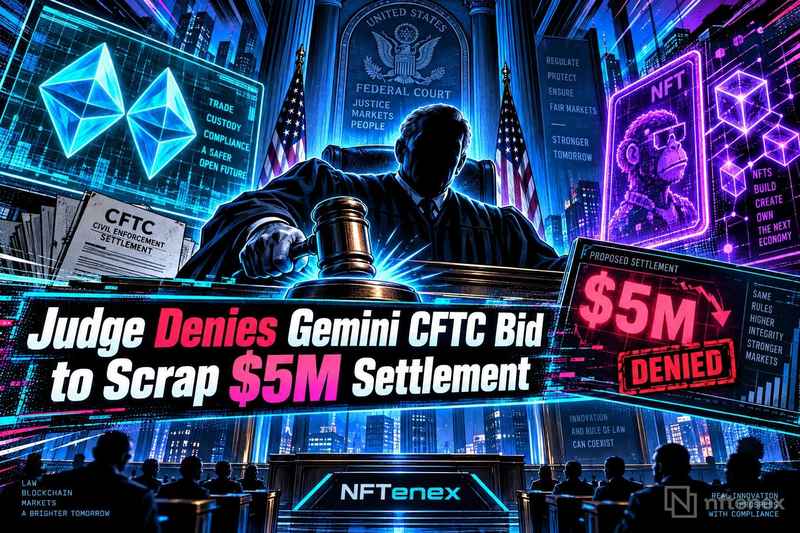
A federal judge has denied a joint effort by crypto exchange Gemini and the Commodity Futures Trading Commission (CFTC) to scrap a $5 million settlement reached during the Biden administration, according to the public docket in the case of CFTC v. Gemini Trust Company.
The ruling leaves the settlement fully intact and turns away what had been an unusual alignment between regulator and regulated: both parties to the enforcement action asked the court, together, to unwind their earlier resolution — a request a judge remains free to grant or refuse on independent judgment.
A Joint Push to Vacate
The motion stood out precisely because it was joint. In most enforcement matters, a regulated company contests an agency's penalties while the agency defends its own action; the two sides rarely stand together to seek the same relief. Here, Gemini and the CFTC filed as one, asking the court to undo the agreement that had closed the case — a posture that reflects the shift in enforcement priorities that arrived with the change of administration in early 2025. The court declined the request.
The settlement itself originated under the prior administration, part of a wave of digital-asset enforcement actions the CFTC pursued during that period. The CFTC's press release on the matter sets out the agency's account of the underlying case. The specific allegations that led to the original resolution, the settlement's terms beyond the dollar figure, and the court's reasoning for the denial are details that require direct review of the court record before they can be stated as established fact.
The dynamic of a regulator and a former enforcement target joining forces to erase a prior penalty has surfaced across several crypto cases since early 2025, as federal agencies revisited Biden-era actions. Courts, however, retain independent authority over consent decrees and settled judgments, and a judge is not bound to honor a joint request to vacate simply because both parties support it — setting aside a final judgment requires a legal ground the court recognizes and weighs on its own.
Why the Biden-Era Settlement Is Back Before the Court
The label attached to the settlement reflects the broader wave of reconsideration now running through crypto enforcement, as agencies reexamine positions taken during the prior regulatory cycle. Regulatory relationships in the digital asset space have been reshaped rapidly, and the withdrawal of VanEck's SEC registration for its Lido Staked Ethereum ETF stands as one example of that realignment.
Several material details remain unconfirmed without direct review of the docket: the date of the original settlement order, the exact conduct the CFTC alleged, the procedural vehicle the parties used to seek vacatur, and any conditions the original settlement placed on Gemini. Those particulars exist in the publicly accessible court record, which should be treated as the authoritative source.
What the Denial Means for Gemini and CFTC Enforcement
The immediate practical effect of the ruling is straightforward: the $5 million settlement remains the operative legal instrument governing the matter. Neither Gemini nor the CFTC succeeded in removing it from the books. Whether either party intends to appeal the denial, file further motions, or accept the ruling is not established by the available record — any such step, from a renewed motion to a notice of appeal, would surface first on the public docket.
The decision also signals that federal courts will not automatically ratify jointly requested unwinding of consent-based resolutions in crypto enforcement cases, even where the agency and the respondent stand together. The court's role as an independent check on settlements it previously approved is a meaningful procedural constraint, regardless of who asks for relief or why.
Payment status under the original settlement, any compliance conditions Gemini remains subject to, and the broader precedential weight of this denial for other pending CFTC crypto matters all require further sourcing from official filings before conclusions can be drawn.
Disclaimer: This article is for informational purposes only and does not constitute financial or investment advice. Cryptocurrency and digital asset markets carry significant risk. Always do your own research before making decisions.

