JPMorgan Extends JPMD Tokenized Dollar Deposit From Base to Ethereum Mainnet
Key Takeaways
- •JPMorgan's blockchain unit Kinexys announced that JPM Coin (JPMD), the bank's tokenized US dollar deposit, now supports transfers across EVM networks including Base and Ethereum mainnet.
- •JPMD remains restricted to approved institutional clients through permissioned Blockchain Deposit Accounts, with no retail availability.
- •Kinexys cited Ethereum's established depth of onchain liquidity and tokenized assets as the reason for choosing the network, with intended uses spanning payments for crypto firms and trade settlement or collateral posting for financial institutions.
- •JPMD launched on Base in November 2025 after a pilot begun in June with Coinbase, Mastercard, and B2C2, and is slated to arrive natively on the Canton Network during 2026.
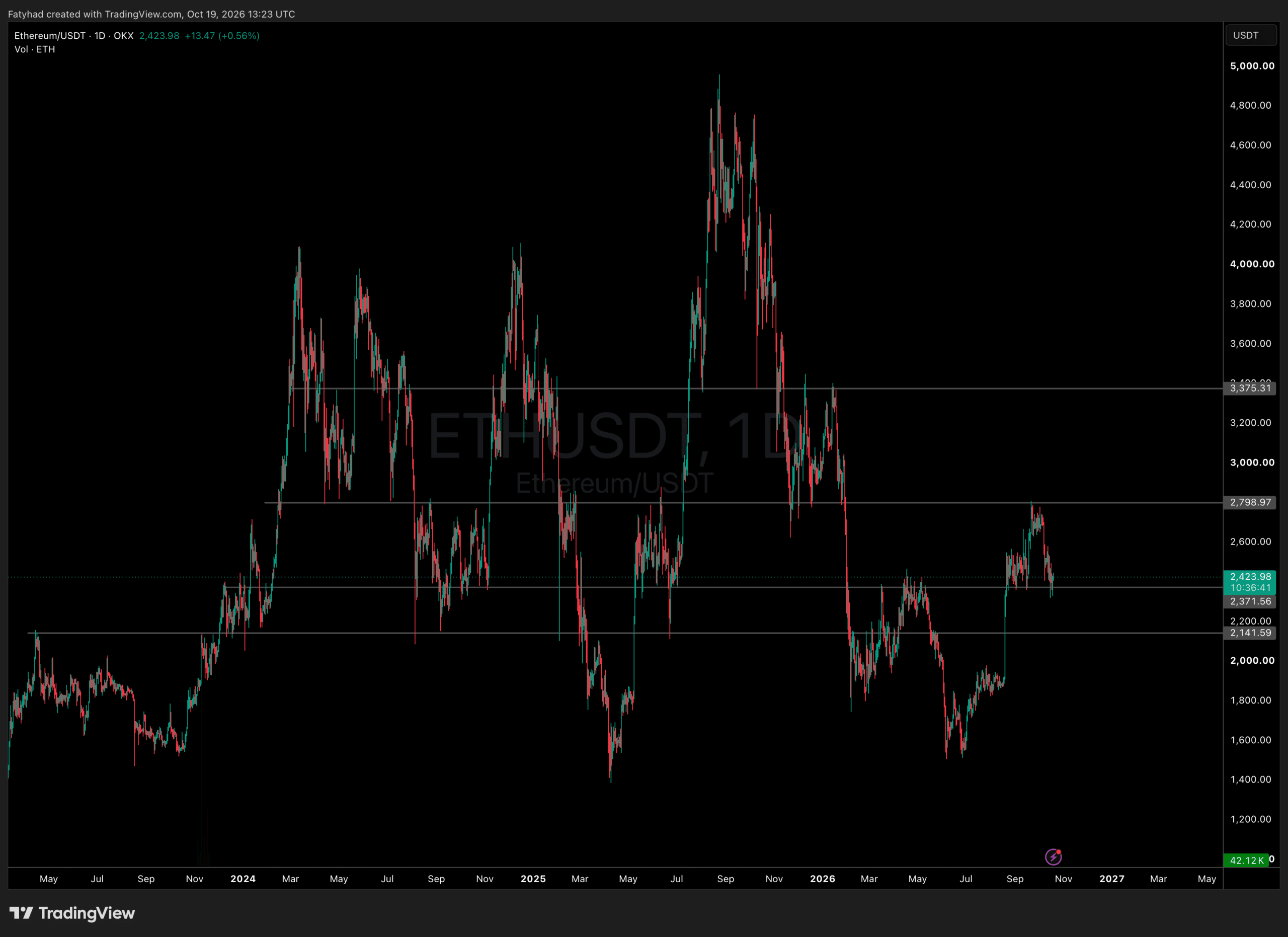
- •ETH traded at $2,423, up 0.14% over 24 hours but down 4.94% for the week, with the announcement producing minimal price impact.
The biggest Ethereum story of the day came from Wall Street rather than a developer call: JPMorgan is extending JPM Coin (JPMD), its tokenized US dollar deposit, from Base to Ethereum mainnet. Kinexys, the bank's blockchain unit, said in a statement on Monday that JPMD now supports transfers across Ethereum Virtual Machine (EVM) networks, including Base and Ethereum. That shared standard is what makes a move like this an extension rather than a rebuild: token logic written for the EVM runs the same way on a layer 2 like Base and on Ethereum mainnet, so a bank can add networks without rewriting the asset.
Access rules remain unchanged. JPMD stays available to approved institutional clients only, so there is no new coin for retail buyers. What changes is where the bank's money can move.
News: JPM Coin (JPMD), @jpmorgan's USD deposit token, is now live on @ethereum. JPMD extends from Base to Ethereum L1, giving institutional clients native onchain cash that sits alongside the assets, collateral and counterparties they transact with already. J.P. Morgan has now… pic.twitter.com/fNYAGoT3Pb
— Ethereum Institutional (@ethereuminsti), October 19, 2026 — post on X
In practical terms, the extension lets approved institutions hold and move tokenized dollar deposits natively on Ethereum mainnet, placing the bank's cash alongside the assets, collateral and counterparties it already transacts with onchain.
Why Ethereum After Base?
Liquidity was the deciding factor. Kinexys pointed to Ethereum's "established depth of onchain liquidity and tokenized assets" as the reason the network was the natural next chain. Emma Landriault, global head of Kinexys Labs, told Bloomberg that crypto firms could use JPMD for payments, while financial institutions could use it to settle trades or post collateral against tokenized assets.
The rollout is the latest step in a longer build-out. JPMD went live on Base, Coinbase's Ethereum layer 2, in November 2025 after a pilot that began in June, with Coinbase, Mastercard and B2C2 testing issuance and redemption. JPMorgan then launched its first tokenized money-market fund on Ethereum in December 2025, followed by a second, JLTXX, in May. In January, Digital Asset and Kinexys said JPMD would also come natively to the Canton Network during 2026.
For scale, Kinexys says it has processed more than $4 trillion since launch and averages about $7 billion a day. Those figures cover the entire platform, so they say nothing about JPMD alone. JPMorgan has not disclosed how much JPMD is in circulation, and Monday's statement came without a mainnet contract address or a go-live date. That leaves the announcement as a capability for now: a published contract address would make mainnet issuance independently verifiable, and the Canton Network commitment gives the build-out its next dated checkpoint in 2026.
What Is JPMD, and Who Can Use It?
JPMD is a bank deposit in token form. Each token represents a claim on US dollars held at JPMorgan, with the bank's balance sheet behind it, and it can pay interest. A stablecoin such as USDC, by contrast, is a separate asset issued by a separate company and backed by a reserve.
That distinction is the core of the pitch. Kara Kennedy, global co-head of Kinexys, said at the Singapore Fintech Festival last November that tokenized deposits receive clearer capital and accounting treatment than newer forms of digital money, because banks can book them like any other deposit.
The token is also permissioned. Clients hold it through Blockchain Deposit Accounts, and only approved clients can receive or move it, even on a chain as open as Ethereum.
So why place a deposit token on a public chain at all? Money that runs around the clock and can be programmed. Kennedy pointed to Kinexys's intraday repo product, in which a repurchase agreement can be opened and closed down to the minute. A repo is a short-term loan: one side hands over assets for cash and agrees to swap them back later. Cutting that cycle from days to minutes frees up cash that banks would otherwise park as a buffer.
Kennedy does not expect the old rails to vanish. She sees public and private blockchains running alongside existing bank systems for years, possibly decades, but expects tokenized finance to look very different within five to 10 years. Transfer rules for regulated digital tokens illustrate how compliance requirements can be built directly into token infrastructure.
What Does JPM Coin on Ethereum Mean for ETH?
Not much today. ETH trades at $2,423, up 0.14% over 24 hours but down 4.94% on the week, and the announcement barely registered on the chart. JPMD transfers pay gas in ETH like any other transaction, tying institutional settlement activity to the network's native asset, though the token itself will not sit in any retail portfolio.
The longer story is demand for blockspace. Almost $50 billion is already locked in Ethereum applications, according to DefiLlama, and every bank that settles on mainnet strengthens the that Ethereum is where tokenized finance lives.
On the daily chart, ETH sits between its 50-day exponential moving average (EMA) at $2,483.81 and its 200-day EMA at $2,314.14. A daily close above the 50-day line would put $2,546.66 in view, while a loss of $2,371 would bring the 200-day EMA into play.
Wall Street is coming onchain one deposit at a time. The price may take longer to notice.

