Ethereum Price Eyes $2,800 as JPMorgan Expands JPM Coin to Ethereum Mainnet
Key Takeaways
- •JPMorgan launched its JPM Coin (JPMD) deposit token on Ethereum mainnet on October 19, bringing bank-issued dollar deposits onto a public blockchain for institutional payments and settlements.
- •The Ethereum rollout extends JPMD's coverage beyond its November 2025 debut on Coinbase-linked Base, with JPMorgan citing Ethereum's deeper on-chain liquidity and large tokenized asset market.
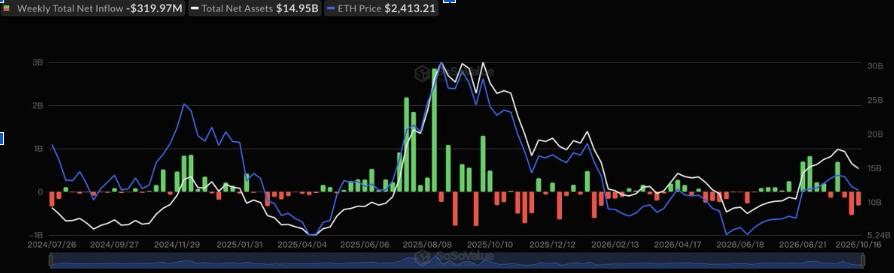
- •U.S. spot Ethereum ETFs recorded approximately $320 million in net outflows between October 12 and 16, marking a third consecutive week of net withdrawals.
- •Ethereum traded around $2,435.84, defended support near $2,356.80, and faced resistance around $2,802.16 after earlier advances toward $2,800 were rejected.
- •Ethereum exchange withdrawals surged and Binance reserves fell to a six-month low, while hot inflation data triggered marketwide liquidations that pushed ETH back toward $2,350.
Ethereum traded under pressure near $2,400 as JPMorgan expanded its JPM Coin deposit token onto Ethereum mainnet, giving the bank's institutional clients another public blockchain for tokenized payments. The October 19 launch strengthened Ethereum's position in tokenized financial infrastructure, though it coincided with continued weakness in cryptocurrency investment products and subdued ETH price performance.
U.S. spot Ethereum exchange-traded funds recorded approximately $320 million in net withdrawals during the previous week, while traders monitored support near $2,350 following repeated rejections at higher resistance levels.
JPMorgan Expands JPM Coin to Ethereum Mainnet
JPMorgan has launched JPM Coin (JPMD) on Ethereum for institutional investors. The token represents dollar deposits held at the bank and is built to power blockchain-based payments around the clock, seven days a week. Because JPMD mirrors a conventional dollar deposit held at JPMorgan rather than a claim on a separate issuer's reserves, the rollout effectively brings bank-issued money onto public blockchain infrastructure.
JPM Coin first went live on Coinbase-linked Base in November 2025, and the Ethereum rollout extends the bank's blockchain coverage. JPMorgan selected Ethereum for its deeper on-chain liquidity and its large market for tokenized assets — a footprint that offers a tokenized deposit an established pool of on-chain settlement activity to operate within.
Emma Landriault, global head of Kinexys Labs, said the expansion gives institutional clients more choices across different blockchain networks. She noted that JPM Coin can move wholesale money across both Web3 systems and traditional financial markets.
JPMorgan expects crypto companies to use JPM Coin for payments, while financial firms can deploy the token for tokenized settlements. The launch follows growing institutional activity across Ethereum, although ETH markets have recently come under pressure from Ethereum ETF outflows.
Ethereum Holds Above $2,350 Support
Ethereum traded around $2,435.84 as buyers attempted to defend support near $2,356.80. ETH previously recovered from the $1,500–$1,750 region before climbing toward the $2,800 area, but sellers re-emerged near $2,700 and $2,802, and the rejection sent the price back toward current levels.
The market now sits between immediate support at $2,356.80 and resistance around $2,802.16. Weekly Bollinger Bands place the middle band near $2,170.58 and the upper band around $2,925.17. ETH remains above the middle band, meaning the recovery structure stays intact as long as that level holds.
Exchange activity has also remained in focus after investors recently moved large amounts of ETH away from centralized trading platforms. A recent report found that Ethereum exchange withdrawals surged while Binance reserves fell to a six-month low — a metric market watchers track because coins held on trading venues are the most readily available for sale.
Meanwhile, spot Ethereum ETFs recorded about $320 million in net outflows between October 12 and October 16. That period marked a third consecutive week of net withdrawals, adding another source of selling pressure. Fund flows are widely used as a gauge of institutional demand, since ETF creations and redemptions translate directly into buying or selling of the underlying asset, and the streak underscores how investment-product sentiment and on-chain infrastructure buildout have moved in opposite directions.
ETH Price Forecast: $2,700 Back in Focus
Ethereum must first defend the $2,350 area before buyers can attempt another move toward higher resistance. A rebound from this zone could put $2,700 back in focus, followed by the $2,802 level.
A weekly close above $2,802.16 would clear the recent rejection area and open a move toward $2,925.17. If buying continues above that level, the $3,000 region would become the next psychological resistance area. The larger technical target sits near $3,447, roughly 41.5% above the current price, although reaching it would require ETH to clear several resistance levels before the broader recovery can extend.
On the downside, recent price weakness has followed changing macro conditions, including inflation data and liquidations across leveraged Ethereum positions. ETH recently fell toward $2,350 after hot inflation data triggered liquidations across the market. The downside setup remains tied to $2,350 and the weekly Bollinger middle band near $2,170.58, and a daily close below $2,350 could shift attention toward the $2,000 area.
With three straight weeks of ETF withdrawals on record, the next weekly fund-flow reports will show whether institutional positioning through U.S. Ether funds is stabilizing — a data point likely to be weighed alongside these technical levels.
Disclaimer
This article is for informational purposes only and does not constitute financial or investment advice. Cryptocurrency markets involve significant volatility and potential capital losses. Readers should conduct independent research and consult a qualified financial adviser before making investment decisions.
This article is a rewritten version of a report originally published by The Market Periodical.

