JPMorgan Projects 10% Annual Bitcoin Return Over 10–15 Years, Above Stocks and Gold
Key Takeaways
- •J.P. Morgan Asset Management published its first Bitcoin return forecast, a base-case compound annual return of 10% over the next 10 to 15 years, in its 2027 Long-Term Capital Market Assumptions report released October 19.
- •The 10% Bitcoin assumption surpasses the firm's projections for U.S. large-cap stocks (7.5%), U.S. REITs (8.2%) and gold (5.5%), while carrying an estimated annualized volatility of55%.
- •Bitcoin remains excluded from JPMorgan's core covariance matrices and portfolio allocation models due to its high volatility and unstable correlations, meaning the forecast informs return expectations rather than portfolio weights.
- •The broader report anticipates a $15 trillion global capital spending surge centered on artificial intelligence through 2040, alongside a global aggregate bond forecast of 5.3%, the highest in two decades.
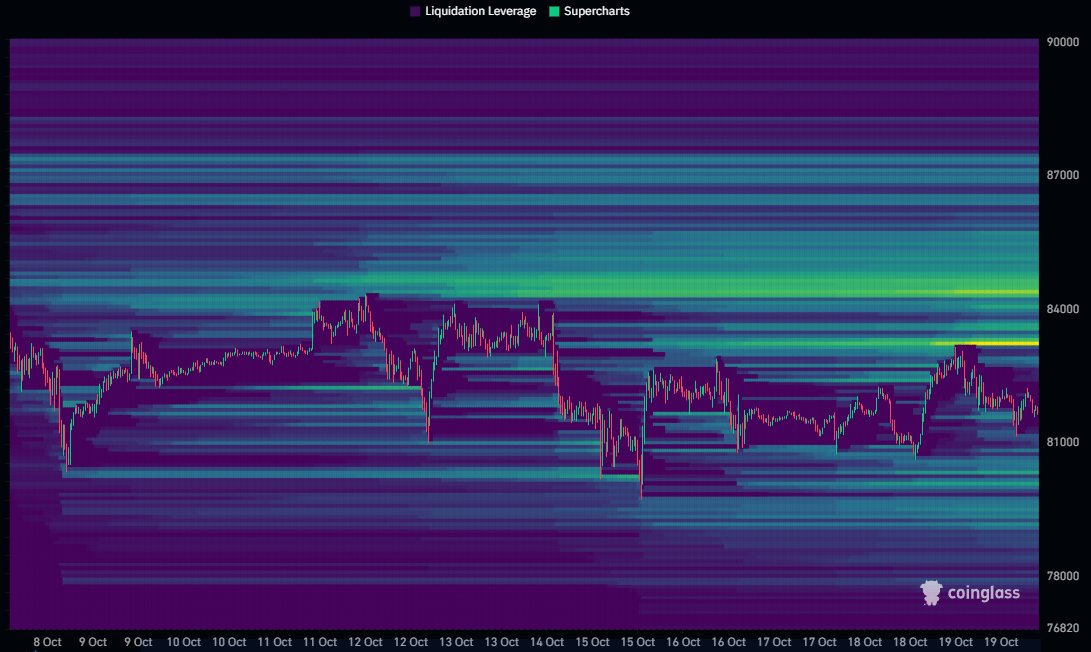
- •Bitcoin traded near $81,213 with traders watching the $79,800 support level and the $83,000 to $84,000 liquidity cluster, while a shift of Bitcoin into JPMorgan's core covariance models is flagged as the key long-term signal to monitor.
J.P. Morgan Asset Management has included Bitcoin in its long-term return forecasts for the first time, assigning the asset a base-case compound annual return of 10% over the next 10 to 15 years.
The projection appears in the firm's 2027 Long-Term Capital Market Assumptions report, released October 19. The annually published report lays out the bank's long-term return, volatility and correlation assumptions across asset classes — the reference points institutional investors typically use for long-horizon planning. Bitcoin's assumed return sits ahead of U.S. large-cap stocks (7.5%), U.S. REITs (8.2%) and gold (5.5%). The caveat: JPMorgan does not yet include Bitcoin in its portfolio allocation models.
What the Forecast Says
J.P. Morgan Asset Management, the investment arm of JPMorgan Chase, published a base-case compound annual return of 10.0% for Bitcoin, the first time the firm has issued a return range for the asset. The report also estimates an arithmetic annual return of 20.9% and annualized volatility of 55%. The gap between the two figures illustrates how large price swings erode compounded growth.
Bitcoin remains outside JPMorgan's main covariance matrices, which measure how assets move relative to one another and inform portfolio construction. The firm modeled it separately because of its high volatility and unstable correlations. As a result, the forecast informs return expectations, not portfolio weights.
Bitwise Chief Investment Officer Matt Hougan said on X that the report now casts Bitcoin as the best-performing asset of the next decade — his reading of the figures, not a JPMorgan claim.
First they ignore you, then they laugh at you, then they fight at you, then they add you to their Long-Term Capital Markets Assumptions paper and predict you'll be the best-performing asset of the next decade. pic.twitter.com/TuOuH51l3c
— Matt Hougan (@Matt_Hougan) October 20, 2026
Why the Outlook Favors Risk Assets
The Bitcoin projection sits inside a broadly upbeat report. JPMorgan expects a $15 trillion global capital spending surge, centered on artificial intelligence and running to 2040, to lift growth and asset returns. It forecasts U.S. real GDP growth of 2.1% and developed-world nominal growth of 4.2 Profit margins above 15% raised its U.S. large-cap equity forecast by 80 basis points, to 7.5%.
Bonds improved as well. The firm's global aggregate bond forecast reaches 5.3%, up from a low of 2.1% in 2021 and the highest in two decades. A balanced global stock-bond portfolio rises to 7.0%.
Against that backdrop, Bitcoin's 10% assumption stands 2.5 percentage points above U.S. large caps — a premium that comes with 55% annualized volatility. That return-for-volatility trade-off is exactly the kind of assumption long-horizon allocators weigh when deciding whether an asset earns a place in a diversified portfolio.
Bitcoin Trades Near $81,000
According to CoinGecko at the time of writing, Bitcoin trades at $81,213.90, down 1.49% over 24 hours and 2.68% over the week. Trading volume over the past day was about $24.74 billion, and the asset has held a range near $81,000.
Analyst Daan Crypto Trades said on X that Bitcoin has been indecisive in October. Price took out liquidity below $80,000 and has chopped since. He identified the largest liquidity cluster at $83,000 to $84,000, the local range high, where open interest that entered the region is still holding.
Trader Lennaert Snyder said Bitcoin dropped into his long entry zone near $81,100. He considers sweeps above the $79,800 prior weekly low valid for longs toward $83,500 to $84,000, then $85,000. If $79,800 fails, he said he would wait for another setup.
$BTC dropped straight into our 81.1K long-POI. My limit-long on Bitcoin got filled, and I also took a long on Solana yesterday. Those are nice hedges against yesterdays short from 82.8K that all hit TP's with this dump. The dump and retest of the POI happened during Asia, so… pic.twitter.com/8cFJ8WLWq6
— Lennaert Snyder (@LennaertSnyder) October 20, 2026
What to Watch
JPMorgan's forecast is a decade-long assumption, not a price target, and it does not change the near-term picture. In the near term, traders can watch whether Bitcoin holds $79,800 and reclaims the $83,000 to $84,000 liquidity cluster. Over the longer term, the signal to watch is whether JPMorgan moves Bitcoin into its core covariance matrices — the step that would connect the return forecast to actual portfolio construction.
Source: Live Bitcoin News

