JPMorgan's 10-Year Outlook Projects Bitcoin Returns Ahead of US Stocks and Gold
Key Takeaways
- •JPMorgan's 2027 Long-Term Capital Market Assumptions, published October 19, is the first edition of the widely followed report to assign a return range to Bitcoin, projecting a 10% compound annual return over ten years.
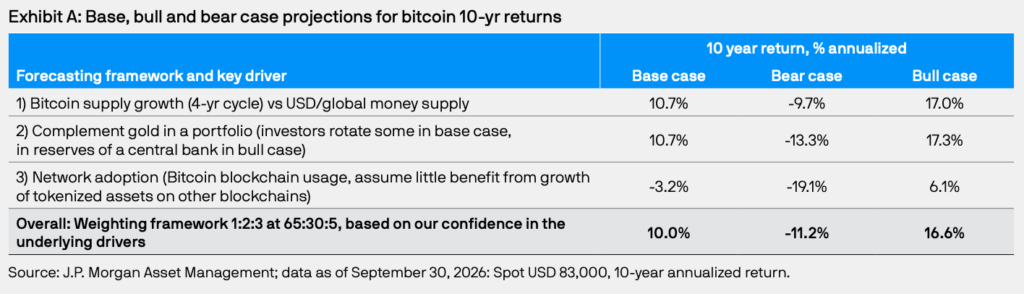
- •The 10% base case is weighted 65% on Bitcoin's halving-driven supply growth measured against dollar and global money supply, 30% on its role as a portfolio complement to gold, and 5% on blockchain network adoption.
- •JPMorgan's Bitcoin return assumption exceeds its projections for U.S. large-cap stocks at 7.5%, U.S. REITs at 8.2%, and gold at5.5%, but the asset's 55% expected volatility is roughly three times higher than either of those asset classes.
- •The forecast spans a bull case of 16.6% annualized gains and a bear case of an 11.2% annualized loss, and Bitcoin remains excluded from the firm's main covariance matrices used to construct balanced portfolios.
- •If the 10% base case holds from the $83,000 spot price used in the report, Bitcoin would trade near $215,000 in a decade, a figure the firm describes as a mechanical extension of the math rather than a price target.
J.P. Morgan Asset Management issued its first long-term Bitcoin forecast, projecting a 10% compound annual return over the next decade. The estimate appears in the firm's 2027 Long-Term Capital Market Assumptions (LTCMA), published October 19, and exceeds the return assumptions JPMorgan applies to U.S. large-cap stocks, U.S. real estate investment trusts (REITs), and gold.
Despite the headline figure, the bank continues to classify Bitcoin as speculative, citing high volatility and unstable correlations with traditional assets. In the reported market snapshot, Bitcoin traded near $81,570 after failing to sustain a recovery toward $83,000.
Bitcoin Tops JPMorgan's Long-Term Return Rankings
The annual LTCMA report is among the most widely followed long-range forecasts in asset management. In practice, such documents set expected returns, volatility, and correlation estimates for the asset classes they cover. Pension funds, financial advisers, and institutional allocators rely on it to structure portfolios over horizons of a decade or more. This year's edition is the first to assign a return range to Bitcoin.
The 10% base case is derived from three forecasting frameworks, each weighted by the confidence JPMorgan places in it. The heaviest weight, 65%, goes to Bitcoin's supply growth under its four-year cycle — the halving schedule that cuts new Bitcoin issuance roughly in half every four years — measured against U.S. dollar and global money supply. A further 30% reflects Bitcoin's role as a complement to gold in portfolios, while the remaining 5% rests on network adoption of the Bitcoin blockchain.
The spread of outcomes is wide. The bull case points to a 16.6% annualized return, while the bear case implies an annualized loss of 11.2%.
Projected Outperformance Against Stocks and Gold
Set against traditional asset classes, the base case stands out. JPMorgan expects U.S. large-cap stocks to return 7.5% a year, U.S. REITs 8.2%, and gold 5.5%. On paper, Bitcoin surpasses all three by a clear margin.
The volatility gap is equally pronounced. U.S. large-cap stocks carry expected volatility of 18% and gold 17.2% — each roughly a third of Bitcoin's 55%. That gap is the practical trade-off embedded in the forecast: a higher assumed return paired with an assumption of far larger price swings.
JPMorgan also keeps Bitcoin out of its main covariance matrices, the models used to construct balanced portfolios, and instead built a smaller, standalone matrix for illustration. The bank describes the asset as a speculative play and a hedge against monetary easing — the expansion of central-bank money supply — while noting that the crypto market is now worth over $2.5 trillion — roughly the size of the Swiss stock market.
Bitcoin Price Levels: The Technical Picture
Long-term forecasts do little for the daily chart. Bitcoin trades around $81,570 after a rebound toward $83,000 ran into selling pressure and pulled the price back into the $81,500–$82,000 zone, leaving the short-term bias leaning bearish on the chart.
The first hurdle above the current price sits at $82,000–$82,200, the near-term recovery zone. Above that, $83,000–$83,100 marks the recent rebound high, where sellers stepped in last time.
On the downside, $81,200 — the recent 24-hour low — is the first line of support. Below it lies the $80,000–$79,800 range, the major visible support zone on the chart. A drop below $81,200 could open the path toward that support zone, and a clean break beneath it would raise downside risk.
If neither side takes control, Bitcoin may keep trading sideways between $81,200 and $82,200. Bulls would need to reclaim $82,200 and hold it to set up a run at the $83,000 target.
Notably, $83,000 is also the spot price JPMorgan used for its forecast. If the 10% base case plays out, Bitcoin would trade near $215,000 a decade from now. That figure is a mechanical extension of the base-case math rather than a price target — the same assumptions paper carries a 16.6% bull case and an 11.2% annualized-loss bear case alongside it.
Bitwise CIO Sees BTC as the Decade's Highest-Returning Asset
Bitwise Chief Investment Officer Matt Hougan said the figures position Bitcoin as the highest-returning asset over the next decade. In a post on X, he wrote: "First they ignore you, then they laugh at you, then they fight at you, then they add you to their Long-Term Capital Markets Assumptions paper and predict you'll be the best-performing asset of the next decade."
Hougan acknowledged that the report carries plenty of caveats and that JPMorgan still views the asset as maturing, but he still called it pretty amazing to see. For Hougan, the bigger story is the source: a major Wall Street asset manager now models Bitcoin alongside stocks, bonds, and gold, and its base case ranks the cryptocurrency first.
JPMorgan stops short of recommending Bitcoin for balanced portfolios, but its decision to forecast the asset at all long-term holders a fresh data point. One signal to watch in future editions of the report: whether Bitcoin graduates from the standalone illustration matrix into the firm's main covariance matrices, the step that would bring its return and volatility assumptions into the models used to construct balanced portfolios.
This article is for informational purposes only and does not constitute financial or investment advice. Cryptocurrency markets involve substantial volatility and potential capital losses. Readers should conduct independent research and consult a qualified financial adviser before making investment decisions.
Source: Bitcoin vs. Stocks and Gold: JPMorgan Reveals Its 10-Year Outlook — The Market Periodical

