Warsh’s Labor Market Comment Points to Post-Pandemic Job Rematching, JOLTS Data Show
Key Takeaways
- •Voluntary quits fell by 157,000 in July to 3.06 million, while quits remained the largest source of labor-market separations.
- •Layoffs and discharges declined to 1.67 million in July and stayed near the lower end of the pre-pandemic range.
- •Job openings increased by 89,000 in July to 7.27 million, based on the Bureau of Labor Statistics’ JOLTS survey of HR departments.
- •Hires fell by 278,000 in July to 5.05 million and mainly reflected positions created by earlier separations.
- •Warsh said the lower turnover in the labor market reflects post-pandemic rematching between employers and employees.
Fed Chair Warsh said in his Jackson Hole speech that “the relatively low turnover in today’s labor market is partly a result of the significant rematching between employers and employees that happened at scale in the post-pandemic environment.”
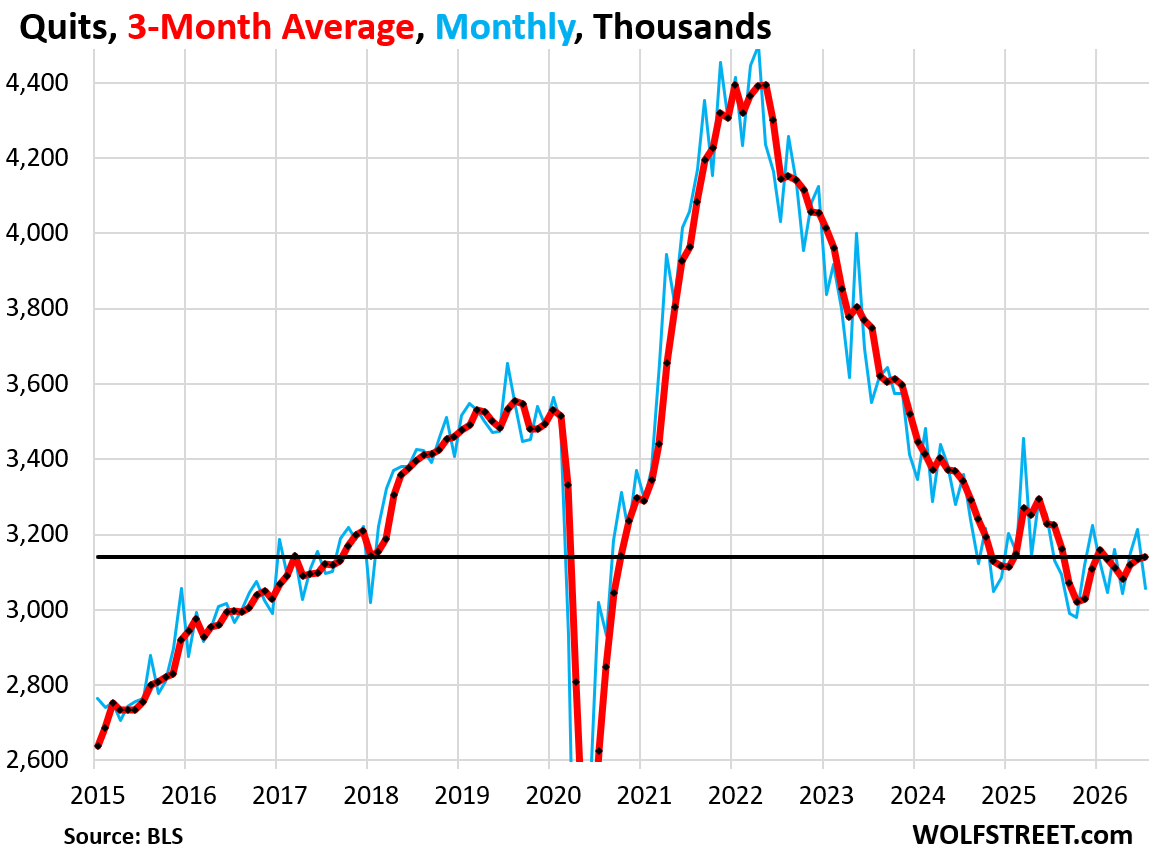
He was referring to the large wave of voluntary quits in 2021 and 2022, when labor shortages led employers to raise wages, hire aggressively, and poach workers from other companies. At the same time, employees moved between jobs and industries as opportunities opened up across the labor market.
That churn helped workers find positions that better matched their skills and aspirations, while employers found workers who were a better fit. After that reshuffling, turnover cooled and the labor market settled into a lower-churn pattern, which matters because JOLTS is one of the main monthly windows into how quickly workers are moving around rather than simply whether payrolls are rising or falling.
Warsh’s comment referred to data from the Bureau of Labor Statistics’ Job Openings and Labor Turnover Survey, or JOLTS, which released July data today. JOLTS measures labor-market turnover, not overall employment growth or unemployment, which were already covered in the July jobs report released on August 7.
Labor-market turnover is driven by positions left behind by workers who quit, were laid off or fired, retired, or separated for other reasons, including deaths while employed. Those vacancies become job openings when employers try to fill them. Once employers fill those openings, they become hires. JOLTS tracks each of those stages.
Voluntary quits fell by 157,000 in July to 3.06 million, as shown in blue in the chart. The three-month average rose to 3.14 million, shown in red. Quits make up 60% of total separations and are the biggest source of labor-market turnover. Fewer quits mean fewer vacancies left behind.
Layoffs and discharges declined to 1.67 million in July, down 106,000 from a year earlier. Being fired, for a range of reasons or for no reason, is a standard feature of the US labor market. The three-month average held at 1.74 million. These figures are at the lower end of the pre-pandemic range. Layoffs and discharges accounted for 33% of all separations.
Retirements and other separations, including deaths while employed, accounted for only 7% of total separations. They are a relatively small part of the turnover picture. That category rose to 350,000 in July. The 12-month average, which smooths monthly swings, increased to 314,000, extending the rebound from the 25-year low reached in 2025.
Job openings rose by 89,000 in July to 7.27 million. The three-month average slipped by 105,000 to 7.33 million, though that was still 129,000 above a year earlier.
The job openings data come from a survey of HR departments at 21,000 business locations, not from online job postings. A job is counted as open only if all three conditions are met: a specific position exists and work is available for it; the job could start within 30 days; and the employer is actively recruiting workers from outside the establishment to fill it.
Excluded are positions open only to internal transfers, promotions, demotions, or recall from layoffs; positions for which employees have already been hired but have not yet started; and positions to be filled by workers from temporary-help agencies, employee-leasing companies, outside contractors, or consultants.
With fewer quits and fewer layoffs and discharges, fewer slots are left behind, and labor turnover remains subdued. The turnover rate has now normalized at a level near the pre-pandemic peak.
Hires to fill those fewer open slots declined by 278,000 in July to 5.05 million. The three-month average fell to 5.21 million. Because hires are largely a function of slots left open by separations, nearly all of those 5.05 million hires filled positions vacated by earlier quits, layoffs and discharges, or other separations. Hires do not measure changes in payrolls, such as jobs added in the employment report released in early August; they mainly reflect labor turnover.
For employers, the massive turnover in 2021 and 2022 came with significant costs. Measures of labor productivity fell from late 2020 through late 2022 as newly hired workers moved up the learning curve. After employees settled in and learned the ropes, productivity recovered to relatively high levels.
Those shifts were not signs of broad strength or weakness in the labor market, but of a major reshuffling that produced a better match between workers and employers, as Warsh put it: “the significant rematching between employers and employees that happened at scale in the post-pandemic environment.” The article says it is refreshing to see the Fed chair make that point after Powell had used JOLTS data for years to support arguments about labor-market strength or weakness.
