The art of Jojie Lloren’s fashion
Key Takeaways
- •Jojie Lloren debuted the limited J.Lloren Editions collection at the MaArte Fair, which ran from August 13 to 16 at The Peninsula Manila.
- •The line, made of linens and charmeuse, was created in collaboration with artist Joey Cobcobo, photographer Kim Montes, and handwoven craft by label SC Vizcarra.
- •Each design will be produced in only a few pieces bearing serial numbers and signatures, with a portion of sales going to the J. Lloren Editions Artist Fund for royalties, grants, mentorship, residencies, and other artist programs.
- •Lloren joined the fair in memory of gallerist Albert Avellana, who died in 2022 and had long invited him to participate in the Museum Foundation of the Philippines' annual benefit event.
- •Lloren, who began designing in 1988 and won the Paris-based Concours International des Jeunes Créateurs de Mode in 1998, said he deliberately chooses to work with young, struggling artists rather than famous ones.
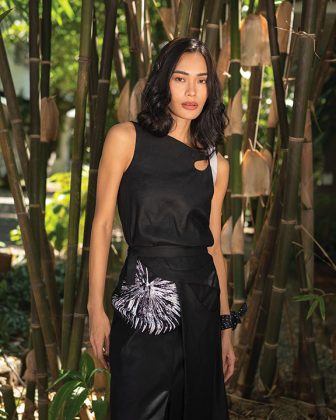
Designer Jojie Lloren first became widely familiar to the public through television, including his stint as a judge on Project Runway Philippines in 2008. He later drew attention for creating clothes that interpreted the works of Filipino masters outside the canvas. Now, he is once again exploring his relationship with art through a collection called J.Lloren Editions, which was first presented at the MaArte Fair, held from Aug. 13 to 16 at The Peninsula Manila.
The collection is made of linens and charmeuse and is a collaboration with artist Joey Cobcobo, photographer Kim Montes, and woven craft by SC Vizcarra, the homegrown label long known for its handwoven bags and footwear. The pieces reflect Mr. Lloren’s signature style: still, stark, strictly tailored, and occasionally interrupted by a print of a wing or a photograph of a leaf.
“I know them already,” Mr. Lloren said when asked why he chose these collaborators. “They’re young artists. I’m not looking for sikat (famous) artists.
“I want to work with struggling artists, the really young ones,” he told BusinessWorld in an interview at the MaArte Fair. His participation in the fair was prompted by the death in 2022 of his friend and neighbor, gallerist Albert Avellana, former president of the Museum Foundation of the Philippines, Inc., which mounts the fair every year as its benefit event, with proceeds supporting the foundation’s projects for Philippine museums. Mr. Avellana had long asked him to join the fair, but he was unable to do so at the time. “Now that he’s gone, I’m here,” Mr. Lloren said. “I made it a point that when I join fairs like this, it would have to be the MaArte Fair.” He added that he planned to join more fairs and trunk shows throughout the year.
The J.Lloren Editions line is limited, with only a few pieces of each design to be made. Each item will carry a serial number and signatures from Mr. Lloren and the artists. A portion of sales will go to the J. Lloren Editions Artist Fund, which will support artist royalties, creative grants, mentorship programs, residency opportunities, exhibition support, publication projects, documentation of Philippine craft, and educational collaborations.
“A lot of struggling artists are really struggling,” he said. “I know some of them; I want to help them.”
When reminded of the exhibit where the two first met, Mr. Lloren spoke about his close relationship with art, while stressing that his collection “is not expansive.”
“I think it guides me. When I see art, I take a look at the proportion. The colors. The composition,” he said. “My observation of artworks helped me improve with my design.”
Mr. Lloren began designing in 1988, but he gained international recognition and local fame after winning the Concours International des Jeunes Créateurs de Mode, a Paris-based competition for emerging designers, in France in 1998. That led him to spend a year at the École de la Chambre Syndicale de la Couture Parisienne, the storied Paris school tied to the French couture establishment, which has since merged with the Institut Français de la Mode. After that, his name became widely visible on store windows, in magazines and newspapers, and even on television.
Asked about the career changes he has seen over the years, he said his starkly tailored style remains central to his work. “Probably because I do not really follow trends. I want my pieces to be timeless. My pieces are very simple, in terms of design. It’s all about the form, the silhouette, the workmanship,” he said.
“I don’t like clothes that are worn just once. I like people to just wear them again and again,” he added.
That day, he was wearing a robe and matching skirt he made in the 2000s in a faded navy blue. The garment showed signs of wear, including seams that had worn through and tiny rips along the cuffs, but the aging only added to its appeal, giving it the look of a piece that had been repeatedly worn and lived in. “I just want people to just wear and wear their clothes. I don’t like clothes they wear once, and then they just store it in their cabinets,” he said. That decades-long use sits at odds with fashion’s fast-fashion cycles, in which garments are typically produced and discarded within a season.
He also spoke about changes in the local fashion market. “I noticed that Filipinos now buy Filipino. There is more consciousness with regards to buying local. Before, they would spend all their money on these foreign brands. Filipinos, they make tawad (haggle) every time,” he said. He added that people should realize that they are supporting “these people: the artisans, the artists.” The MaArte Fair is built on that same premise, convening Filipino artisans, designers, and craft makers each year.
When asked about his longevity in the business and his continued relevance, Mr. Lloren demurred as friends and clients stopped by throughout the interview to shop. “I don’t know. Am I?” he said.
— Joseph L. Garcia

