John Mauldin: Revisiting the Muddle Through Economy
Key Takeaways
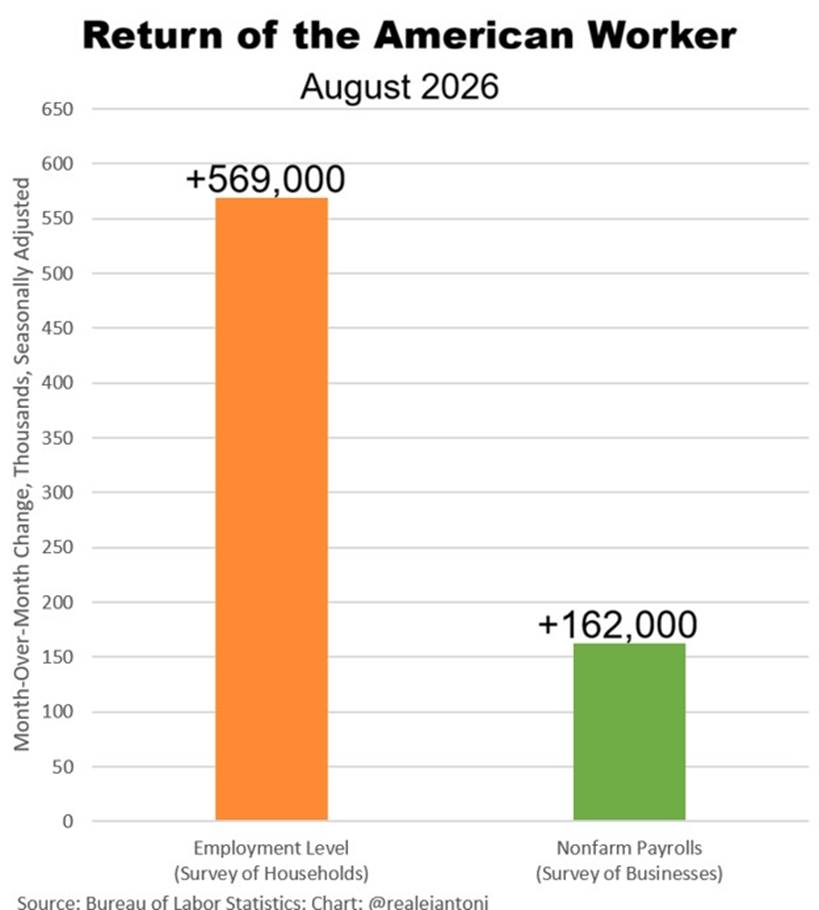
- •The August BLS report showed 162,000 jobs created, beating estimates of 58,000, with July revised from -23,000 to +21,000 and unemployment at 4.1%.
- •The Fed's Beige Book described modest economic activity, with ten of twelve districts reporting slight to moderate growth, consistent with roughly 1.5-2% GDP growth.
- •Q2 GDP growth of 1.5% was reduced by about 1.3 percentage points due to imports, largely reflecting AI data center hardware purchases that distort headline GDP figures.
- •Mauldin expects the Fed to avoid raising rates before the midterm election, with any hike more likely afterward, despite Kevin Warsh's hawkish leanings.
- •Mauldin identifies 3.9% inflation as the main threat and warns of a potential collision between the bond market and rising Congressional spending.
In his latest commentary, John Mauldin revisits his long-standing thesis that the United States remains in a "Muddle Through Economy" — one in which GDP grows slightly below 2% over time, as has been the case for 25 years. Writing over Labor Day weekend (GoldSeek), he surveys the latest jobs data, the Federal Reserve's Beige Book, trade deficits, and interest rates to gauge whether that framework still holds. The "Muddle Through" framing has been a recurring theme in Mauldin's writing for years, serving as his baseline against which incoming data either confirms or challenges a subdued-growth outlook.
A Solid Labor Report
On its face, the BLS labor report was quite solid, with a few minor caveats. Overall, Mauldin calls it the best report seen in some time. The monthly employment situation report is based on two separate surveys — the establishment survey of payrolls, which markets watch most closely, and the household survey, from which the unemployment rate and participation figures are drawn — and the two do not always agree. Quoting Barry Habib at MBS Highway (source: Morning Update):
"The Bureau of Labor Statistics (BLS) released its August jobs report, showing 162,000 jobs were created, well above estimates of 58,000. Adding to the strong report were positive revisions to the previous two months totaling 55,000. Notably, July was revised from a negative -23,000 to positive +21,000, accounting for most of the revision.
"While today's BLS report was strong across the board, it does not jive with the other labor market reports from ADP and Revelio. BLS includes government, so in order to compare apples to apples, we have to look at the BLS private payroll figure, which was +127,000. That compares with +38,000 in ADP versus 37,000 in Revelio - clearly some big disparities.
"Additionally, the BLS said there were 74,000 jobs created from the birth/death model, which tries to capture small business job growth that compares with zero job growth in small businesses in ADP."
While most of the press and markets focus on the establishment survey, Mauldin notes there were standout elements in the household survey. From Steve Moore:
"But the big number that jumps off the page is the return of the American worker. After many months of troubling declines in the workforce (one million missing workers) from the peak last year, in August we saw a complete reversal. According to the household survey, 683,000 more workers entered the workforce and 569,000 of them found jobs and started earning a paycheck. The labor force participation rate rose. Data center construction is one of the major drivers of new employment."
Mauldin calls this a welcome outcome, noting that unemployment at only 4.1% bodes well. He adds that at some point there will be serious analysis of how the large influx of illegal immigrants affected the jobs numbers, and that with government deportations and self-deportations, the number of workers in the US is dropping — which, at least for the past month, finally showed up in the participation rate, a figure that had been causing concern.
Beige Book Blahs
Peter Boockvar, Mauldin writes, does an outstanding job summarizing the Federal Reserve Beige Book, which tracks the business climate across the 12 Federal Reserve districts. Published roughly eight times a year ahead of Federal Open Market Committee meetings, the Beige Book is compiled from anecdotal reports gathered by each regional Fed bank and often provides a more granular, real-time texture of the economy than official statistical releases. There were good parts, but much of it was just "blah" — a fitting description of Muddle Through. On the positive side:
"While we know data center CapEx is massive, the upper income spender is robustly spending and the US government is flowing $2 trillion of more money into the economy than it's taking in via taxes."
But the flipside, per Boockvar: "…the net economic result still seems around 1.5-2% (of GDP) when listening to the Fed's Beige Book describe it: 'Economic activity increased modestly since early July. Ten of the twelve Federal Reserve Districts reported growth in the slight to moderate range; two Districts reported no change.'" The labor market also sounded blah: "Employment rose very slightly overall, with three Districts showing modest gains in employment, four reporting slight gains, and five Districts experiencing no change."
That is the overall US economic climate. Yet corporate earnings reports seem to describe a different world, with one company after another beating expectations. The stock market sits within a hair of its all-time highs, and while some sectors are struggling, investors overall have little to complain about. Mauldin, who pays close attention to pension funding and has previously expressed concern about underfunded pension funds, says current data (with some state decision-making exceptions) shows a rising market has cured many of those underfunding problems.
The Bullish Argument
For the bullish case on stocks and the economy, Mauldin turns to Dr. Ed Yardeni, a longtime Wall Street strategist known for his quantitative, data-driven market commentary, who wrote:
"Earnings are strong because the economy is booming. The Atlanta Fed's GDPNow model is projecting real GDP growth of 4.7% (saar) in Q3 (chart). Consumer spending is expected to rise 3.8%, while AI-driven business investment remains strong, with equipment spending projected to increase 18.3% and intellectual property investment 6.8%. Final sales to private domestic purchasers are running at 4.6%."
Mauldin notes the GDPNow model is revised almost weekly as new data arrives, and highlights the gap between blue-chip economist assessments and the Atlanta Fed's figures — a divergence that sometimes runs the other way when the consensus is more bullish. GDPNow is a nowcasting model that aggregates incoming data releases in real time and, by design, can swing sharply as the quarter progresses, which is one reason it often diverges from professional forecasters.
Source: GDPNow - Federal Reserve Bank of Atlanta
Trade Deficits and GDP
In GDP accounting, exports add to growth while imports subtract. In the second quarter, the BEA estimated the US grew 1.5%; growth would have been comfortably in the high 2%'s except that imports subtracted roughly 1.3%.
Source: Bureau of Economic Analysis, U.S. Department of Commerce
Ed Yardeni points out that much of the trade deficit widening reflects surging US imports of computer hardware, components, and accessories amid the AI building boom, with individual AI data center components showing enormous increases over the last year. This is a notable illustration of how the AI investment boom distorts headline GDP arithmetic: even as it drives domestic construction and equipment spending, the imported hardware component can mechanically depress the reported growth figure. As Mauldin puts it: "Data centers giveth and data centers taketh away."
A Few Thoughts on Interest Rates
Mauldin points to one of the steepest yield curves seen in some time. A steepening curve — where long-term yields rise faster than short-term yields — typically reflects markets demanding more compensation for holding longer-dated debt, among other factors.
Source: US Treasury Yield Curve
Long-term government interest rates are rising worldwide, not just in the US, and so are mortgage rates. Even Japan has long-term rates close to 3%, with signals of rate increases ahead that could help stabilize its currency — a notable shift for a country that has spent decades anchoring policy rates near or below zero.
Kevin Warsh delivered a relatively hawkish Jackson Hole speech. Odds of a rate increase at the September meeting rose slightly after the BLS labor report, but remain only in the 60% range. In Mauldin's personal view, Warsh would clearly like to raise rates in September, though the votes may not be there; absent a shockingly low CPI next week, he expects Warsh to maintain a bias toward hiking.
The complication, Mauldin writes, is political timing: raising rates — and signaling the start of a hike cycle — immediately before an election is typically not done. He expects rates to increase after the midterm, and does not see Warsh raising rates ahead of the election on a 7-5 or 8-4 vote; more consensus is needed in an election year. Whether that emerges will say a lot about Warsh's abilities as a consensus builder.
On balance, Mauldin concludes the economy is growing about the same as it has for the last two decades: a nice, solid Muddle Through. The great fly in the ointment is inflation. As he has repeatedly argued, inflation was triggered by monetary policy under Powell, but the response now is geared toward fiscal policy.
Mauldin references Andrew Ross Sorkin's remark that rising rates mean investors are worried about getting their money back from the US government, with a caveat: no serious bond investor doubts they will receive a dollar back from US government bonds — what they legitimately worry about is what that dollar will be worth. Inflation at 3.9% can erode a lot of value. Ultimately, Mauldin argues, the bond market and US Congress spending are going to collide, with potentially explosive results — a collision he has warned about in prior commentaries as deficits and interest costs continue to climb.
New York, DC, The Cleveland Clinic and More
On personal matters, Mauldin writes that he will be in New York Tuesday evening for meetings Wednesday, returning to San Juan Thursday; he will be in DC on November 10 and in Cleveland on October 11 for Nancy and Mike Roizen's shared 80th birthday party.
He thanks readers for their kind words about his daughter Abbi, who faces brain surgery on November 5. He praised neurosurgeon Dr. Gene Barnett and his team at the Cleveland Clinic, noting the surgery is very difficult because the benign tumor is growing and located in the center of her brain. A combination of multiple real-time MRI scans, AI, and robotics makes such surgeries possible — literally, the AI indicates which cell to take and which to leave. Five years ago, he notes, the prognosis would have been much worse.
Mauldin describes a somber week following a funeral that prompted reflection; he turns 77 next month. At a barbecue at Joe Lonsdale's, he spoke with several Republican activists who were less optimistic than he expected about Ken Paxton's prospects of being elected Senator from Texas, noting Paxton will need to raise significantly more money. With Senate control in the balance, many Republican donors are reportedly angry that John Cornyn is not on the ballot. Mauldin says he will stick to his tradition of limited political commentary, as his readers come for economics and finance.
John Mauldin is Co-Founder of Mauldin Economics () and a recognized speaker at investment conferences worldwide, including the MoneyShow, the Agora Financial Investment Symposium, and the CFA Institute Annual Conference.
Source: GoldSeek

